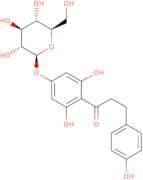
CAS 4192-90-9
:Trilobatina
Descripción:
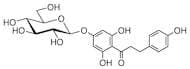
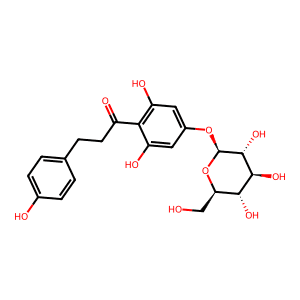
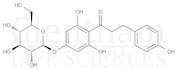
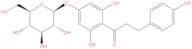
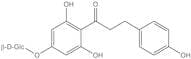
Trilobatina, con el número CAS 4192-90-9, es un compuesto químico que pertenece a la clase de los flavonoides, específicamente un glucósido flavonólico. Se deriva principalmente de diversas fuentes vegetales, particularmente aquellas de la familia de las leguminosas. Trilobatina se caracteriza por su estructura glucosídica, que consiste en un aglicona flavonoide unida a un componente de azúcar. Este compuesto exhibe una variedad de actividades biológicas, incluyendo propiedades antioxidantes, que contribuyen a sus posibles beneficios para la salud. Además, se ha estudiado Trilobatina por sus efectos antiinflamatorios y antimicrobianos. Sus características de solubilidad pueden variar dependiendo del disolvente utilizado, y generalmente es más soluble en disolventes polares debido a la presencia del componente de azúcar. Al igual que muchos flavonoides, Trilobatina también puede desempeñar un papel en la pigmentación de las plantas y la protección contra los UV. Se están realizando más investigaciones para esclarecer completamente sus mecanismos de acción y posibles aplicaciones en farmacéuticos y nutracéuticos.
Fórmula:C21H24O10
InChI:InChI=1/C21H24O10/c22-9-16-18(27)19(28)20(29)21(31-16)30-12-7-14(25)17(15(26)8-12)13(24)6-3-10-1-4-11(23)5-2-10/h1-2,4-5,7-8,16,18-23,25-29H,3,6,9H2/t16-,18-,19+,20-,21-/m1/s1
Clave InChI:InChIKey=GSTCPEBQYSOEHV-QNDFHXLGSA-N
SMILES:C(CCC1=CC=C(O)C=C1)(=O)C2=C(O)C=C(O[C@@H]3O[C@H](CO)[C@@H](O)[C@H](O)[C@H]3O)C=C2O
Sinónimos:- 1-Propanone, 1-(4-(beta-D-glucopyranosyloxy)-2,6-dihydroxyphenyl)-3-(4-hydroxyphenyl)-
- 1-Propanone, 1-[4-(β-<span class="text-smallcaps">D</span>-glucopyranosyloxy)-2,6-dihydroxyphenyl]-3-(4-hydroxyphenyl)-
- 1-[4-(β-<span class="text-smallcaps">D</span>-Glucopyranosyloxy)-2,6-dihydroxyphenyl]-3-(4-hydroxyphenyl)-1-propanone
- Phloretin 4′-glucoside
- Phloretin 4′-β-<span class="text-smallcaps">D</span>-glucoside
- Phloretin-4′-O-β-<span class="text-smallcaps">D</span>-glucopyranoside
- Phloretine-4′-glucoside
- Prunin dihydrochalcone
- Trilobatin
- p-Phloridzin
- p-Phlorizin
- 1-[4-(β-D-Glucopyranosyloxy)-2,6-dihydroxyphenyl]-3-(4-hydroxyphenyl)-1-propanone
- 1-Propanone, 1-[4-(β-D-glucopyranosyloxy)-2,6-dihydroxyphenyl]-3-(4-hydroxyphenyl)-
- TRILOBATIN(SH)
- PRUNINDIHYDROCHALCONE
- 1-[2,6-dihydroxy-4-[(2S,3R,4S,5S,6R)-3,4,5-trihydroxy-6-(hydroxymethyl)oxan-2-yl]oxyphenyl]-3-(4-hydroxyphenyl)propan-1-one
- Ver más sinónimos
Ordenar por
Pureza (%)
0
100
|
0
|
50
|
90
|
95
|
100
Encontrado 9 productos.
Trilobatin
CAS:Fórmula:C21H24O10Pureza:>95.0%(T)(HPLC)Forma y color:White to Light yellow powder to crystalPeso molecular:436.41Trilobatin
CAS:Trilobatin analytical standard provided with w/w absolute assay, to be used for quantitative titration.Fórmula:C21H24O10Pureza:(HPLC) ≥99%Forma y color:PowderPeso molecular:436.42Trilobatin
CAS:Trilobatin has anti-oxidant, and anti-inflammatory effects, it can increase superoxide dismutase (SOD) activity, and it potentially inhibits the lipopolysaccharide (LPS)-induced inflammatory response by suppressing the NF-κB signaling pathway. Trilobatin shows a strong inhibitory activity against α-glucosidase and a moderate inhibitory activity against α-amylase for management of postprandial hyperglycemia with less side effect.Fórmula:C21H24O10Pureza:95%~99%Forma y color:PowderPeso molecular:436.413Trilobatin
CAS:Trilobatin (P-Phlorizin) has anti-oxidant effect, can increase superoxide dismutase (SOD) activity.Trilobatin has anti-inflammatory effect, it potentiallyFórmula:C21H24O10Pureza:97.16%Forma y color:SolidPeso molecular:436.41Ref: TM-T2S0731
1mg50,00€5mg99,00€1mL*10mM (DMSO)109,00€10mg141,00€25mg260,00€50mg385,00€100mg557,00€200mg790,00€Trilobatin
CAS:Trilobatin is a high-purity steviol glycoside that is extracted from the leaves of the plant Stevia rebaudiana. It has been shown to have significant antioxidant properties, and its use as an anti-inflammatory agent has been shown in animal models. Trilobatin inhibits oxidative injury by binding to toll-like receptors on the surface of cells, preventing activation of certain enzymes and reducing inflammation. This activity may be due to inhibition of caspase-independent cell death or mitochondrial membrane potential. Trilobatin also acts as a pro-apoptotic protein by triggering the release of cytochrome C from mitochondria, which leads to apoptosis.Fórmula:C21H24O10Pureza:Min. 95%Forma y color:PowderPeso molecular:436.41 g/mol