CAS 4195-17-9
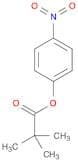
:4-Nitrofenil 2,2-dimetilpropanoato
Descripción:
4-Nitrofenil 2,2-dimetilpropanoato es un compuesto orgánico caracterizado por su grupo funcional éster, que se forma a partir de la reacción de 4-nitrofenol y ácido 2,2-dimetilpropanoico. Este compuesto típicamente aparece como un sólido cristalino amarillo y es conocido por sus propiedades aromáticas debido a la presencia del grupo nitrofenilo. Tiene una fórmula molecular que refleja su estructura, incorporando componentes aromáticos y alifáticos. El grupo nitro (-NO2) en el anillo fenílico contribuye a su reactividad, lo que lo convierte en un intermediario útil en la síntesis orgánica, particularmente en la producción de productos farmacéuticos y agroquímicos. Además, la bulky 2,2-dimetilpropanoato puede influir en su solubilidad y propiedades estéricas, afectando sus interacciones en varios entornos químicos. Al igual que muchos compuestos nitro, puede presentar consideraciones específicas de seguridad y manejo debido a su potencial toxicidad e impacto ambiental. Se deben tomar las precauciones adecuadas al trabajar con esta sustancia en entornos de laboratorio.
Fórmula:C11H13NO4
InChI:InChI=1S/C11H13NO4/c1-11(2,3)10(13)16-9-6-4-8(5-7-9)12(14)15/h4-7H,1-3H3
Clave InChI:InChIKey=QADVJDGFQGNSIF-UHFFFAOYSA-N
SMILES:O(C(C(C)(C)C)=O)C1=CC=C(N(=O)=O)C=C1
Sinónimos:- 4-Nitrophenyl 2,2-dimethylpropanoate
- Pivalic acid, p-nitrophenyl ester
- Propanoic acid, 2,2-dimethyl-, 4-nitrophenyl ester
- p-Nitrophenyl pivalate
- p-Nitrophenyl trimethylacetate
Ordenar por
Pureza (%)
0
100
|
0
|
50
|
90
|
95
|
100
Encontrado 3 productos.
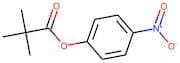
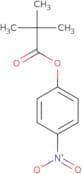
4-Nitrophenyl trimethylacetate
CAS:4-Nitrophenyl trimethylacetate is a cytosolic proteinase inhibitor. It binds to the active site of trypsin and other enzymes that hydrolyze peptide bonds, thereby inhibiting the activity of these enzymes. 4-Nitrophenyl trimethylacetate has been shown to inhibit soybean trypsin, which has led to its use as a model system for studying enzyme inhibition. The binding site on 4-Nitrophenyl trimethylacetate is competitive with respect to substrate binding but not with respect to the enzyme's catalytic triad. This inhibitor also has a high buffer capacity and can be used in low pH systems.
Pureza:Min. 95%Peso molecular:223.23 g/mol