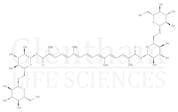
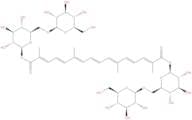
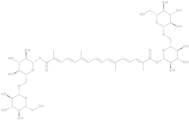
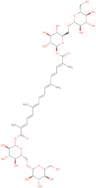
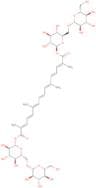
CAS 42553-65-1
:Crocin
Descripción:
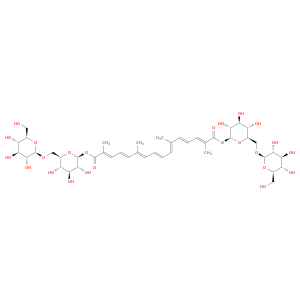
Crocin es un pigmento carotenoide derivado principalmente de la planta de azafrán, Crocus sativus. Es conocido por su vibrante color amarillo-naranja y es responsable del tono característico del azafrán. Químicamente, Crocin es un derivado glicosilado de la crocetina, que consiste en un esqueleto de ácido dicarboxílico con múltiples moieties de azúcar adjuntas, lo que mejora su solubilidad en agua. Crocin exhibe diversas actividades biológicas, incluyendo efectos antioxidantes, antiinflamatorios y potenciales efectos neuroprotectores, lo que lo hace de interés tanto en las industrias alimentaria como farmacéutica. A menudo se estudia por sus posibles aplicaciones terapéuticas, particularmente en el contexto de enfermedades neurodegenerativas y trastornos del estado de ánimo. Además, Crocin es reconocido por su papel como colorante natural en productos alimenticios, proporcionando una alternativa segura a los colorantes sintéticos. Su estabilidad y biodisponibilidad son factores importantes en su aplicación, y la investigación en curso continúa explorando su rango completo de beneficios y usos para la salud.
Fórmula:C44H64O24
InChI:InChI=1S/C44H64O24/c1-19(11-7-13-21(3)39(59)67-43-37(57)33(53)29(49)25(65-43)17-61-41-35(55)31(51)27(47)23(15-45)63-41)9-5-6-10-20(2)12-8-14-22(4)40(60)68-44-38(58)34(54)30(50)26(66-44)18-62-42-36(56)32(52)28(48)24(16-46)64-42/h5-14,23-38,41-58H,15-18H2,1-4H3/b6-5+,11-7+,12-8+,19-9+,20-10+,21-13+,22-14+/t23-,24-,25-,26-,27-,28-,29-,30-,31+,32+,33+,34+,35-,36-,37-,38-,41-,42-,43+,44+/m1/s1
Clave InChI:InChIKey=SEBIKDIMAPSUBY-RTJKDTQDSA-N
SMILES:C(O[C@@H]1O[C@H](CO)[C@@H](O)[C@H](O)[C@H]1O)[C@H]2O[C@@H](OC(/C(=C/C=C/C(=C/C=C/C=C(/C=C/C=C(/C(O[C@@H]3O[C@H](CO[C@@H]4O[C@H](CO)[C@@H](O)[C@H](O)[C@H]4O)[C@@H](O)[C@H](O)[C@H]3O)=O)\C)\C)/C)/C)=O)[C@H](O)[C@@H](O)[C@@H]2O
Sinónimos:- 6-O-β-D-glucopyranosyl-1-O-[(2E,4E,6E,8E,10Z,12E,14Z)-16-{[(6-O-β-D-glucopyranosyl-β-D-glucopyranosyl)oxy]methyl}-2,6,11,15-tetramethylheptadeca-2,4,6,8,10,12,14,16-octaenoyl]-β-D-glucopyranose
- 8,8′-Diapo-ψ,ψ-carotenedioic acid, bis(6-O-β-<span class="text-smallcaps">D</smallcap>-glucopyranosyl-β-<smallcap>D</span>-glucopyranosyl) ester
- Crocetin bis(gentiobiosyl) ester
- Crocetin di(β-<span class="text-smallcaps">D</span>-gentiobiosyl) ester
- Crocetin di-β-gentiobiosyl ester
- Crocetin digentiobioside
- Crocin
- Crocin (gardenia fruit
- Crocin 1
- Crocin 4
- Crocin A
- Kiriyasu Oil Yellow GY
- Saffron
- Saffron (Natural)
- Trans-crocin-1
- all-trans-Crocetin di-β-<span class="text-smallcaps">D</span>-gentiobiosyl ester
- bis[(2S,3R,4S,5S,6R)-3,4,5-trihydroxy-6-({[(2R,3R,4S,5S,6R)-3,4,5-trihydroxy-6-(hydroxymethyl)tetrahydro-2H-pyran-2-yl]oxy}methyl)tetrahydro-2H-pyran-2-yl] (2E,4E,6E,8E,10E,12E,14E)-2,6,11,15-tetramethylhexadeca-2,4,6,8,10,12,14-heptaenedioate (non-preferred name)
- trans-Crocetin di(β-<span class="text-smallcaps">D</span>-gentiobiosyl) ester
- α-Crocin
- β-<span class="text-smallcaps">D</smallcap>-Glucopyranose, 6-O-β-<smallcap>D</span>-glucopyranosyl-, 1,1′-[(2E,4E,6E,8E,10E,12E,14E)-2,6,11,15-tetramethyl-2,4,6,8,10,12,14-hexadecaheptaenedioate]
- 8,8′-Diapo-ψ,ψ-carotenedioic acid, bis(6-O-β-D-glucopyranosyl-β-D-glucopyranosyl) ester
- Ver más sinónimos
Ordenar por
Pureza (%)
0
100
|
0
|
50
|
90
|
95
|
100
Encontrado 13 productos.
Crocin (Gardenia Fruits Extract)
CAS:Fórmula:C44H64O24Pureza:multi component mixture(HPLC)Forma y color:Light yellow to Brown powder to crystalPeso molecular:976.97Crocin
CAS:Crocin: a water-soluble carotenoid in saffron, used for flavoring, coloring, and in Chinese medicine; inhibits TNF-alpha-induced apoptosis in cells.Fórmula:C44H64O24Pureza:98.13% - 99.27%Forma y color:Solid /Di-Gentiobiose Ester/ SolidPeso molecular:976.96Crocin I, 98%
CAS:Fórmula:C44H64O24Pureza:(HPLC) ≥ 98.0%Forma y color:Orange to dark red powderPeso molecular:976.97Crocin I
CAS:Crocin is a water-soluble carotenoid pigment of saffron (Crocus sativus L.), it has been used as a spice for flavoring and coloring food preparations. Crocin has anti-inflammatory, anti-oxidative, anti-apoptotic, anti-asthma, anti-cancer, and hypolipidemic effects. Crocin improves toxic effects of diazinon via reducing lipid peroxidation and restoring altered contractile and relaxant responses in rat aorta; it also protects retinal photoreceptors against light-induced cell death. Crocin can also promote ovarian cancer HO-8910 cell apoptosis, most likely by increasing p53 and Fas/APO-1 expression, and then activating the apoptotic pathway regulated by Caspase-3.Fórmula:C44H64O24Pureza:95%~99%Peso molecular:976.972Crocin
CAS:Natural glycosideFórmula:C44H64O24Pureza:≥ 95.0 % (HPLC)Forma y color:PowderPeso molecular:976.98Crocin
CAS:Stability Light Sensitive
Applications Crocin, is a natural carotenoid derived the flowers crocus and gardenia. Crocin has been shown to be a potent antioxidant. It has also been shown to have an antiproliferative action against cancer cells in vitro, and also possessing possible antidepressant properties.
References Zheng, Y. Q., et al.: Brain Res., 1138, 86 (2006); Hosseinzadeh, H., et al.: PTR, 24 (5), 726 (2010); Ochiai, T., et al.: Biochim. Biophys. Acta., 1770(4), 578 (2006);Fórmula:C44H64O24Forma y color:Dark Yellow Crystalline PowderPeso molecular:976.96Crocin I
CAS:Crocin is a pharmaceutical product which is an antipyretic and analgesic medication, primarily composed of paracetamol (acetaminophen). It is synthesized through chemical processes originally derived from coal tar, although modern production predominantly utilizes petrochemical sources. The mode of action of Crocin involves the inhibition of cyclooxygenase (COX) enzymes, particularly COX-2, in the central nervous system. This action leads to a decrease in the synthesis of prostaglandins, which are responsible for pain and fever.Fórmula:C44H64O24Pureza:Min. 98.0 Area-%Forma y color:PowderPeso molecular:976.96 g/molCrocin - microscopy grade
CAS:Crocin is a carotenoid found in the fruit of Crocus sativus. It has been shown to have potential anticancer activity, as well as antioxidant and anti-inflammatory properties. Crocin has demonstrated significant cytotoxicity against cancer cells in vitro. The mechanism of action is not fully understood, but it may be due to its ability to inhibit oxidative injury and receptor activity. Crocin has also been shown to have an effect on eye disorders such as retinitis pigmentosa and macular degeneration, which may be due to its antioxidant properties. The analytical method for crocin is high performance liquid chromatography (HPLC). HPLC separation is achieved using a reversed-phase column with gradient elution using water, acetonitrile and methanol. Preparative HPLC is used for isolation from natural sources.Fórmula:C44H64O24Pureza:Min. 95%Forma y color:PowderPeso molecular:976.96 g/mol