CAS 435-97-2
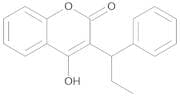
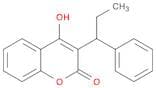
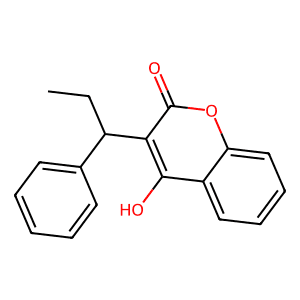
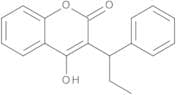
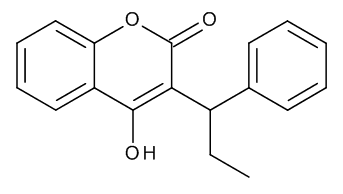
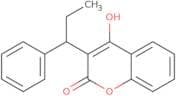
:2H-1-benzopirano-2-ona, 4-hidroxi-3-(1-fenilpropil)-
Descripción:
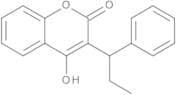
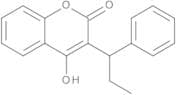
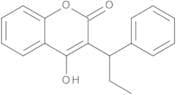
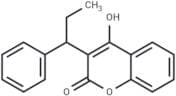
2H-1-benzopirano-2-ona, 4-hidroxi-3-(1-fenilpropil)-, comúnmente conocido como un compuesto flavonoide, exhibe varias características notables. Esta sustancia presenta un esqueleto de cromona, que es una estructura de anillo fusionado de benceno y pirona, contribuyendo a sus propiedades aromáticas. La presencia de un grupo hidroxilo en la posición 4 mejora su potencial para la formación de enlaces de hidrógeno y aumenta su solubilidad en disolventes polares. El sustituyente fenilpropilo en la posición 3 añade a su carácter hidrofóbico, influyendo en su actividad biológica e interacción con las membranas celulares. Este compuesto es conocido por sus propiedades antioxidantes, que pueden atribuirse al sistema de enlaces dobles conjugados dentro de la estructura de cromona. Además, puede exhibir varios efectos farmacológicos, incluyendo actividades antiinflamatorias y anticancerígenas, lo que lo hace de interés en la química medicinal. Su número CAS, 435-97-2, permite una fácil identificación en bases de datos químicas, facilitando la investigación y aplicación en varios campos, incluyendo la farmacéutica y la química de productos naturales.
Fórmula:C18H16O3
InChI:InChI=1/C18H16O3/c1-2-13(12-8-4-3-5-9-12)16-17(19)14-10-6-7-11-15(14)21-18(16)20/h3-11,13,19H,2H2,1H3
Clave InChI:InChIKey=DQDAYGNAKTZFIW-UHFFFAOYSA-N
SMILES:C(CC)(C1=C(O)C=2C(OC1=O)=CC=CC2)C3=CC=CC=C3
Sinónimos:- (.+-.)-Phenprocoumon
- 3-(1-Phenylpropyl)-4-hydroxycoumarin
- 3-(α-Ethylbenzyl)-4-hydroxycoumarin
- 3-(α-Phenylpropyl)-4-hydroxycoumarin
- 4-Hydroxy-2-oxo-3-(1-phenylpropyl)-2H-chromene
- 4-Hydroxy-3-(1-phenylpropyl)-2H-1-benzopyran-2-one
- <span class="text-smallcaps">DL</span>-3-(α-Ethylbenzyl)-4-hydroxycoumarin
- Bs 7565
- Coumarin, 3-(α-ethylbenzyl)-4-hydroxy-
- DL-3-(α-Ethylbenzyl)-4-hydroxycoumarin
- Falithrom
- Fencumar
- Fenprocoumona
- Liquamar
- Marcoumar
- Marcumar
- Phenprocoumarol
- Phenprocoumarole
- Phenprocoumone
- Phenprocumon
- Ro 1-4849
- 2-hydroxy-3-(1-phenylpropyl)-4H-chromen-4-one
- 4-hydroxy-3-(1-phenylpropyl)coumarin
- 4-hydroxy-3-(1-phenylpropyl)-2H-chromen-2-one
- 2H-1-Benzopyran-2-one, 4-hydroxy-3-(1-phenylpropyl)-
- PHENYLPROPYL-4-HYDROXYCOUMARIN
- Coumarin, 3-(alpha-ethylbenzyl)-4-hydroxy-
- 4-Hydroxy-3-(1-phenylpropyl)-2H-chromen-2-on
- 3-(1'-Phenyl-propyl)-4-oxycoumarin
- 3-(alpha-Ethylbenzyl)-4-hydroxycoumarin
- MARCUMA
- 2-hydroxy-3-[(1S)-1-phenylpropyl]-4H-chroMen-4-one
- Phenprocoumon (Marcumar)
- Phenprocumone
- Ver más sinónimos
Ordenar por
Pureza (%)
0
100
|
0
|
50
|
90
|
95
|
100
Encontrado 11 productos.
Phenprocoumon 100 µg/mL in Acetonitrile
CAS:Fórmula:C18H16O3Forma y color:Single SolutionPeso molecular:280.32Phenprocoumon
CAS:Phenprocoumon is an antagonist of vitamin K(IC50:1 μM).Fórmula:C18H16O3Pureza:95.79% - 97.98%Forma y color:Fine White Crystalline Powder SolidPeso molecular:280.32Phenprocoumon
CAS:Producto controladoApplications Phenprocoumon is known for being an oral anti-coagulant.
Not a dangerous good if item is equal to or less than 1g/ml and there is less than 100g/ml in the package
References Kohl, C. et al.: Drug. Metab. Disp., 28, 161 (2000);Fórmula:C18H16O3Forma y color:White To Off-WhitePeso molecular:280.32Phenprocoumon
CAS:Producto controladoApplications Phenprocoumon is known for being an oral anti-coagulant.
References Kohl, C. et al.: Drug. Metab. Disp., 28, 161 (2000);Fórmula:C18H16O3Forma y color:White To Off-WhitePeso molecular:280.32Phenprocoumon
CAS:Phenprocoumon is a drug that belongs to the class of coumarin derivatives. It is used as an oral anticoagulant for the prevention and treatment of thrombosis or embolism in patients with atrial fibrillation, chronic deep venous thrombosis, or pulmonary embolism. Phenprocoumon prevents clot formation by inhibiting vitamin K-dependent factors necessary for blood coagulation. This drug may also be used to control bleeding in persons with hemophilia A or B. Phenprocoumon has been shown to decrease the rate of myocardial infarction (heart attack) and mortality rates in patients who have had a previous myocardial infarction. The mechanism by which phenprocoumon works is not well understood but it is known that this drug may interact with other drugs such as nonsteroidal anti-inflammatory drugs (NSAIDs).Fórmula:C18H16O3Pureza:Min. 95%Peso molecular:280.32 g/mol