CAS 4362-40-7
:4-(Clorometil)-2,2-dimetil-1,3-dioxolano
Descripción:
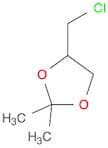
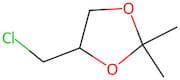
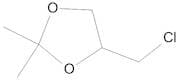
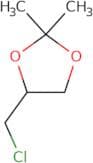
4-(Clorometil)-2,2-dimetil-1,3-dioxolano es un compuesto orgánico caracterizado por su estructura de anillo dioxolano, que presenta dos átomos de oxígeno en un anillo de cinco miembros. La presencia de un grupo clorometilo (-CH2Cl) en la posición 4 y dos grupos metilo en la posición 2 contribuyen a sus propiedades químicas únicas. Este compuesto es típicamente un líquido incoloro a amarillo pálido con un olor distintivo. Es soluble en disolventes orgánicos y puede exhibir reactividad moderada debido al grupo clorometilo, que puede participar en reacciones de sustitución nucleofílica. La parte dioxolana es conocida por su estabilidad y a menudo se utiliza como grupo protector en la síntesis orgánica. Además, el compuesto puede tener aplicaciones en la síntesis de productos farmacéuticos o agroquímicos, gracias a sus grupos funcionales que pueden facilitar transformaciones químicas adicionales. Se deben tomar precauciones de seguridad al manipular esta sustancia, ya que puede representar riesgos para la salud si se inhala o ingiere.
Fórmula:C6H11ClO2
InChI:InChI=1/C6H11ClO2/c1-6(2)8-4-5(3-7)9-6/h5H,3-4H2,1-2H3/t5-/m1/s1
Clave InChI:InChIKey=BNPOTXLWPZOESZ-UHFFFAOYSA-N
SMILES:C(Cl)C1OC(C)(C)OC1
Sinónimos:- (4R)-4-(chloromethyl)-2,2-dimethyl-1,3-dioxolane
- (4S)-4-(chloromethyl)-2,2-dimethyl-1,3-dioxolane
- 1,3-Dioxolane, 4-(chloromethyl)-2,2-dimethyl-
- 1-Chloro-2,3-O-isopropylidenepropane
- Ai3-17556
- Brn 0104463
- 5-19-01-00085 (Beilstein Handbook Reference)
- 4-(Chloromethyl)-2,2-dimethyl-1,3-dioxolane
- (±)-4-(Chloromethyl)-2,2-dimethyl-1,3-dioxolane
- 4-Chloromethyl-2,2-dimethyl-1,3-dioxolane
- 4-(chloromethyl)-2,2-dimethyl-3-dioxolane
- 4-(CHLOROMETHYL)-2,2-DIMETHYL-1,3- DIOXOLANE 99%
- 4-(Chloromethyl)-2,2-dimethyl-1,3-dioxolane,99%
- 4-chloromethyl-2,2-dimethyl-3-dioxolane
- Ver más sinónimos
Ordenar por
Pureza (%)
0
100
|
0
|
50
|
90
|
95
|
100
Encontrado 5 productos.
1,3-Dioxolane,4-(chloromethyl)-2,2-dimethyl-
CAS:Fórmula:C6H11ClO2Pureza:98%Forma y color:LiquidPeso molecular:150.60334-(Chloromethyl)-2,2-dimethyl-1,3-dioxolane
CAS:4-(Chloromethyl)-2,2-dimethyl-1,3-dioxolanePureza:96%Peso molecular:150.60g/mol4-Chloromethyl-2,2-dimethyl-1,3-dioxolane
CAS:Producto controladoApplications 4-Chloromethyl-2,2-dimethyl-1,3-dioxolane is used in biosynthetic preparations.
Not a dangerous good if item is equal to or less than 1g/ml and there is less than 100g/ml in the package
References Spelberg, J.H., Tetrahedron, Asy., 10, 2863 (1999);Fórmula:C6H11ClO2Forma y color:NeatPeso molecular:150.60334-(Chloromethyl)-2,2-dimethyl-1,3-dioxolane
CAS:Fórmula:C6H11ClO2Pureza:98%Forma y color:LiquidPeso molecular:150.64-Chloromethyl-2,2-dimethyl-1,3-dioxolane
CAS:4-Chloromethyl-2,2-dimethyl-1,3-dioxolane is a chemical compound that is used as a marker to identify the presence of fatty acids in plant tissues. It can be synthesized by reacting chloroacetaldehyde with methanol and sodium hydroxide. This compound has a cyclic structure and is chiral. It is also used for mass spectrometric analysis of fatty acid composition in plants. The synthesis of 4-chloromethyl-2,2-dimethyl-1,3-dioxolane involves four steps: (i) chlorination of acetaldehyde with sodium hypochlorite; (ii) hydrolysis of the resulting chloroacetaldehyde with methanol and sodium hydroxide; (iii) oxidation of the resulting chloroformate with hydrogen peroxide; and (iv) hydrolysis of the resulting 4-chloromethyloxymethanol with water.Fórmula:C6H11ClO2Pureza:Min. 95%Peso molecular:150.6 g/mol