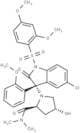
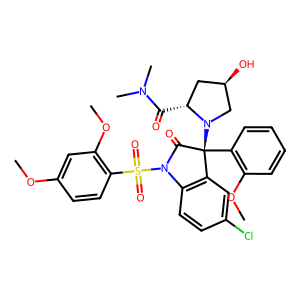
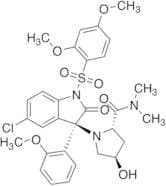
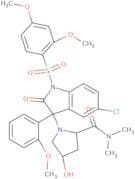
![(2S,4R)-1-[(3R)-5-Chloro-1-[(2,4-dimethoxyphenyl)sulfonyl]-2,3-dihydro-3-(2-methoxyphenyl)-2-oxo-1…](/_next/image/?url=https%3A%2Fstatic.cymitquimica.com%2Fcas-image%2Fthumb-webp%2F395368-2s-4r-1-r-5-chloro-1-24-dimethoxy-benzenesulfonyl-3-2-methoxy-phenyl-2-oxo-23-dihydro-1h-indol-3-yl-4-hydroxy-pyrrolidine-2-carboxylic-acid-dimethylamide.webp&w=3840&q=75)
CAS 439687-69-1
:(2S,4R)-1-[(3R)-5-Cloro-1-[(2,4-dimetoxifenil)sulfonil]-2,3-dihidro-3-(2-metoxifenil)-2-oxo-1H-indol-3-il]-4-hidroxi-N,N-dimetil-2-pirrolidinacarboxamida
- SSR 149415
- 2-Pyrrolidinecarboxamide, 1-[(3R)-5-chloro-1-[(2,4-dimethoxyphenyl)sulfonyl]-2,3-dihydro-3-(2-methoxyphenyl)-2-oxo-1H-indol-3-yl]-4-hydroxy-N,N-dimethyl-, (2S,4R)-
- (2S,4R)-1-[(3R)-5-Chloro-1-[(2,4-dimethoxyphenyl)sulfonyl]-2,3-dihydro-3-(2-methoxyphenyl)-2-oxo-1H-indol-3-yl]-4-hydroxy-N,N-dimethyl-2-pyrrolidinecarboxamide
- Nelivaptan
- SSR 149415 - Nelivaptan
- (2S,4R)-1-[(R)-5-CHLORO-1-(2,4-DIMETHOXY-BENZENESULFONYL)-3-(2-METHOXY-PHENYL)-2-OXO-2,3-DIHYDRO-1H-INDOL-3-YL]-4-HYDROXY-PYRROLIDINE-2-CARBOXYLIC ACID DIMETHYLAMIDE
- (2S,4R)-1-[(3R)-5-chloro-1-(2,4-dimethoxyphenyl)sulfonyl-3-(2-methoxyphenyl)-2-oxoindol-3-yl]-4-hydroxy-N,N-dimethylpyrrolidine-2-carboxamide
- Nelivaptan(SSR-149,415)
Nelivaptan
CAS:Nelivaptan (SR 149415) is a vasopressin V1b receptor antagonist that can eliminate CHS-induced GE damage.Cost-effective and quality-assured.Fórmula:C30H32ClN3O8SPureza:99.46% - 99.89%Forma y color:SolidPeso molecular:630.11SSR 149415
CAS:SSR 149415 is an orally active small molecule that inhibits the activity of receptor tyrosine kinases (RTKs) and can be used to treat autoimmune diseases. SSR 149415 has been shown to inhibit the expression of osteogenic genes in cells. It has also been shown to inhibit the proliferation of prostate cancer cells by binding to the RTKs and inhibiting their downstream signaling pathways. The molecule has been shown to have a high affinity for asymmetric synthesis, which makes it more stable than other molecules. SSR 149415 has been found to bind specifically with polymorphic regions on a number of different proteins, which may make it useful for diagnostic purposes.
SSR 149415 was shown to block dopamine release from striatal neurons in cell culture studies, indicating that this drug may be useful in treating Parkinson’s disease.Fórmula:C30H32ClN3O8SPureza:Min. 95%Peso molecular:630.1 g/mol