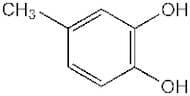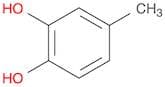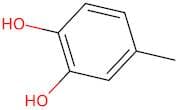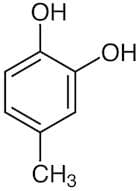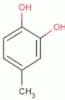
CAS 452-86-8
:4-Metilcatecol
Descripción:
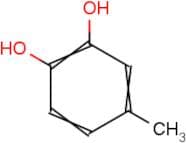
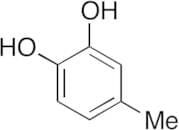
4-Metilcatecol, también conocido como 4-metil-1,2-benzenodiol, es un compuesto orgánico caracterizado por su estructura de catecol con un grupo metilo en la posición para. Tiene la fórmula molecular C8H10O2 y presenta dos grupos hidroxilo (-OH) unidos a un anillo bencénico, lo que contribuye a su reactividad y solubilidad en disolventes polares. Este compuesto es típicamente un líquido o sólido incoloro a amarillo pálido, dependiendo de su pureza y temperatura. 4-Metilcatecol exhibe propiedades antioxidantes y se utiliza en diversas aplicaciones, incluyendo como precursor en la síntesis de productos farmacéuticos y agroquímicos. También puede servir como estabilizador en ciertas formulaciones debido a su capacidad para atrapar radicales libres. El compuesto es sensible a la oxidación y debe ser manejado con cuidado para prevenir la degradación. Además, es importante considerar los datos de seguridad, ya que puede representar riesgos para la salud si se inhala o ingiere, lo que requiere medidas de seguridad adecuadas durante el manejo y almacenamiento.
Fórmula:C7H8O2
InChI:InChI=1S/C7H8O2/c1-5-2-3-6(8)7(9)4-5/h2-4,8-9H,1H3
Clave InChI:InChIKey=ZBCATMYQYDCTIZ-UHFFFAOYSA-N
SMILES:OC1=C(O)C=CC(C)=C1
Sinónimos:- 1,2-Dihydroxy-4-methylbenzene
- 1-Methyl-3,4-dihydroxybenzene
- 2-Hydroxy-4-methylphenol
- 3,4-Dihydroxytoluene
- 4-Methyl-1,2-benzediol
- 4-Methyl-1,2-benzenediol
- 4-Methyl-1,2-dihydroxybenzene
- 4-Methylbenzcatechin
- 4-Methylbrenzcatechin
- 4-Methylcatechol
- 4-Methylpyrocatechol
- 4-Metilpirocatecol
- 5-Methylcatechol
- Catechol, 4-Methyl-
- Homocatechol
- Homopyrocatechol
- Nsc 17489
- Pyrocatechol, 4-methyl-
- Toluene-3,4-diol
- p-Methylcatechol
- p-Methylpyrocatechol
- 4-Methyl-1,2-benzenediol (4-methylpyrocatechol)
- 4-methyl-pyrocatecho
- 4-methyl-benzene-1,2-diol
- 4-methyl-2-benzenediol
- Ver más sinónimos
Ordenar por
Pureza (%)
0
100
|
0
|
50
|
90
|
95
|
100
Encontrado 10 productos.
4-Methylcatechol, 96%
CAS:This Thermo Scientific Chemicals brand product was originally part of the Alfa Aesar product portfolio. Some documentation and label information may refer to the legacy brand. The original Alfa Aesar product / item code or SKU reference has not changed as a part of the brand transition to Thermo SciFórmula:C7H8O2Pureza:96%Forma y color:White to cream to brown or pale pink to pale gray, Crystals or powder or crystalline powder or flakes or lumps and/or chunksPeso molecular:124.144-Methylcatechol
CAS:Fórmula:C7H8O2Pureza:>98.0%(GC)Forma y color:White to Light yellow to Light orange powder to lumpPeso molecular:124.144-Methylcatechol
CAS:4-MethylcatecholFórmula:C7H8O2Pureza:95%Forma y color: white solidPeso molecular:124.14g/mol4-Methylcatechol
CAS:4-Methylcatechol, a homoprotocatechuic acid metabolite, induces BDNF and inhibits Catechol 2,3-dioxygenase. Lack of BDNF may lead to neuropathic pain.Fórmula:C7H8O2Pureza:98.67%Forma y color:SolidPeso molecular:124.144-Methylcatechol
CAS:Applications 4-Methylcatechol is a potent inducer of nerve growth factor (NGF) synthesis in vitro and in vivo.
References Kaechi, K., et al.: J. Pharmacol. Exp. Ther., 272, 1300 (1995); Hanaoka, Y., et al.: J. Neurol. Sci., 122, 28 (1994)Fórmula:C7H8O2Forma y color:NeatPeso molecular:124.144-Methylcatechol
CAS:4-Methylcatechol is a plant compound that has been shown to have neurotrophic and anticarcinogenic properties. It is a natural product that can be found in the bark of the cinchona tree, and it has been used as an additive in skin care products for its antioxidant properties. 4-Methylcatechol has been shown to have anti-inflammatory effects and inhibit the growth of cancer cells in vitro. It also shows potential for the treatment of diabetic neuropathy, due to its ability to inhibit acetylcholine esterase activity. 4-Methylcatechol is a neurotrophic factor that affects cell nuclei and protein synthesis. This compound acts by binding with DNA, preventing DNA polymerase from adding new bases during replication. This effect inhibits RNA synthesis, which leads to cell death after prolonged exposure. In addition, 4-methylcatechol may be carcinogenic when administered orally or topically on skin cells in vivo or when applied exFórmula:C7H8O2Pureza:Min. 95%Peso molecular:124.14 g/mol