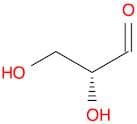
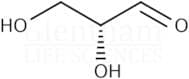
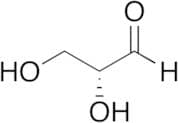
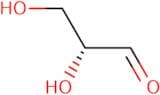
CAS 453-17-8
:(+)-Gliceraldehído
- (+)-Glyceraldehyde
- (2R)-2,3-Dihydroxypropanal
- (R)-(+)-2,3-Dihydroxypropanal
- (R)-(+)-Glyceraldehyde
- <span class="text-smallcaps">D</span>-(+)-Glyceraldehyde
- <span class="text-smallcaps">D</span>-Glycerose
- Glyceraldehyde, <span class="text-smallcaps">D</span>-
- NSC 91534
- Propanal, 2,3-dihydroxy-, (2R)-
- Propanal, 2,3-dihydroxy-, (R)-
- Triose
- D-Glyceraldehyde
- Ver más sinónimos
D-Glyceraldehyde (>80%)
CAS:Producto controladoApplications D-Glyceraldehyde is the simplest of all aldoses and have been shown to be the one of the carbonyl metabolite of dietary fructose.
References Yang, K., et al.: Chem-Biol. Interact., 191, 315 (2011); Zheng, X.H., et al.: Chem. Med. Chem., 7, 1921 (2012);Fórmula:C3H6O3Pureza:>80%Forma y color:NeatPeso molecular:90.08D-(+)-Glyceraldehyde
CAS:D-Glyceraldehyde is sold by active weight in solution
Fórmula:C3H6O3Pureza:85%MinForma y color:Colorless Clear Viscous LiquidPeso molecular:90.08 g/molD-Glyceraldehyde
CAS:D-Glyceraldehyde is a 3-phosphate glycolytic intermediate that is used in the synthesis of polymers. It has been shown to have anti-inflammatory and anti-ulcerative effects in animal models of colitis. D-Glyceraldehyde has also been shown to inhibit the activity of bacterial DNA polymerase, which may be due to its ability to act as a divalent cation cofactor. The low dose group was found to have less reactive oxygen species than the high dose group, indicating that D-glyceraldehyde may be an effective treatment for oxidative stress.
Fórmula:C3H6O3Pureza:Min. 75 Area-%Peso molecular:90.08 g/molD-(+)-Glyceraldehyde extrapure, 85%
CAS:Fórmula:C3H6O3Pureza:min. 85%Forma y color:Colourless to pale yellow to yellowish brown, Viscous liquidPeso molecular:90.08