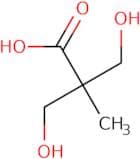
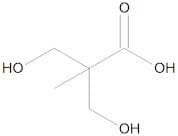
CAS 4767-03-7
:Ácido dimetilolpropiónico
Descripción:
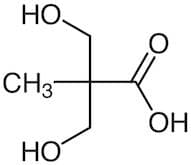
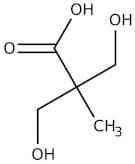
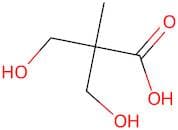
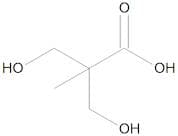
Ácido dimetilolpropiónico (DMPA) es un compuesto químico caracterizado por su estructura, que incluye dos grupos hidroximetilo y un grupo funcional de ácido carboxílico. Es un sólido cristalino blanco que es soluble en agua y en disolventes orgánicos polares. DMPA se utiliza principalmente como un bloque de construcción en la síntesis de poliuretanos y otros polímeros, donde actúa como un extensor de cadena o agente de entrecruzamiento. Su estructura única permite una mejor solubilidad en agua y compatibilidad con varias resinas, lo que lo hace valioso en recubrimientos, adhesivos e tintas. Además, DMPA puede mejorar las propiedades mecánicas y la durabilidad de los materiales resultantes. El compuesto se considera generalmente de baja toxicidad, pero como muchos productos químicos, debe manejarse con cuidado, siguiendo las pautas de seguridad apropiadas. Sus aplicaciones se extienden a la producción de tensioactivos y otros productos químicos especiales, reflejando su versatilidad en procesos industriales.
Fórmula:C5H10O4
InChI:InChI=1S/C5H10O4/c1-5(2-6,3-7)4(8)9/h6-7H,2-3H2,1H3,(H,8,9)
Clave InChI:InChIKey=PTBDIHRZYDMNKB-UHFFFAOYSA-N
SMILES:C(C(O)=O)(CO)(CO)C
Sinónimos:- 2,2-Bis(hydroxymethyl)propanoic acid
- 2,2-Bis(hydroxymethyl)propionsaure
- 2,2-Bis(methylol)propionic acid
- 2,2-Dihydroxymethylpropanoic acid
- 2,2-Dimethylol Propionic Acid
- 2,2-Dimethylolpropionic acid
- 3-Hydroxy-2-(Hydroxymethyl)-2-Methylpropanoate
- 3-Hydroxy-2-(hydroxymethyl)-2-methyl-propanoic acid
- 3-Hydroxy-2-(hydroxymethyl)-2-methylpropanoic acid
- 3-Hydroxy-2-hydroxymethyl-2-methylpropionic acid
- A 05150
- Acide 2,2-bis(hydroxymethyl)propionique
- Acido 2,2-Bis(Hidroximetil)Propionico
- Bis(hydroxymethyl)propionic acid
- Bis-MPA
- Dihydroxypivalic Acid
- Dimethylolpropionic acid
- Dmpa
- Nikkamer PA
- Nsc 96616
- Propanoic acid, 2,2-bis(hydroxymethyl)-
- Propanoic acid, 3-hydroxy-2-(hydroxymethyl)-2-methyl-
- Propionic Acid, 2,2'Bis(Hydroxymethyl)-
- α,α-Bis(hydroxymethyl)propionic acid
- α,α-Dimethylolpropionic acid
- Ver más sinónimos
Ordenar por
Pureza (%)
0
100
|
0
|
50
|
90
|
95
|
100
Se han encontrado 8 productos.
2,2-Bis(hydroxymethyl)propionic Acid
CAS:Fórmula:C5H10O4Pureza:>97.0%(GC)(T)Forma y color:White to Almost white powder to crystalPeso molecular:134.132,2-Bis(hydroxymethyl)propionic acid, 98+%
CAS:2,2-Bis(hydroxymethyl)propionic acid is used in the synthesis and characterization studies of polyurethane dispersion modified with polymethylsiloxane (Si-PUD) and its nanocomposites incorporated with clays1.2,2-Bis(hydroxymethyl)propionic acid based dendrimers have potent applications as delivery sFórmula:C5H10O4Pureza:98+%Forma y color:White, Powder or crystalline powder or crystalsPeso molecular:134.133-Hydroxy-2-(hydroxymethyl)-2-methylpropanoic acid
CAS:Fórmula:C5H10O4Pureza:95%Forma y color:Liquid, No data available.Peso molecular:134.1312,2-Bis(hydroxymethyl)propionic acid
CAS:2,2-Bis(hydroxymethyl)propionic acidFórmula:C5H10O4Pureza:95%Peso molecular:134.130492,2-Bis(Hydroxymethyl)Propanoicacid
CAS:Fórmula:C5H10O4Pureza:98%Forma y color:SolidPeso molecular:134.13052,2-Dimethylolpropionic acid
CAS:Fórmula:C5H10O4Forma y color:White Crystalline PowderPeso molecular:134.1305Dimethylol propionic acid
CAS:Dimethylol propionic acid is a synthetic compound that is chemically related to the natural product paclitaxel and is used as a cross-linking agent. Dimethylol propionic acid has been shown to be effective in neutralizing, emulsifying and cross-linking of polybasic, neutralizing, and trimethylolpropane acrylic polymer systems. It is also biodegradable and can be used as an additive for deionized water. Dimethylol propionic acid may be used as a chromophore or silicon donor in organic synthesis. Stannous octoate can be used as an inorganic catalyst for this reaction.Fórmula:C5H10O4Pureza:Min. 95%Forma y color:PowderPeso molecular:134.13 g/mol2,2-Bis(hydroxymethyl)propionic Acid
CAS:Producto controladoStability Hygroscopic
Applications 2,2-Bis(hydroxymethyl)propionic Acid is a reagent used in the synthesis of disulfide monomers for cross-linked poly(urethane-urea) coatings.
References Nevejans, S. et al.: Polym., 166, 229 (2019);Fórmula:C5H10O4Forma y color:NeatPeso molecular:134.1305