CAS 4769-96-4
:6-Nitroindol
Descripción:
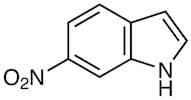
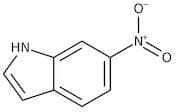
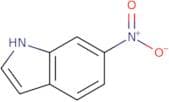
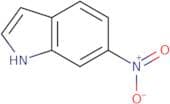
6-Nitroindol es un compuesto orgánico caracterizado por la presencia de un grupo nitro (-NO2) unido a la estructura del indol, que es un compuesto bicíclico que consiste en un anillo de benceno fusionado con un anillo de pirrol de cinco miembros que contiene nitrógeno. Este compuesto típicamente aparece como un sólido de color amarillo a naranja y es conocido por sus propiedades aromáticas. Es soluble en disolventes orgánicos pero tiene una solubilidad limitada en agua. 6-Nitroindol se utiliza a menudo en diversas síntesis químicas y aplicaciones de investigación, particularmente en los campos de la química medicinal y la ciencia de materiales. El grupo nitro puede influir en la reactividad del compuesto, lo que lo convierte en un intermediario útil en la síntesis de otros heterociclos que contienen nitrógeno. Además, 6-Nitroindol puede exhibir actividad biológica, lo que ha llevado a investigaciones sobre sus posibles aplicaciones farmacológicas. Al igual que con muchos compuestos nitro, es importante manejar 6-Nitroindol con cuidado debido a su potencial toxicidad y preocupaciones ambientales.
Fórmula:C8H6N2O2
InChI:InChI=1S/C8H6N2O2/c11-10(12)7-2-1-6-3-4-9-8(6)5-7/h1-5,9H
Clave InChI:InChIKey=PSWCIARYGITEOY-UHFFFAOYSA-N
SMILES:N(=O)(=O)C=1C=C2C(=CC1)C=CN2
Sinónimos:- 1H-Indole, 6-nitro-
- 6-Nitro-1H-indole
- Indole, 6-nitro-
- NSC 89285
- 6-Nitroindole
Ordenar por
Pureza (%)
0
100
|
0
|
50
|
90
|
95
|
100
Encontrado 8 productos.
6-Nitroindole
CAS:Fórmula:C8H6N2O2Pureza:>98.0%(GC)Forma y color:Light yellow to Brown powder to crystalPeso molecular:162.156-Nitroindole, 97%
CAS:This Thermo Scientific Chemicals brand product was originally part of the Alfa Aesar product portfolio. Some documentation and label information may refer to the legacy brand. The original Alfa Aesar product / item code or SKU reference has not changed as a part of the brand transition to Thermo SciFórmula:C8H6N2O2Pureza:97%Forma y color:Yellow to orange to brown, Crystals or powder or crystalline powderPeso molecular:162.156-Nitroindole
CAS:Fórmula:C8H6N2O2Pureza:95%Forma y color:Solid, Reddish yellow to deep yellow red powderPeso molecular:162.1486-Nitro-1H-indole
CAS:6-Nitro-1H-indoleFórmula:C8H6N2O2Pureza:98%Forma y color: dark yellow powderPeso molecular:162.15g/mol6-Nitroindole
CAS:6-Nitroindole is a versatile building block that can be used as a reagent, speciality chemical, or useful scaffold in organic synthesis. This compound is used in the preparation of complex compounds and research chemicals. 6-Nitroindole has a CAS No. 4769-96-4 and a molecular weight of 180.24 g/mol.Fórmula:C8H6N2O2Peso molecular:162.15 g/mol6-Nitroindole
CAS:6-Nitroindole is a heterocyclic compound that belongs to the group of nitro compounds. It is a methylating agent that can be used for the production of 6-nitropurines, which are used as anticancer agents. The reaction mechanism of this compound involves the attack of the electrophilic nitro group on an electron-deficient carbon atom in a molecule. This process creates an N-methylated product, which can then be oxidized to form a carboxylic acid. The kinetics of this reaction have been studied using kinetic data and anomers. 6-Nitroindole has also been shown to inhibit DNA synthesis by binding to oligodeoxynucleotides and inhibiting their catalytic activity.
Fórmula:C8H6N2O2Pureza:Min. 95%Forma y color:PowderPeso molecular:162.15 g/mol