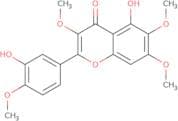
CAS 479-91-4
:Casticina
Descripción:
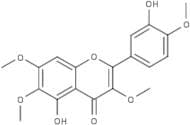
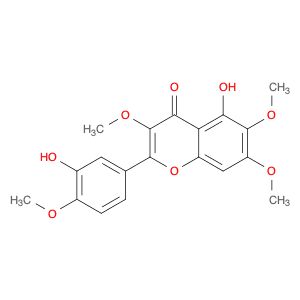
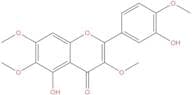
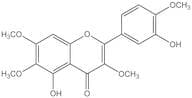
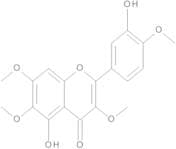
Casticina, con el número CAS 479-91-4, es un compuesto flavonoide que se encuentra principalmente en varias plantas, particularmente en el género Vitex, como Vitex agnus-castus (árbol de la castidad). Se caracteriza por su apariencia cristalina amarilla y es conocido por sus posibles propiedades farmacológicas, incluyendo efectos antiinflamatorios, antioxidantes y neuroprotectores. Casticina exhibe una variedad de actividades biológicas, que han despertado interés en los campos de la medicina herbal y la farmacología. Su mecanismo de acción puede involucrar la modulación de diversas vías de señalización e interacciones con receptores específicos. Además, se ha estudiado Casticina por sus posibles efectos sobre la regulación hormonal, particularmente en relación con la salud reproductiva. El compuesto es soluble en disolventes orgánicos pero tiene una solubilidad limitada en agua, lo cual es una característica común de muchos flavonoides. En general, Casticina representa un área significativa de investigación debido a sus diversas actividades biológicas y posibles aplicaciones terapéuticas.
Fórmula:C19H18O8
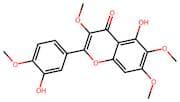
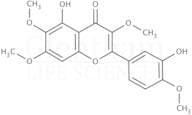
InChI:InChI=1S/C19H18O8/c1-23-11-6-5-9(7-10(11)20)17-19(26-4)16(22)14-12(27-17)8-13(24-2)18(25-3)15(14)21/h5-8,20-21H,1-4H3
Clave InChI:InChIKey=PJQLSMYMOKWUJG-UHFFFAOYSA-N
SMILES:O=C1C=2C(OC(=C1OC)C3=CC(O)=C(OC)C=C3)=CC(OC)=C(OC)C2O
Sinónimos:- 3,6,7,4′-Tetra-O-methyl-5,3′-dihydroxyflavone
- 3,6,7,4′-Tetra-O-methylquercetagetin
- 4H-1-benzopyran-4-one, 5-hydroxy-2-(3-hydroxy-4-methoxyphenyl)-3,6,7-trimethoxy-
- 5,12-Dihydroxy-2,6,7,13-tetramethoxyflavone
- 5,3′-Dihydroxy-3,6,7,4′-tetramethoxyflavone
- 5-Hydroxy-2-(3-hydroxy-4-methoxyphenyl)-3,6,7-trimethoxy-4H-1-benzopyran-4-one
- 5-Hydroxy-2-(3-hydroxy-4-methoxyphenyl)-3,6,7-trimethoxy-4H-chromen-4-on
- 5-Hydroxy-2-(3-hydroxy-4-methoxyphenyl)-3,6,7-trimethoxy-4H-chromen-4-one
- Casticine
- Flavone, 3′,5-dihydroxy-3,4′,6,7-tetramethoxy-
- Quercetagetin 3,6,7,4′-tetramethyl ether
- Vitexcarpin
- Vitexicarpin
- Ver más sinónimos
Ordenar por
Pureza (%)
0
100
|
0
|
50
|
90
|
95
|
100
Encontrado 13 productos.
Casticin
CAS:Casticin analytical standard provided with w/w absolute assay, to be used for quantitative titration.Fórmula:C19H18O8Pureza:(HPLC) ≥98%Forma y color:PowderPeso molecular:374.35Casticin
CAS:Aromatic heterocyclic compounds with oxygen hetero-atom(s) only, nesoiFórmula:C19H18O8Forma y color:Light Yellow PowderPeso molecular:374.10017Casticin
CAS:Vitexicarpin has shown antitumor, cytotoxicity, anti-inflammatory, analgesic and immunoregulatory properties.Vitexicarpin can act as a novel angiogenesis inhibitor, it exerts good antiangiogenic effects by inhibiting vascular-endothelial-growth-factor-(VEGF-) induced endothelial cell proliferation, migration, and capillary-like tube formation on matrigel in a dose-dependent manner. It can significantly reduce vascular inflammation, through inhibition of ROS-NF-κB pathway in vascular endothelial cells.Fórmula:C19H18O8Pureza:95%~99%Peso molecular:374.345Casticin
CAS:Casticin combats vascular inflammation by blocking ROS-NF-κB and could lead in prostate cancer treatment.Fórmula:C19H18O8Pureza:99.37% - ≥95%Forma y color:SolidPeso molecular:374.34Casticin
CAS:Oxygen-heterocyclic compoundFórmula:C19H18O8Pureza:≥ 95.0 % (HPLC)Forma y color:PowderPeso molecular:374.35Casticin
CAS:Producto controladoApplications Casticin is a biological compound known to induce human glioma cell death through an apoptotic mechanism and disruption of the mitotic cycle.
References Liu, E. et al.: (Cell. Phys. Biochem., 31, 805 (2013); Zhu, J. et al.: J. Agri. Food Chem., 55, 2438 (2007);Fórmula:C19H18O8Forma y color:NeatPeso molecular:374.34Vitexicarpin
CAS:Vitexicarpin is a type of flavonoid compound, which is derived from plants in the Vitex genus, commonly known as the chaste tree. This naturally occurring bioactive compound acts primarily through the inhibition of various signaling pathways involved in inflammation and cancer progression. Its mechanism often targets pathways such as NF-kB and MAPK, which play crucial roles in inflammatory responses and cellular proliferation.
Fórmula:C19H18O8Pureza:Min. 95%Forma y color:PowderPeso molecular:374.34 g/mol