CAS 481-74-3
:Crisofanol
Descripción:
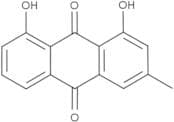
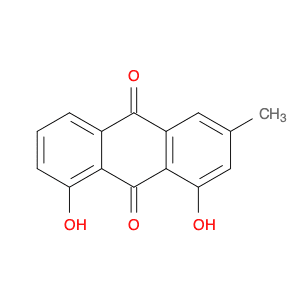
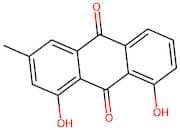
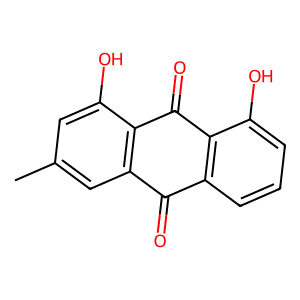
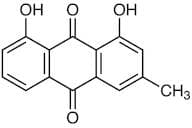
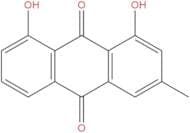
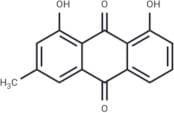
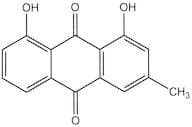
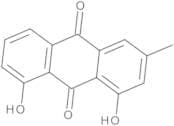
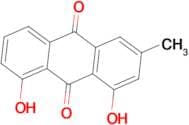
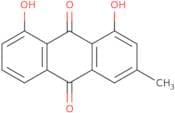
Crisofanol, con el número CAS 481-74-3, es un compuesto de antraquinona que se encuentra de forma natural principalmente en varias plantas, incluyendo el ruibarbo y ciertas especies del género Rheum. Presenta una apariencia cristalina de color amarillo a naranja y es conocido por sus posibles propiedades terapéuticas, incluyendo actividades antiinflamatorias, antimicrobianas y anticancerígenas. Crisofanol es soluble en disolventes orgánicos como el etanol y la acetona, pero tiene una solubilidad limitada en agua. Su estructura química presenta un grupo hidroxilo, que contribuye a su actividad biológica y reactividad. Además de sus propiedades medicinales, Crisofanol también se estudia por su papel como colorante y pigmento en diversas aplicaciones. Debido a su naturaleza bioactiva, ha despertado interés en la investigación farmacológica, aunque se necesitan más estudios para comprender completamente sus mecanismos de acción y posibles aplicaciones en medicina. Al igual que muchas antraquinonas, Crisofanol también puede exhibir efectos citotóxicos, lo que requiere una consideración cuidadosa en contextos terapéuticos.
Fórmula:C15H10O4
InChI:InChI=1S/C15H10O4/c1-7-5-9-13(11(17)6-7)15(19)12-8(14(9)18)3-2-4-10(12)16/h2-6,16-17H,1H3
Clave InChI:InChIKey=LQGUBLBATBMXHT-UHFFFAOYSA-N
SMILES:O=C1C=2C(C(=O)C=3C1=CC=CC3O)=C(O)C=C(C)C2
Sinónimos:- 1,8-Dihidroxi-3-Metilantraquinona
- 1,8-Dihydroxy-3-Methylanthracene-9,10-Dione
- 1,8-Dihydroxy-3-Methylanthraquinone
- 1,8-Dihydroxy-3-methyl-9,10-anthracenedione
- 1,8-Dihydroxy-3-methyl-9,10-anthraquinone
- 1,8-Dihydroxy-3-methyl-anthraquinone
- 1,8-Dihydroxy-3-methylanthrachinon
- 2-Methyl-4,5-dihydroxyanthraquinone
- 3-Methyl-1,8-dihydroxyanthraquinone
- 3-Methylchrysazin
- 4,5-Dihydroxy-2-methylanthraquinone
- 9,10-Anthracenedione, 1,8-dihydroxy-3-methyl-
- Anthraquinone, 1,8-dihydroxy-3-methyl-
- Chrysophanic acid
- Nsc 37132
- Nsc 646567
- Turkey Rhubarb
- Ver más sinónimos
Ordenar por
Pureza (%)
0
100
|
0
|
50
|
90
|
95
|
100
Encontrado 13 productos.
Chrysophanol
CAS:Chrysophanol analytical standard provided with w/w absolute assay, to be used for quantitative titration.Fórmula:C15H10O4Pureza:(HPLC) ≥99%Forma y color:PowderPeso molecular:254.25Chrysophanic Acid
CAS:Fórmula:C15H10O4Pureza:>98.0%(T)(HPLC)Forma y color:Light yellow to Brown powder to crystalPeso molecular:254.24Chrysophanol
CAS:Chrysophanol has anti-inflammatory activity through the suppression of NF-κB/caspase-1 activation in vitro and in vivo.Fórmula:C15H10O4Pureza:95%~99%Forma y color:Yellow powderPeso molecular:254.241Chrysophanol
CAS:Chrysophanol (Turkey Rhubarb) is an EGFR/mTOR pathway inhibitor, which can be found in rhubarb, and sorrel.Fórmula:C15H10O4Pureza:99.44% - 99.91%Forma y color:Physical Description Golden Yellow Plates Or Brown Powder Melting Point 196°CPeso molecular:254.24Chrysophanol
CAS:Fórmula:C15H10O4Pureza:≥ 98.0%Forma y color:Orange to yellow or yellow-brown powder or crystalsPeso molecular:254.24Chrysophanol
CAS:QuinoneFórmula:C15H10O4Pureza:≥ 95.0 % (HPLC)Forma y color:PowderPeso molecular:254.24Chrysophanic Acid
CAS:Applications A topical ointment used in the treatment of dermal conditions such as eczema and herpes.
References McDougall, G., et al.: Food Chem., 119, 758 (2009), Lu, B., et al.: Phytochem. Anal., 20, 385 (2009), Liang, X., et al.: J. Pharm. Biomed. Anal., 51, 565 (2010),Fórmula:C15H10O4Forma y color:NeatPeso molecular:254.24Chrysophanic acid
CAS:Chrysophanic acid is a naturally occurring anthraquinone compound, which is typically extracted from plants such as rhubarb and senna. It is commonly found in species within the Polygonaceae family. This compound functions primarily through mechanisms that involve modulating cellular pathways, possessing anti-inflammatory, antimicrobial, and potential anticancer properties.
Fórmula:C15H10O4Pureza:Min. 95 Area-%Forma y color:PowderPeso molecular:254.24 g/molRef: 3D-FC20424
Producto descatalogado