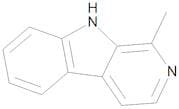
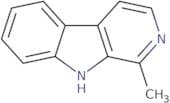
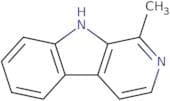
CAS 486-84-0
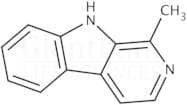
:Harman
- 1-Methyl-9H-pyrido[3,4-b]indole
- 1-Methyl-9H-β-carboline
- 1-Methyl-β-carboline
- 1-methyl-9H-beta-carboline
- 2,9-Pyridindole, 1-methyl-
- 2-Methyl-?carboline
- 9H-Pyrido[3,4-b]indole, 1-methyl-
- Aribin
- Aribine
- Aribine~1-Methyl-9H-pyrido[3,4-b]indole
- Harman
- Indoter
- Locuturin
- Locuturine
- NSC 54439
- Ver más sinónimos
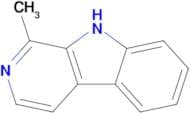
1-Methyl-9H-pyrido[3,4-b]indole
CAS:Fórmula:C12H10N2Pureza:97%Forma y color:SolidPeso molecular:182.22121-Methyl-9H-Pyrido[3,4-B]Indole
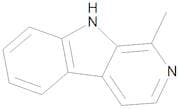
CAS:1-Methyl-9H-Pyrido[3,4-B]IndolePureza:99%Peso molecular:182.22g/molHarmane
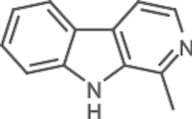
CAS:Harmane (Loturine) is a bio-active β-Carboline and monoamine oxidase inhibitor found in coffee and tobacco smoke.Fórmula:C12H10N2Pureza:97.89% - >99.99%Forma y color:Off-White SolidPeso molecular:182.22Harman
CAS:Applications Harman alkaloid like harmane, harmine, harmalol, harmaline obtained from Banisteriopsis caapi L. showed cytotoxicity, antimicrobial activity against Staphylococcus aureus, Escherichia coli, Proteus vulgaris and Candida albicans.
References Sigg, E.B., et al.: Arch. Int. Pharmacodyn., 149, 164 (1964), Saano, V., et al.: Acta Pharmacol. Toxicol., 51, 300 (1982), Tse, S., et al.: Biochem. Pharmacol., 42, 459 (1991), Rommelspacher, H., et al.: Eur. J. Pharmacol., 252, 51 (1994), Louis, E., et al.: Neurology, 59, 1940 (2002),Fórmula:C12H10N2Forma y color:White To Dark BrownPeso molecular:182.22Harman
CAS:Harman is a naturally occurring indole alkaloid that is structurally similar to the neurotransmitter serotonin. It has been shown to have inhibitory properties on mammalian cells, such as cytosolic Ca2+ levels, and to act as an inhibitor molecule against chemical pesticides. Harman has also been shown to be a competitive inhibitor of human serum albumin, with a Kd value of 1.3 μM. Harmane is synthesized from tryptophan by the enzyme indoleamine dioxygenase (IDO). The synthesis of harmane from tryptophan is catalyzed by IDO in the presence of molecular oxygen. The first step in this reaction involves the conversion of tryptophan into N-formylkynurenine by the enzyme tryptophan 2,3-dioxygenase (TDO). In the second step, IDO converts N-formylkynurenine into N-formFórmula:C12H10N2Pureza:Min. 95%Forma y color:PowderPeso molecular:182.22 g/molHarmane, free base
CAS:Harmane is a chemical with the molecular formula C 10 H 13 NO. It can be used as a versatile building block for organic synthesis, or as an intermediate in the production of other chemicals such as pharmaceuticals and pesticides. Harmane is also used in research involving complex compounds and drug discovery. The CAS number for harmane is 486-84-0.
Fórmula:C12H10N2Peso molecular:182.23 g/molRef: 3D-H-1150
5gA consultar10gA consultar25gA consultar50gA consultar2500mgA consultar-Unit-ggA consultarRef: 4Z-H-152
Producto descatalogado
![1-Methyl-9H-pyrido[3,4-b]indole](/_next/image/?url=https%3A%2Fstatic.cymitquimica.com%2Fproducts%2FIN%2Fthumb%2FDA003QU1.jpg&w=3840&q=75)


![1-Methyl-9H-Pyrido[3,4-B]Indole](/_next/image/?url=https%3A%2Fstatic.cymitquimica.com%2Fproducts%2F54%2Fthumb%2FOR1009535.jpg&w=3840&q=75)