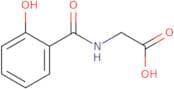
CAS 487-54-7
:Ácido salicilúrico
Descripción:
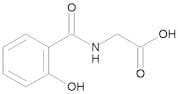
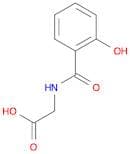
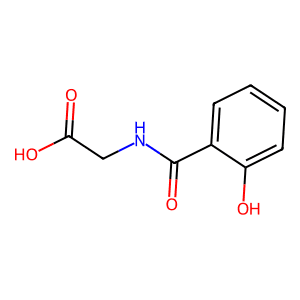
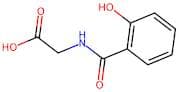
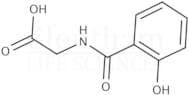
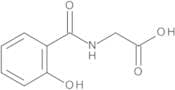
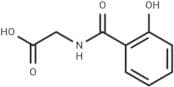
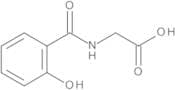
Ácido salicilúrico, con el número CAS 487-54-7, es un compuesto orgánico que es un derivado del ácido salicílico. Se caracteriza por su estructura, que incluye tanto un grupo de ácido salicílico como un grupo de urea. Este compuesto típicamente aparece como un sólido cristalino blanco a blanco sucio y es soluble en agua, reflejando su naturaleza polar debido a la presencia de grupos funcionales hidroxilo y amina. Ácido salicilúrico es conocido por su papel en el metabolismo de los fármacos salicilatos, como la aspirina, y a menudo se estudia por sus posibles actividades biológicas, incluidas las propiedades antiinflamatorias. Su síntesis puede implicar la reacción del ácido salicílico con urea o compuestos relacionados. En términos de seguridad, al igual que muchos compuestos orgánicos, debe manejarse con cuidado, ya que sus efectos en la salud humana y el medio ambiente aún se están investigando. En general, Ácido salicilúrico sirve como un compuesto importante tanto en la química farmacéutica como en los estudios metabólicos.
Fórmula:C9H9NO4
InChI:InChI=1S/C9H9NO4/c11-7-4-2-1-3-6(7)9(14)10-5-8(12)13/h1-4,11H,5H2,(H,10,14)(H,12,13)
Clave InChI:InChIKey=ONJSZLXSECQROL-UHFFFAOYSA-N
SMILES:C(NCC(O)=O)(=O)C1=C(O)C=CC=C1
Sinónimos:- (2-Hydroxybenzoyl)glycine
- (2R)-hydroxy[(phenylcarbonyl)amino]ethanoate
- (2S)-hydroxy[(phenylcarbonyl)amino]ethanoate
- (Benzoylamino)(Hydroxy)Acetic Acid
- 2-(2-Hydroxybenzamido)acetic acid
- 2-[(2-Hydroxyphenyl)formamido]acetic acid
- Glycine, N-(2-hydroxybenzoyl)-
- Hippuric acid, o-hydroxy-
- N-(2-hydroxybenzoyl)glycine
- N-(o-Hydroxybenzoyl)glycine
- N-Salicyloylglycine
- NSC 524135
- Salicylglycine
- Salicyloylglycine
- Salicyluric acid
- [(Benzoylamino)Oxy]Acetic Acid
- alpha-Hydroxybenzoylglycine
- alpha-Hydroxyhippuric acid
- o-Hydroxyhippuric acid
- {[(2-Hydroxyphenyl)Carbonyl]Amino}Acetate
- Ver más sinónimos
Ordenar por
Pureza (%)
0
100
|
0
|
50
|
90
|
95
|
100
Encontrado 13 productos.
Glycine, N-(2-hydroxybenzoyl)-
CAS:Fórmula:C9H9NO4Pureza:95%Forma y color:SolidPeso molecular:195.1721N-(2-Hydroxybenzoyl)glycine
CAS:N-(2-Hydroxybenzoyl)glycineFórmula:C9H9NO4Pureza:≥95%Forma y color: white powderPeso molecular:195.17g/molSalicyluric acid
CAS:Salicyluric acid (2-Hydroxy Hippuric Acid) is a metabolite of Salicylic Acid.Fórmula:C9H9NO4Pureza:99.70%Forma y color:SolidPeso molecular:195.172-Hydroxyhippuric acid
CAS:2-Hydroxyhippuric acid (2HPA) is a metabolite of salicylic acid. 2HPA is used to measure the concentration of salicylic acid in urine, which can be used as a biomarker for disease activity. When 2HPA is present in the urine, it indicates that the body has been exposed to salicylic acid. The concentration of 2HPA in urine correlates with the amount of salicylic acid taken orally and excreted by the kidneys. The analytical method for determining 2HPA in urine involves measuring the concentration of 2HPA and its derivatives with high pressure liquid chromatography or gas chromatography-mass spectrometry. Some biological samples that can be tested include blood, serum, plasma, saliva, sweat, or hair. Pharmacological agents that may affect 2HPA levels include other drugs such as nonsteroidal anti-inflammatory drugs (NSAIDs) or aspirin. The model system for this metabolite is humanFórmula:C9H9NO4Pureza:Min. 94 Area-%Forma y color:White PowderPeso molecular:195.17 g/mol