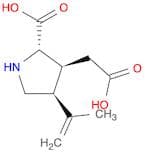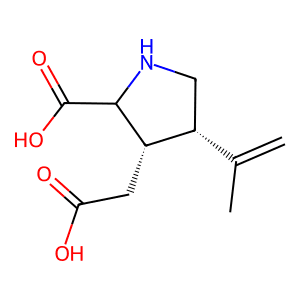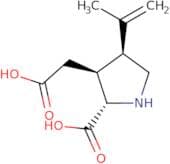
CAS 487-79-6
:Ácido α-kainico
- (-)-α-Kainic acid
- (2-Carboxy-4-isopropenyl-3-pyrrolidinyl)-essigsaeure anhydrous
- (2S,3S,4S)-2-Carboxy-4-(1-methylethenyl)-3-pyrrolidineacetic acid
- (2S,3S,4S)-2-Carboxy-4-isopropenylpyrrolidine-3-acetic acid
- (3S,4S)-3-(carboxymethyl)-4-prop-1-en-2-yl-L-proline
- 3-(Carboxymethyl)-4-Prop-1-En-2-Ylproline
- 3-Pyrrolidineacetic acid, 2-carboxy-4-(1-methylethenyl)-, (2S,3S,4S)-
- 3-Pyrrolidineacetic acid, 2-carboxy-4-(1-methylethenyl)-, [2S-(2α,3β,4β)]-
- 3-Pyrrolidineacetic acid, 2-carboxy-4-isopropenyl-
- <span class="text-smallcaps">L</span>-α-Kainic acid
- Digenic acid
- Digenin
- Helminal
- Ver más sinónimos
3-Pyrrolidineacetic acid, 2-carboxy-4-(1-methylethenyl)-, (2S,3S,4S)-
CAS:Fórmula:C10H15NO4Pureza:98%Forma y color:SolidPeso molecular:213.2304Kainic Acid
CAS:M02036 - Kainic Acid
Fórmula:C10H15NO4Pureza:>99%Forma y color:SolidPeso molecular:213.233Kainic acid
CAS:Kainic acid is an excitatory amino acid receptor agonist (EC50=16.2 μM). Kainic acid is an effective excitatory toxic agent. High-Quality, Low-Cost!Fórmula:C10H15NO4Pureza:98.47% - >99.99%Forma y color:White SolidPeso molecular:213.23(-)-α-Kainic Acid Lithium Salt
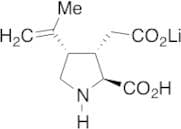
CAS:Producto controladoApplications (-)-α-Kainic Acid Lithium Salt is a naturally occurring neuroexcitatory chemical that is an selective agonist for a subtype of ionotropic glutamate receptor. Administration of (-)-α-Kainic Acid has been shown to increase production of reactive oxygen species, mitochondrial dysfunction, and apoptosis in neurons in many regions of the brain, particularly in the hippocampal subregions and in the hilus of dentate gyrus.
References Wacker, D.A., et al.: Synlett, 503 (1997), Dunleavy, M., et al.: J. Molec. Neurosci., 49, 202 (2013); Zhang, J., et al.: Neuron., 76, 1133 (2012); Yamada, J., et al.: Neurosci., 226, 119 (2012); Wang,Q., et al.: Mol. Neurobiol., 31, 3 (2005)’Fórmula:C10H14LiNO4Forma y color:NeatPeso molecular:219.163(-)-alpha-Kainic Acid
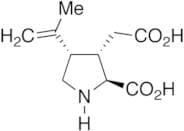
CAS:Producto controladoApplications (-)-α-Kainic Acid is a naturally occurring neuroexcitatory chemical that is an selective agonist for a subtype of ionotropic glutamate receptor. Administration of (-)-α-Kainic Acid has been shown to increase production of reactive oxygen species, mitochondrial dysfunction, and apoptosis in neurons in many regions of the brain, particularly in the hippocampal subregions and in the hilus of dentate gyrus.
References Wacker, D.A., et al.: Synlett, 503 (1997), Dunleavy, M., et al.: J. Molec. Neurosci., 49, 202 (2013); Zhang, J., et al.: Neuron., 76, 1133 (2012); Yamada, J., et al.: Neurosci., 226, 119 (2012); Wang,Q., et al.: Mol. Neurobiol., 31, 3 (2005)’Fórmula:C10H15NO4Forma y color:NeatPeso molecular:213.23Kainic Acid
CAS:Kainic Acid is a potent neuroexcitant, which is derived from certain species of red algae such as Digenea simplex. It acts as an agonist of kainate receptors, a subtype of ionotropic glutamate receptors, leading to excitotoxicity through the influx of calcium ions and the overactivation of neuronal circuits. Kainic Acid's ability to induce seizures by mimicking the neurotransmitter glutamate makes it an invaluable tool in neuroscientific research.
Fórmula:C10H15NO4Pureza:Min. 95%Peso molecular:213.23 g/molRef: 3D-AAA48779
Producto descatalogado