CAS 491-71-4
:Crisoeriol
Descripción:
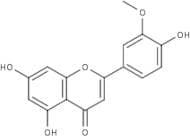
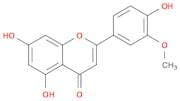
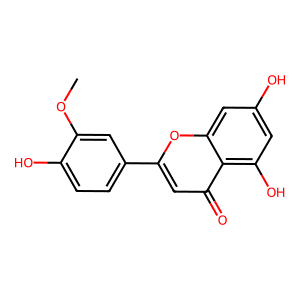
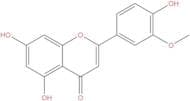
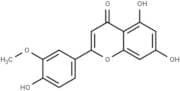
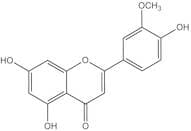
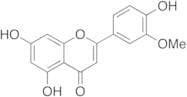
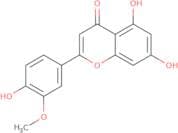
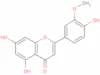
Crisoeriol, con el número CAS 491-71-4, es un flavonoide que se encuentra de forma natural y pertenece a la clase de las flavonas. Se caracteriza por su pigmento amarillo y se encuentra comúnmente en varias plantas, particularmente en las hojas y flores de ciertas especies. Crisoeriol exhibe propiedades antioxidantes, que contribuyen a sus posibles beneficios para la salud, incluyendo efectos antiinflamatorios y anticancerígenos. El compuesto tiene una fórmula molecular que refleja su estructura, que incluye múltiples grupos hidroxilo que mejoran su reactividad y solubilidad en disolventes polares. Crisoeriol también es conocido por su papel en la pigmentación de las plantas y puede contribuir al color de ciertos frutos y flores. Además de sus actividades biológicas, ha despertado interés en las industrias alimentaria y farmacéutica por sus posibles aplicaciones. En general, Crisoeriol es un compuesto significativo tanto en la química de productos naturales como en la investigación medicinal, destacando la importancia de los flavonoides en la salud y la nutrición.
Fórmula:C16H12O6
InChI:InChI=1S/C16H12O6/c1-21-14-4-8(2-3-10(14)18)13-7-12(20)16-11(19)5-9(17)6-15(16)22-13/h2-7,17-19H,1H3
Clave InChI:InChIKey=SCZVLDHREVKTSH-UHFFFAOYSA-N
SMILES:O=C1C=2C(OC(=C1)C3=CC(OC)=C(O)C=C3)=CC(O)=CC2O
Sinónimos:- 3'-Methoxyapigenin
- 3'-O-Methyluteolin
- 3′-Methoxy-4′,5,7-trihydroxyflavone
- 3′-O-Methylluteolin
- 4',5,7-Trihydroxy-3'-Methoxyflavone
- 4H-1-Benzopyran-4-one, 5,7-dihydroxy-2-(4-hydroxy-3-methoxyphenyl)-
- 5,7,4′-Trihydroxy-3′-methoxyflavone
- 5,7-Dihydroxy-2-(4-hydroxy-3-methoxyphenyl)-4H-1-benzopyran-4-one
- 5,7-dihydroxy-2-(4-hydroxy-3-methoxyphenyl)-4H-chromen-4-one
- Brn 0295004
- Chryseriol
- Chrysoeriol
- Chrysoriol
- Flavone, 4',5,7-trihydroxy-3'-methoxy-
- Flavone, 4′,5,7-trihydroxy-3′-methoxy-
- Luteolin 3'-methyl ether
- 5-18-05-00296 (Beilstein Handbook Reference)
- Ver más sinónimos
Ordenar por
Pureza (%)
0
100
|
0
|
50
|
90
|
95
|
100
Encontrado 11 productos.
Chrysoeriol
CAS:Chrysoeriol analytical standard provided with w/w absolute assay, to be used for quantitative titration.Fórmula:C16H12O6Pureza:(HPLC) ≥99%Forma y color:PowderPeso molecular:300.28Chrysoeriol
CAS:Chrysoeriol has antioxidant, antiinflammatory, antitumor, antimicrobial, antiviral, and free radical scavenging activities, it also shows selectiveFórmula:C16H12O6Pureza:97.32% - 99.805%Forma y color:SolidPeso molecular:300.26Chrysoeriol
CAS:Oxygen-heterocyclic compoundFórmula:C16H12O6Pureza:≥ 90.0 % (HPLC)Forma y color:PowderPeso molecular:300.26Chrysoeriol (>90%)
CAS:Producto controladoApplications Chrysoeriol is a methoxyflavonoid that selectively inhibits the formation of a carcinogenic estrogen metabolite in MCF-7 breast cancer cells. A metabolite of Luteolin (L475000).
References Takemura, H. et al.: J. Steroid Biochem. Mol. Biol., 118, 70 (2010); Petroianu, G. et al.: Open Med. Chem. J., 3, 1 (2009); Takemura, H. et al.: Toxicology, 274, 42 (2010);Fórmula:C16H12O6Pureza:>90%Forma y color:NeatPeso molecular:300.26Chrysoeriol
CAS:Chrysoeriol is a flavonoid compound, which is derived from various plant sources, including many herbs and flowers such as chamomile and tarragon. It functions through inhibition of certain cellular pathways that lead to inflammation, such as the suppression of NF-kB and cyclooxygenase activity. Additionally, chrysoeriol exhibits antioxidative effects by scavenging free radicals and enhancing the body's natural antioxidant enzyme systems.Fórmula:C16H12O6Pureza:Min. 95%Forma y color:Yellow PowderPeso molecular:300.26 g/mol