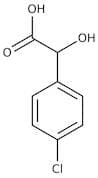
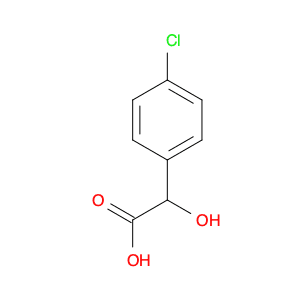
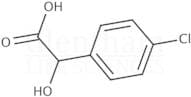
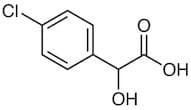
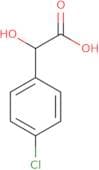
CAS 492-86-4
:Ácido 4-cloromandélico
- (2R)-(4-chlorophenyl)(hydroxy)ethanoate
- (2S)-(4-chlorophenyl)(hydroxy)ethanoate
- (4-Chlorophenyl)(Hydroxy)Acetic Acid
- (4-Chlorophenyl)hydroxyacetic acid
- (p-Chlorophenyl)hydroxyacetic acid
- 2-(4-Chlorophenyl)-2-hydroxyacetic acid
- 2-Hydroxy-2-(4-chlorophenyl)acetic acid
- 4-Chloro-<span class="text-smallcaps">D</smallcap><smallcap>L</span>-mandelic acid
- 4-Chloro-Alpha-Hydroxy-Benzeneaceticacid
- 4-Chloro-Alpha-Hydroxyphenylacetic Acid
- 4-Chloro-hydroxyphenylaceticacid
- 4-Chloro-α-hydroxybenzeneacetic acid
- 4-Chlorohydroxyphenylaceticacid
- 4-Chloromandelic acid
- <span class="text-smallcaps">D</smallcap><smallcap>L</span>-4-Chloromandelic acid
- <span class="text-smallcaps">D</smallcap><smallcap>L</span>-p-Chloromandelic acid
- Benzeneacetic acid, 4-chloro-α-hydroxy-
- Chloromandelicacid
- Mandelic acid, p-chloro-
- NSC 31400
- NSC 8112
- P-Chloro-Dl-Mandelic Acid
- P-Chloro-Phenylglycollicacid
- P-Chloromandelic Acid
- Ver más sinónimos
4-Chloromandelic acid, 98%
CAS:This Thermo Scientific Chemicals brand product was originally part of the Alfa Aesar product portfolio. Some documentation and label information may refer to the legacy brand. The original Alfa Aesar product / item code or SKU reference has not changed as a part of the brand transition to Thermo SciFórmula:C8H7ClO3Pureza:98%Forma y color:White to pale cream, PowderPeso molecular:186.592-(4-Chlorophenyl)-2-hydroxyacetic acid
CAS:Fórmula:C8H7ClO3Pureza:97%Forma y color:SolidPeso molecular:186.59244-Chloromandelic acid
CAS:4-Chloromandelic acidFórmula:C8H7ClO3Pureza:≥95%Forma y color: pale-yellow solidPeso molecular:186.59g/mol4-Chloro-DL-mandelic Acid
CAS:Fórmula:C8H7ClO3Pureza:>98.0%(GC)(T)Forma y color:White to Almost white powder to crystalPeso molecular:186.592-(4-Chlorophenyl)-2-hydroxyacetic acid
CAS:Fórmula:C8H7ClO3Pureza:95%Forma y color:SolidPeso molecular:186.594-Chloromandelic acid
CAS:4-Chloromandelic acid is an organic compound that is an important intermediate in the synthesis of pharmaceuticals and other organic compounds. It can be used as a ligand to form complexes with transition metals, such as Mo(VI), which are used to catalyze hydrogenation reactions. 4-Chloromandelic acid binds to the substrate binding site on the enzyme through hydrogen bonding interactions. This binding causes a conformational change in the enzyme that inhibits its activity. The kinetic data for 4-chloromandelic acid was determined using trifluoroacetic acid as the solvent and supercritical carbon dioxide as the antisolvent. The enantiomer of 4-chloromandelic acid was identified by analytical methods, including gas chromatography and mass spectroscopy.
Fórmula:C8H7ClO3Pureza:Min. 95%Forma y color:PowderPeso molecular:186.59 g/molRef: 3D-FC36579
Producto descatalogado