CAS 4947-89-1
:N-(3-Clorofenil)tiourea
Descripción:
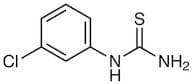
N-(3-Clorofenil)tiourea es un compuesto orgánico caracterizado por la presencia de un grupo funcional tiourea unido a un anillo fenílico clorado. Su estructura molecular presenta una parte de tiourea, que consiste en un átomo de carbono unido por un doble enlace a un átomo de azufre y por un enlace simple a un grupo amino, junto con un anillo fenílico sustituido con un átomo de cloro en la posición meta. Este compuesto típicamente aparece como un sólido blanco a blanco sucio y es soluble en disolventes orgánicos polares. N-(3-Clorofenil)tiourea es de interés en varios campos, incluida la química medicinal y los agroquímicos, debido a sus potenciales actividades biológicas, como propiedades antifúngicas y herbicidas. La presencia del átomo de cloro puede influir en su reactividad e interacción con objetivos biológicos. Al igual que con muchos derivados de tiourea, es esencial manejar este compuesto con cuidado, ya que las tioureas pueden exhibir toxicidad y pueden representar riesgos ambientales. Se deben seguir los protocolos de seguridad adecuados al trabajar con esta sustancia en entornos de laboratorio.
Fórmula:C7H7ClN2S
InChI:InChI=1S/C7H7ClN2S/c8-5-2-1-3-6(4-5)10-7(9)11/h1-4H,(H3,9,10,11)
Clave InChI:InChIKey=LSYZRUOXXOTVAV-UHFFFAOYSA-N
SMILES:N(C(N)=S)C1=CC(Cl)=CC=C1
Sinónimos:- (m-Chlorophenyl)thiourea
- 1-(3-Chlorophenyl)Thiourea
- 1-(m-Chlorophenyl)thiourea
- 3-(Chlorophenyl)thiourea
- Brn 2090370
- N-(3-Chlorophenyl)thiourea
- Nsc 164965
- Thiourea, (3-chlorophenyl)-
- Thiourea, (3-chlorophenyl)- (9CI)
- Thiourea, N-(3-chlorophenyl)-
- Urea, 1-(m-chlorophenyl)-2-thio-
- Ver más sinónimos
Ordenar por
Pureza (%)
0
100
|
0
|
50
|
90
|
95
|
100
Encontrado 4 productos.
(3-Chlorophenyl)thiourea
CAS:Fórmula:C7H7ClN2SPureza:>98.0%(HPLC)(N)Forma y color:White to Almost white powder to crystalPeso molecular:186.661-(3-Chlorophenyl)-2-thiourea
CAS:Fórmula:C7H7ClN2SPureza:98.0%Forma y color:SolidPeso molecular:186.661-(3-Chlorophenyl) thiourea
CAS:1-(3-Chlorophenyl) thiourea is a curcumin analog that has been shown to inhibit the epidermal growth factor (EGF) receptor. It is synthesized from 1,2-dichlorobenzene and urea in a two-step process. The anhydrous potassium carbonate is first converted to the potassium salt with an acid chloride. The second step is the reaction of this salt with urea in the presence of excess anhydrous potassium carbonate. This product has been shown to be effective against cancer cells and may be used as a potential anticancer agent for treatment of skin cancer. 1-(3-Chlorophenyl) thiourea inhibits EGF receptor by binding to it and preventing its activation, which prevents cell proliferation and reduces tumor size.
Pureza:Min. 95%