CAS 495-18-1
:Ácido benzoilhidroxámico
Descripción:
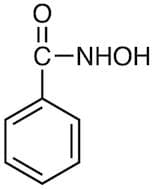
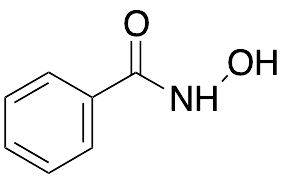
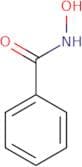
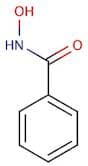
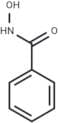
Ácido benzoilhidroxámico, con el número CAS 495-18-1, es un compuesto orgánico caracterizado por la presencia de un grupo funcional ácido hidroxámico y un anillo de benceno. Típicamente aparece como un sólido cristalino blanco a blanco sucio y es soluble en disolventes polares como agua y alcoholes. El compuesto presenta una porción de hidroxilamina (-NHOH) unida a un grupo bencilo, lo que contribuye a su reactividad y aplicaciones potenciales. Ácido benzoilhidroxámico es conocido por su capacidad para quelar iones metálicos, lo que lo hace útil en varios campos, incluida la química analítica y la bioquímica. Se ha estudiado por su potencial como inhibidor de ciertas enzimas, particularmente en el contexto del desarrollo de fármacos y aplicaciones terapéuticas. Además, exhibe propiedades que pueden ser aprovechadas en la síntesis de otros compuestos químicos. Al igual que muchos ácidos orgánicos, debe manejarse con cuidado, ya que puede ser irritante para la piel y los ojos. Se deben seguir los protocolos de seguridad adecuados al trabajar con esta sustancia.
Fórmula:C7H7NO2
InChI:InChI=1S/C7H7NO2/c9-7(8-10)6-4-2-1-3-5-6/h1-5,10H,(H,8,9)
Clave InChI:InChIKey=VDEUYMSGMPQMIK-UHFFFAOYSA-N
SMILES:C(NO)(=O)C1=CC=CC=C1
Sinónimos:- Benzamide, N-hydroxy-
- Benzenehydroxamic acid
- Benzhydroxamic acid
- Benzohydroximic acid
- Benzoylhydroxylamine
- Bham
- Brd 3493
- Hydroxybenzamide, n-
- Hydroxylamine, N-benzoyl-
- N-Benzohydroxamic acid
- N-Benzoylhydroxylamine
- N-Hydroxybenzamid
- N-hidroxibenzamida
- N-hydroxybenzamide
- Nsc 147248
- Nsc 3136
- Phenylhydroxamic acid
- Ver más sinónimos
Ordenar por
Pureza (%)
0
100
|
0
|
50
|
90
|
95
|
100
Encontrado 13 productos.
Benzohydroxamic Acid
CAS:Fórmula:C7H7NO2Pureza:>98.0%(T)Forma y color:White to Almost white powder to crystalPeso molecular:137.14Benzohydroxamic acid, 98%
CAS:Benzhydroxamic acid is used as precursor in the synthesis of novel mono-anionic and di-anionic hydroxamato complexes by reacting with BiPh3 and Bi(O(t)Bu)3, which has anti-bacterial activity against helicobacter pylori. It is used in the photometric determination of trace amounts of vanadium in alloFórmula:C7H7NO2Pureza:98%Forma y color:White or pink to pale brown, Crystalline powder or flakesPeso molecular:137.14Benzhydroxamic acid
CAS:Fórmula:C7H7NO2Pureza:≥ 98.0%Forma y color:White to light yellow crystalline powderPeso molecular:137.14Benzohydroxamic Acid
CAS:Producto controladoStability Moisture and Temperature Sensitive
Applications Benzohydroxamic Acid (cas# 495-18-1) is a compound useful in organic synthesis.
References Siliphaivanh, P., et al.: Bioorg. Med. Chem. Lett., 17, 4619 (2007), Serafimova, R., et al.: Chem. Res. Toxicol., 20, 1225 (2007), Fielding, A., et al.: Biochem., 47, 9781 (2008),Fórmula:C7H7NO2Forma y color:White To BeigePeso molecular:137.14Benzohydroxamic acid
CAS:Benzohydroxamic acid is a weak organic acid that is formed from the condensation of two molecules of benzoic acid. The thermodynamic data for this compound are available in the form of an equation and an enthalpy change. Benzohydroxamic acid interacts with metal hydroxides by forming metal complexes, which can be used as catalysts in transfer reactions. In addition, benzohydroxamic acid has been shown to inhibit HIV infection by inhibiting reverse transcriptase activity. This compound also undergoes hydrogen bonding interactions with other molecules due to its hydroxyl group and fatty acid moieties.Fórmula:C7H7NO2Pureza:Min. 95%Forma y color:PowderPeso molecular:137.14 g/molBenzohydroxamic Acid extrapure, 99%
CAS:Fórmula:C7H7NO2Pureza:min. 99%Forma y color:White, Crystalline powder, Clear, ColourlessPeso molecular:137.14Benzohydroxamic acid
CAS:Benzohydroxamic acid (BHA) is a chitin deacetylase (CDA) inhibitor with notable antifungal properties. It displays Ki values of 8.31 μM against Verticillium dahliae CDA and 9.83 μM against Puccinia striiformis f. sp. tritici CDA. BHA can restore the defense responses in infected host plants by upregulating the expression of defense-related genes, thereby reducing fungal growth and proliferation within the plants. It is applicable in the research of agricultural fungal diseases, such as cotton wilt and wheat stripe rust, caused by pathogens like Verticillium dahliae and Puccinia striiformis.Fórmula:C7H7NO2Forma y color:SolidPeso molecular:137.136Benzhydroxamic acid
CAS:Fórmula:C6H5CONHOHPureza:99.0 min. %Forma y color:White solidPeso molecular:137.14