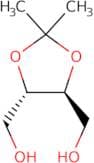
CAS 50622-09-8
:(4S,5S)-2,2-Dimetil-1,3-dioxolano-4,5-dimetanol
Descripción:
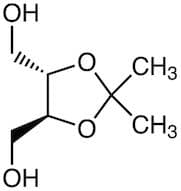
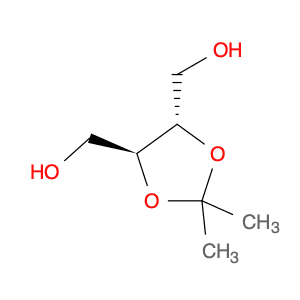
(4S,5S)-2,2-Dimetil-1,3-dioxolano-4,5-dimetanol es un compuesto químico caracterizado por su estructura única de anillo de dioxolano, que presenta dos grupos hidroximetilo en las posiciones 4 y 5 y dos grupos metilo en la posición 2. Este compuesto es una molécula quiral, con una estereoquímica específica denotada por la configuración (4S,5S), que indica la disposición espacial de sus átomos. La presencia del anillo de dioxolano contribuye a su estabilidad y reactividad, lo que lo convierte en un candidato potencial para diversas reacciones químicas, incluidas las de síntesis orgánica. Los grupos hidroximetilo mejoran su solubilidad en disolventes polares y pueden participar en enlaces de hidrógeno, influyendo en sus propiedades físicas como el punto de ebullición y el punto de fusión. Además, la estructura del compuesto sugiere aplicaciones potenciales en productos farmacéuticos o como intermedios en la síntesis orgánica debido a los grupos funcionales presentes. En general, (4S,5S)-2,2-Dimetil-1,3-dioxolano-4,5-dimetanol es notable por su estereoquímica y versatilidad funcional en reacciones químicas.
Fórmula:C7H14O4
InChI:InChI=1S/C7H14O4/c1-7(2)10-5(3-8)6(4-9)11-7/h5-6,8-9H,3-4H2,1-2H3/t5-,6-/m0/s1
Clave InChI:InChIKey=INVRLGIKFANLFP-WDSKDSINSA-N
SMILES:C(O)[C@H]1[C@H](CO)OC(C)(C)O1
Sinónimos:- (+)-2,3-O-Isopropylidene-<span class="text-smallcaps">L</span>-threitol
- (+)-2,3-O-Isopropylidene-L-Threitol
- (2,2-Dimethyl-1,3-dioxolane-4,5-diyl)dimethanol
- (4S,5S)-2,2-Dimethyl-1,3-dioxolane-4,5-dimethanol
- (4S,5S)-4,5-Bis(hydroxymethyl)-2,2-dimethyl-1,3-dioxolane
- 1,3-Dioxolane-4,5-Dimethanol, 2,2-Dimethyl-
- 1,3-Dioxolane-4,5-dimethanol, 2,2-dimethyl-, (4S,5S)-
- 1,3-Dioxolane-4,5-dimethanol, 2,2-dimethyl-, (4S-trans)-
- 256-658-6
- [(4S,5S)-2,2-dimethyl-1,3-dioxolane-4,5-diyl]dimethanol
Ordenar por
Pureza (%)
0
100
|
0
|
50
|
90
|
95
|
100
Encontrado 9 productos.
(+)-2,3-O-Isopropylidene-L-threitol
CAS:Fórmula:C7H14O4Pureza:>97.0%(GC)Forma y color:White or Colorless to Light yellow powder to lump to clear liquidPeso molecular:162.191,3-Dioxolane-4,5-dimethanol, 2,2-dimethyl-, (4S,5S)-
CAS:Fórmula:C7H14O4Pureza:98%Forma y color:SolidPeso molecular:162.18372,3-O-Isoproylidene-L-threitol
CAS:Fórmula:C7H14O4Pureza:(GC) ≥ 97.0%Forma y color:Conflicting attributes definedPeso molecular:162.19(+)-2,3-O-Isopropylidene-L-threitol
CAS:(+)-2,3-O-Isopropylidene-L-threitolPureza:99%Peso molecular:162.18g/mol2,3-O-Isopropylidene-L-threitol
CAS:Producto controladoApplications 2,3-O-Isopropylidene-L-threitol is an intermediate in the synthesis of versicolactone compounds.
References Wang, L., et al.: Tetrahedron. Lett., 54, 6729 (2013);Fórmula:C7H14O4Forma y color:NeatPeso molecular:162.18((4S,5S)-2,2-Dimethyl-1,3-dioxolane-4,5-diyl)dimethanol
CAS:Fórmula:C7H14O4Pureza:99%+(GC-MS);RGForma y color:No data available.Peso molecular:162.1852,3-O-Isopropylidene-L-threitol
CAS:2,3-O-Isopropylidene-L-threitol is a chiral sugar alcohol that is a new type of HDAC inhibitor. It has been shown to be an effective inhibitor of histone deacetylase (HDAC) and can be used in the treatment of certain cancers. 2,3-O-Isopropylidene-L-threitol is considered to be enantiomerically pure because it contains only one stereoisomer. It is also synthesized via a dehydrogenative process, which starts with the addition of 2 equivalents of phenol to diphenol followed by the addition of 4 equivalents of biphenyl. This product can also be used to make polycarbonates with functional groups such as epoxy or vinyl groups.Fórmula:C7H14O4Pureza:Min. 95%Forma y color:Yellow PowderPeso molecular:162.18 g/mol