CAS 50789-45-2
:3-fenoxibenzonitrilo
Descripción:
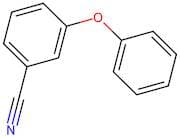
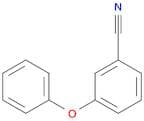
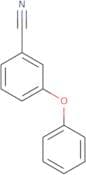
3-fenoxibenzonitrilo, con el número CAS 50789-45-2, es un compuesto orgánico caracterizado por sus grupos funcionales fenoxi y benzonitrilo. Típicamente aparece como un sólido blanco a amarillo claro y es conocido por sus propiedades aromáticas debido a la presencia de anillos de benceno. El compuesto tiene una fórmula molecular que refleja su estructura, compuesta por átomos de carbono, hidrógeno y nitrógeno. Generalmente es insoluble en agua pero soluble en disolventes orgánicos, lo cual es común para muchos compuestos aromáticos. 3-fenoxibenzonitrilo se utiliza a menudo en síntesis orgánica y puede servir como un intermedio en la producción de varios productos farmacéuticos y agroquímicos. Su estabilidad química y reactividad pueden verse influenciadas por los sustituyentes en los anillos aromáticos, lo que lo convierte en un tema de interés en la investigación relacionada con la ciencia de materiales y la química medicinal. Se deben consultar los datos de seguridad para su manejo, ya que, al igual que muchos compuestos orgánicos, puede representar riesgos para la salud si no se gestiona adecuadamente.
Fórmula:C13H9NO
InChI:InChI=1/C13H9NO/c14-10-11-5-4-8-13(9-11)15-12-6-2-1-3-7-12/h1-9H
SMILES:c1ccc(cc1)Oc1cccc(c1)C#N
Sinónimos:- Benzonitrile, 3-phenoxy-
- 3-Phenoxybenzonitrile
Ordenar por
Pureza (%)
0
100
|
0
|
50
|
90
|
95
|
100
Se han encontrado 4 productos.
3-Phenoxybenzonitrile
CAS:3-PhenoxybenzonitrileFórmula:C13H9NOPureza:97%Forma y color:LiquidPeso molecular:195.216653-Phenoxybenzonitrile
CAS:3-Phenoxybenzonitrile is a diphenyl ether that can be used as an anti-cancer and pesticide. It has been shown to inhibit the growth of human cancer cells in vitro, and is effective against a number of insect pests. 3-Phenoxybenzonitrile is toxic to humans, but is less toxic than other phenoxybenzamines. 3-Phenoxybenzonitrile has also been shown to be carcinogenic, with parameters such as hydrogen chloride, optimization and chloride affecting its carcinogenicity. This chemical's toxicity depends on the functional group present at the 3-position. In the presence of chloride ions, it reacts with acetonitrile to form 1,2-dioxane and hydrogen chloride. The rate of this reaction will depend on the reaction time and temperature.
Fórmula:C13H9NOPureza:Min. 95%Peso molecular:195.22 g/mol