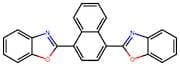
CAS 5089-22-5
:1,4-Bis(2-benzoxazolil)naftaleno
Descripción:
1,4-Bis(2-benzoxazolil)naftaleno, con el número CAS 5089-22-5, es un compuesto orgánico caracterizado por su estructura, que consiste en un núcleo de naftaleno sustituido con dos grupos benzoxazol en las posiciones 1 y 4. Este compuesto exhibe notables propiedades de fluorescencia, lo que lo hace de interés en diversas aplicaciones, incluyendo como sonda fluorescente o en ciencia de materiales. Típicamente aparece como un sólido a temperatura ambiente y es soluble en disolventes orgánicos. La presencia de los moieties benzoxazol contribuye a sus características fotofísicas, incluyendo espectros de absorción y emisión, que pueden verse influenciados por el entorno del disolvente. Además, este compuesto puede exhibir estabilidad térmica y puede sufrir diversas reacciones químicas típicas de compuestos aromáticos. Su estructura y propiedades únicas lo convierten en un objeto de investigación en campos como la electrónica orgánica, la fotónica y la tecnología de sensores. Se deben consultar los datos de seguridad para el manejo y uso, como con cualquier sustancia química.
Fórmula:C24H14N2O2
InChI:InChI=1S/C24H14N2O2/c1-2-8-16-15(7-1)17(23-25-19-9-3-5-11-21(19)27-23)13-14-18(16)24-26-20-10-4-6-12-22(20)28-24/h1-14H
Clave InChI:InChIKey=WFYSPVCBIJCZPX-UHFFFAOYSA-N
SMILES:C=1(C2=C(C(=CC1)C3=NC=4C(O3)=CC=CC4)C=CC=C2)C5=NC=6C(O5)=CC=CC6
Sinónimos:- 1,4-Bis(2-benzoxazoly)naphthalene
- 1,4-Bis(2-benzoxazolyl)naphthalene
- 1,4-Bis(Benziazolyl-2-Yl-)Naphth-Alene
- 1,4-Di(2-benzoxazolyl)naphthalene
- 2,2'-Naphthalene-1,4-Diylbis(1,3-Benzoxazole)
- 2,2′-(1,4-Naphthalenediyl)bis[benzoxazole]
- 2-[4-(1,3-Benzoxazol-2-yl)naphthalen-1-yl]-1,3-benzoxazole
- Benzoxazole, 2,2′-(1,4-naphthalenediyl)bis-
- Benzoxazole, 2,2′-(1,4-naphthylene)bis-
- Fba 367
- Fluorescent Brightener 367
- Fluorescent Whitening Agent KCB
- Hostalux Kcb
- KCB
- Optical Brightener KCB
- Optical Brightening Agent KCB
- Optical Brightner KCB
- FLUORESCENT BRIGHTENER-KCB
- Ver más sinónimos
Ordenar por
Pureza (%)
0
100
|
0
|
50
|
90
|
95
|
100
Encontrado 5 productos.
1,4-Bis(2-benzoxazolyl)naphthalene
CAS:Fórmula:C24H14N2O2Pureza:>98.0%(HPLC)(N)Forma y color:Light yellow to Amber to Dark green powder to crystalPeso molecular:362.391,4-Bis(benzo[d]oxazol-2-yl)naphthalene
CAS:Fórmula:C24H14N2O2Pureza:96%Forma y color:SolidPeso molecular:362.38021,4-Bis(benzo[d]oxazol-2-yl)naphthalene
CAS:Pureza:98.0%Forma y color:Solid, Pale yellow to yellow green powderPeso molecular:362.388000488281251,4-Bis(1,3-benzoxazol-2-yl)naphthalene
CAS:1,4-Bis(1,3-benzoxazol-2-yl)naphthaleneFórmula:C24H14N2O2Pureza:>98.0%Forma y color: green solidPeso molecular:362.38g/mol1,4-Bis(benzoxazolyl-2-yl)naphthalene
CAS:1,4-Bis(benzoxazolyl-2-yl)naphthalene is a chemical substance that belongs to the group of biocides. It is used as a preservative in plastics and textiles, as well as an analytical reagent for organic compounds. The reaction monitoring technique was used to determine the concentration of 1,4-bis(benzoxazolyl-2-yl)naphthalene in a solution. This technique involves ultrasonically dispersing the sample and forming droplets before thermocycling it to break down the matrix. The calibration curve was then plotted on a graph based on the number of cycles required to produce a certain fluorescence intensity. Multiple reaction monitoring (MRM) is an analytical method that can be used to identify different substances in a mixture by examining their characteristic spectra at different wavelengths. MRM is often used in conjunction with chromatography methods, such as gas chromatography or liquid chromatography, becauseFórmula:C24H14N2O2Pureza:Min. 98 Area-%Forma y color:PowderPeso molecular:362.4 g/mol


![1,4-Bis(benzo[d]oxazol-2-yl)naphthalene](/_next/image/?url=https%3A%2Fstatic.cymitquimica.com%2Fproducts%2FIN%2Fthumb%2FDA003DMM.jpg&w=3840&q=75)

![1,4-Bis(benzo[d]oxazol-2-yl)naphthalene](/_next/image/?url=https%3A%2Fstatic.cymitquimica.com%2Fproducts%2F10%2Fthumb%2FF235754.jpg&w=3840&q=75)