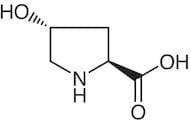
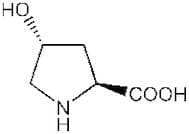
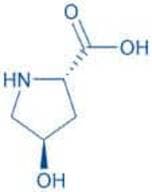
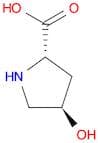
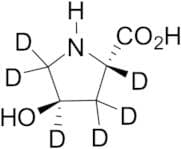
CAS 51-35-4
:L-Hidroxiprolina
- (-)-4-Hydroxy-2-pyrrolidinecarboxylic acid
- (2S,4R)-(-)-4-Hydroxy-2-pyrrolinecarboxylic acid
- (2S,4R)-(-)-4-Hydroxypyrrolidine-2-carboxylic acid
- (2S,4R)-4-Hydroxyproline
- (4R)-4-Hydroxy-<span class="text-smallcaps">L</span>-proline
- (4R)-4-hydroxy-L-proline
- (4R,2S)-Hydroxyproline
- (R)-4-Hydroxy-(S)-proline
- (R)-4-Hydroxy-<span class="text-smallcaps">L</span>-proline
- (R)-4-Hydroxy-L-proline
- (S)-Hydroxyproline
- 1-Hydroxyproline
- 1-hydroxy-L-proline
- 3-hydroxy-L-proline
- 4(R)-Hydroxy-2(S)-pyrrolidinecarboxylic acid
- 4(R)-Hydroxyproline
- 4-Hydroxy-(S)-proline
- 4-Hydroxy-<span class="text-smallcaps">L</span>-proline
- 4-Hydroxy-L-proline
- 4-Hydroxyproline
- 4-L-Hydroxyproline
- 4-hydroxy-L-proline (trans)
- 4-trans-Hydroxy-<span class="text-smallcaps">L</span>-proline
- 4-trans-Hydroxy-L-proline
- <span class="text-smallcaps">L</span>-4-Hydroxyproline
- <span class="text-smallcaps">L</span>-Hydroxyproline
- <span class="text-smallcaps">L</span>-Hypro
- <span class="text-smallcaps">L</span>-Proline, 4-hydroxy-, (4R)-
- <span class="text-smallcaps">L</span>-Proline, 4-hydroxy-, trans-
- <span class="text-smallcaps">L</span>-trans-4-Hydroxyproline
- H-Hyp-OH
- Hydroxy-<span class="text-smallcaps">L</span>-proline
- Hydroxy-L-proline
- Hydroxyproline
- Hydroxyproline, L-
- Hypro
- L-4-Hydroxyprolin
- L-4-Hydroxyproline
- L-4-hidroxiprolina
- L-Hydroxyproline
- L-Hypro
- L-Proline, 4-hydroxy-, (4R)-
- L-Proline, 4-hydroxy-, trans-
- L-trans-4-Hydroxyproline
- L<sub>s</sub>-Hydroxyproline
- Ls-Hydroxyproline
- Nsc 46704
- Proline, 4-hydroxy-
- Proline, 4-hydroxy-, <span class="text-smallcaps">L</span>-
- Proline, 4-hydroxy-, L-
- Trans-4-hydroxyl-L-proline
- delta-Hydroxyproline
- trans-(2S,4R)-4-Hydroxy-<span class="text-smallcaps">L</span>-proline
- trans-4-Hydroxy-<span class="text-smallcaps">L</span>-proline
- trans-4-Hydroxyproline
- trans-<span class="text-smallcaps">L</span>-4-Hydroxyproline
- trans-<span class="text-smallcaps">L</span>-Hydroxyproline
- trans-L-4-Hydroxyproline
- trans-L-Hydroxyproline
- Ver más sinónimos
trans-4-Hydroxy-L-proline
CAS:Fórmula:C5H9NO3Pureza:>99.0%(T)(HPLC)Forma y color:White powder to crystalinePeso molecular:131.13trans-4-Hydroxy-L-proline, 99+%
CAS:trans-4-Hydroxy-L-proline is used as a reagent for the preparation of neuroexcitatory kainoids and antifungal echinocandins. It is also involved in the synthesis of chiral ligands for enantioselective ethylation of aldehydes. This Thermo Scientific Chemicals brand product was originally part of the
Fórmula:C5H9NO3Pureza:99+%Forma y color:White to pale cream, Crystals or powder or crystalline powderPeso molecular:131.13H-Hyp-OH
CAS:Kristensen et al. achieved the selective O-acylation of unprotected trans-hydroxyproline.Fórmula:C5H9NO3Forma y color:WhitePeso molecular:131.13Ref: IN-DA0035PX
5g20,00€25g22,00€5kg205,00€100g26,00€250g35,00€500g53,00€250kgA consultar500kgA consultartrans-4-Hydroxy-L-proline, GlenCell™, suitable for cell culture
CAS:Fórmula:C5H9NO3Pureza:(dried basis) 99.0 - 101.0 %Forma y color:White crystalline powderPeso molecular:131.13trans-4-Hydroxy-L-Proline
CAS:Fórmula:C5H9NO3Forma y color:White To Off-White SolidPeso molecular:131.13(2S,4R)-4-Hydroxypyrrolidine-2-carboxylic acid
CAS:(2S,4R)-4-Hydroxypyrrolidine-2-carboxylic acidFórmula:C5H9NO3Pureza:≥95%Forma y color: white crystalsPeso molecular:131.12985g/moltrans-4-Hydroxy-L-proline
CAS:Fórmula:C5H9NO3Pureza:98.5 - 101.5 %Forma y color:White to off-white crystalline powder, or colourless crystalsPeso molecular:131.13L-Hydroxyproline
CAS:L-Hydroxyproline (L-Hydroxyprolin) is one of the hydroxyproline (Hyp) isomers.Fórmula:C5H9NO3Pureza:99.77% - 99.92%Forma y color:SolidPeso molecular:131.13trans-4-Hydroxy-L-proline
CAS:Producto controladoApplications A natural constituent of animal structural proteins such as collagen and elastin. Several microorganisms producing proline trans-4- and cis-3-hydroxylase were discovered and these enzymes were applied to the industrial production of trans-4- and cis-3-hydroxy-L-proline.
References Langmaier, F. et al.: Int. J. Cosm. Sci., 24, 273 (2002); Lawrence, C., et al.: Biochem. J., 313, 185 (1996); Mori, H., et al.: J. Bacteriol.; 179, 5677 (1997); Clifton, I., et al.: Eur. J. Biochem., 268, 6625 (2001);Fórmula:C5H9NO3Forma y color:NeatPeso molecular:131.13trans-4-Hydroxy-L-proline
CAS:Proline is a non-essential amino acid that is found in the basic structure of collagen. Proline has been shown to have physiological effects, including a protective effect on the myocardium, and can be used as an analytical method for detecting proline residues in biological samples. Trans-4-Hydroxy-L-proline is a proline derivative that has been shown to inhibit collagenase activity in vitro. It was also shown to have an optimum concentration of 1 mM and a matrix effect at pH 6.5. The model system used to study trans-4-hydroxy-l-proline was the enzyme extracted from rat liver.Fórmula:C5H9NO3Forma y color:White PowderPeso molecular:131.13 g/molH-Hyp-OH
CAS:M03214 - H-Hyp-OH
Fórmula:C5H9NO3Pureza:97%Forma y color:Off-white crystalline powderPeso molecular:131.131L-Hydroxyproline extrapure CHR, 99%
CAS:Fórmula:C5H9NO3Pureza:min. 99.0%Forma y color:White to off white, Crystalline powder, Clear, Colourless to Pale yellowPeso molecular:131.13trans-4-Hydroxy-L-proline-d6
CAS:Producto controladoFórmula:C5D6H3NO3Forma y color:NeatPeso molecular:137.167