CAS 51-39-8
:Ácido 3,4,5-triclorobenzoico
Descripción:
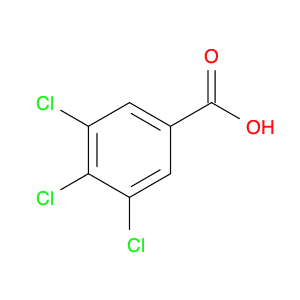
Ácido 3,4,5-triclorobenzoico es un ácido carboxílico aromático caracterizado por la presencia de tres átomos de cloro sustituidos en las posiciones 3, 4 y 5 del anillo bencénico del ácido benzoico. Su fórmula molecular es C7H3Cl3O2, y presenta un grupo funcional ácido carboxílico (-COOH) que le confiere propiedades ácidas. Este compuesto es típicamente un sólido cristalino blanco a blanco sucio, y es poco soluble en agua pero más soluble en disolventes orgánicos como el etanol y la acetona. Ácido 3,4,5-triclorobenzoico es conocido por sus aplicaciones en la síntesis orgánica, particularmente como un intermedio en la producción de herbicidas y otros agroquímicos. También sirve como reactivo en varias reacciones químicas, incluidos los procesos de cloración y acilación. Debido a la presencia de átomos de cloro, exhibe una persistencia ambiental significativa y una potencial toxicidad, lo que requiere un manejo y disposición cuidadosos de acuerdo con las regulaciones de seguridad.
Fórmula:C7H3Cl3O2
InChI:InChI=1/C7H3Cl3O2/c8-4-1-3(7(11)12)2-5(9)6(4)10/h1-2H,(H,11,12)
Clave InChI:InChIKey=ICUICNRYLHKQGS-UHFFFAOYSA-N
SMILES:C(O)(=O)C1=CC(Cl)=C(Cl)C(Cl)=C1
Sinónimos:- 3,4,5-Trichlorobenzoicacid
- Benzoic Acid, 3,4,5-Trichloro-
- 3,4,5-Trichlorobenzoic acid
- Ai3-33273
- 3,4,5-TRICHLORO-BENZOICACID
- Brn 3267440
Ordenar por
Pureza (%)
0
100
|
0
|
50
|
90
|
95
|
100
Encontrado 4 productos.
3,4,5-Trichlorobenzoic acid
CAS:Trichlorobenzoic acid is a chemical compound that is found in plants, such as Trifolium pratense L. and other legumes. It has been shown to inhibit the growth of bacteria by competitive inhibition of the enzyme ribonucleotide reductase, which catalyzes the conversion of ribonucleotides to deoxyribonucleotides. This prevents the production of RNA, which is necessary for protein synthesis and cell division. Inhibition of this enzyme can be achieved by either conjugating trichlorobenzoic acid with a sugar or using ion-exchange resins to remove it from water. The concentration required for this type of inhibition varies depending on the type of organism, but generally ranges between 5-10 ppm.END>
Pureza:Min. 95%