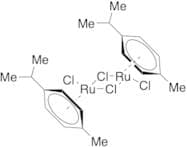
CAS 52462-29-0
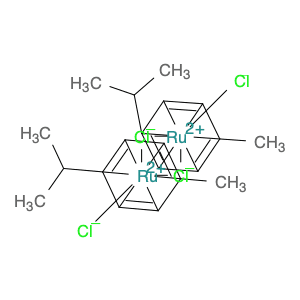
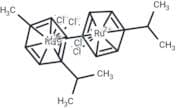
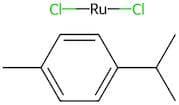
:Bis(dicloro(η6-p-cimeno)rutenio)
Descripción:
Bis(dicloro(η6-p-cimeno)rutenio) es un compuesto de coordinación que presenta al rutenio como el átomo central de metal, coordinado a dos ligandos dicloro(η6-p-cimeno). Este compuesto se caracteriza por su estructura única, donde el ligando p-cimeno, un hidrocarburo aromático sustituido, se une al centro de rutenio de manera η6, lo que indica que todo el anillo aromático está involucrado en la coordinación. Los grupos dicloro contribuyen a la estabilidad y reactividad general del complejo. Típicamente, tales complejos de rutenio exhiben propiedades catalíticas interesantes, particularmente en transformaciones orgánicas y reacciones de polimerización. También pueden mostrar potencial en química medicinal, especialmente en el tratamiento del cáncer, debido a su capacidad para interactuar con moléculas biológicas. El compuesto generalmente se maneja con cuidado debido a la presencia de cloro, que puede ser tóxico. Su solubilidad en disolventes orgánicos y estabilidad bajo diversas condiciones lo convierten en un tema de interés tanto en la investigación académica como industrial. En general, Bis(dicloro(η6-p-cimeno)rutenio) ejemplifica la versatilidad de los complejos de metales de transición en la química de coordinación.
Fórmula:C20H28Cl4Ru2
InChI:InChI=1S/2C10H14.4ClH.2Ru/c2*1-8(2)10-6-4-9(3)5-7-10;;;;;;/h2*4-8H,1-3H3;4*1H;;/q;;;;;;2*+2/p-4
Clave InChI:InChIKey=LAXRNWSASWOFOT-UHFFFAOYSA-J
SMILES:[Cl-][Ru+2]123456(C=7(C(C)C)[CH]1=[CH]2C3(C)=[CH]4[CH]57)[Cl-][Ru+2]89%10%11%12([Cl-])([Cl-]6)C=%13(C(C)C)[CH]8=[CH]9C%10(C)=[CH]%11[CH]%12%13
Sinónimos:- (Cymene)ruthenium dichloride dimer
- (p-Cymene)ruthenium dichloride dimer
- (p-Cymene)ruthenium(II) chloride dimer
- Benzene, 1-methyl-4-(1-methylethyl)-, ruthenium complex
- Bis(((η6-4-isopropyltoluene)(chloro)(μ-chloro)ruthenium))
- Bis(((η<sup>6</sup>-4-isopropyltoluene)(chloro)(μ-chloro)ruthenium))
- Bis((dichloro(η6-p-isopropyl(methyl)benzene)ruthenium))
- Bis((dichloro(η<sup>6</sup>-p-isopropyl(methyl)benzene)ruthenium))
- Bis((η6-p-cymene)dichlororuthenium)
- Bis((η<sup>6</sup>-p-cymene)dichlororuthenium)
- Bis((μ-chloro)chloro(η6-1-isopropyl-4-methylbenzene)ruthenium)
- Bis((μ-chloro)chloro(η6-4-isopropyltoluene)ruthenium)
- Bis((μ-chloro)chloro(η<sup>6</sup>-1-isopropyl-4-methylbenzene)ruthenium)
- Bis((μ-chloro)chloro(η<sup>6</sup>-4-isopropyltoluene)ruthenium)
- Bis(4-isopropyltoluene)tetrachlorodiruthenium
- Bis(chloro(μ-chloro)(η6-p-cymene)ruthenium)
- Bis(chloro(μ-chloro)(η6-p-isopropyl(methyl)benzene)ruthenium)
- Bis(chloro(μ-chloro)(η6-p-isopropyltoluene)ruthenium)
- Bis(chloro(μ-chloro)(η<sup>6</sup>-p-cymene)ruthenium)
- Bis(chloro(μ-chloro)(η<sup>6</sup>-p-isopropyl(methyl)benzene)ruthenium)
- Bis(chloro(μ-chloro)(η<sup>6</sup>-p-isopropyltoluene)ruthenium)
- Bis(dichloro(p-η6-isopropyltoluene)ruthenium)
- Bis(dichloro(p-η<sup>6</sup>-isopropyltoluene)ruthenium)
- Bis(dichloro(η6-4-isopropyltoluene)ruthenium)
- Bis(dichloro(η6-p-cymene)ruthenium)
- Bis(dichloro(η6-p-isopropyltoluene)ruthenium)
- Bis(dichloro(η<sup>6</sup>-4-isopropyltoluene)ruthenium)
- Bis(dichloro(η<sup>6</sup>-p-cymene)ruthenium)
- Bis(dichloro(η<sup>6</sup>-p-isopropyltoluene)ruthenium)
- Bis(p-cymene)diruthenium(II) tetrachloride
- Bis(η6-p-Cymene)tetrachlorodiruthenium
- Bis(η<sup>6</sup>-p-Cymene)tetrachlorodiruthenium
- Bis(μ-chlorochloro(η6-4-cymene)ruthenium)
- Bis(μ-chlorochloro(η<sup>6</sup>-4-cymene)ruthenium)
- Bis[(η6-p-isopropyltoluene)dichlororuthenium]
- Bis[(η<sup>6</sup>-1-isopropyl-4-methylbenzene)dichlororuthenium]
- Bis[(η<sup>6</sup>-p-isopropyltoluene)dichlororuthenium]
- Bis[dichlorido(cym) ruthenium(II)]
- Bis[dichloro(1-isopropyl-4-methylbenzene)ruthenium]
- Bis[dichloro(p-cymene)ruthenium]
- Bis[dichloro(η6-1-isopropyl-4-methylbenzene)ruthenium]
- Bis[dichloro(η<sup>6</sup>-1-isopropyl-4-methylbenzene)ruthenium]
- Di-chlorobis[(p-cymene)chlororuthenium(II)]
- Di-micron-chlorobis(p-cymene)chlororuthenium(II)
- Di-μ-chlorobis(chloro(η6-4-cymene)ruthenium)
- Di-μ-chlorobis(chloro(η6-4-isopropyltoluene)ruthenium)
- Di-μ-chlorobis(chloro(η6-p-cymene)ruthenium)
- Di-μ-chlorobis(chloro(η<sup>6</sup>-4-cymene)ruthenium)
- Di-μ-chlorobis(chloro(η<sup>6</sup>-4-isopropyltoluene)ruthenium)
- Di-μ-chlorobis(chloro(η<sup>6</sup>-p-cymene)ruthenium)
- Di-μ-chlorobis[(p-cymene)chlororuthenium(II)]
- Di-μ-chlorobis[(p-cymene)chlororuthenium]
- Di-μ-chlorodichlorobis(η<sup>5</sup>-1-isopropyl-4-methylbenzene)diruthenium
- Di-μ-chlorodichlorobis(η<sup>6</sup>-p-cymene)diruthenium
- Di-μ-chlorodichlorobis[(1,2,3,4,5,6-η)-1-methyl-4-(1-methylethyl)benzene]diruhtenium
- Di-μ-chlorodichlorobis[(1,2,3,4,5,6-η)-1-methyl-4-(1-methylethyl)benzene]diruthenium
- Dichloro(p-cymene)ruthenium dimer
- Dichloro(p-cymene)ruthenium(II) dimer
- Dichlorobis(p-cymene)ruthenium(II)-dimer
- DichlorobispcymenechlororutheniumIImin
- Dichlorodi-μ-chlorobis(η6-4-isopropyltoluene)diruthenium
- Dichlorodi-μ-chlorobis(η<sup>6</sup>-4-isopropyltoluene)diruthenium
- Ruthenium 120
- Ruthenium(2+) Chloride-1-Methyl-4-(Propan-2-Yl)Benzene (1:2:1)
- Ruthenium, di-μ-chlorodichlorobis[(1,2,3,4,5,6-η)-1-methyl-4-(1-methylethyl)benzene]di-
- Tetrachlorobis(4-cymene)diruthenium
- Tetrachlorobis(4-cymene)diruthenium(II)
- Tetrachlorobis(4-isopropyltoluene)diruthenium
- Tetrachlorobis(mu-4-cymene)diruthenium(II)
- Tetrachlorobis(p-cymene)diruthenium
- Tetrachlorobis(η6-cymene)diruthenium
- Tetrachlorobis(η6-p-cymene)diruthenium
- Tetrachlorobis(η<sub>6</sub>-cymene)diruthenium
- Tetrachlorobis(η<sup>6</sup>-p-cymene)diruthenium
- [Ru(p-cymene)Cl2]2
- [Ru(p-cymene)Cl<sub>2</sub>]<sub>2</sub>
- Ver más sinónimos
Ordenar por
Pureza (%)
0
100
|
0
|
50
|
90
|
95
|
100
Encontrado 11 productos.
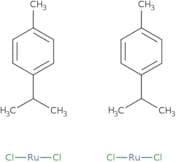
Dichloro(p-cymene)ruthenium(II) Dimer
CAS:Fórmula:C20H28Cl4Ru2Pureza:>95.0%(T)Forma y color:Light yellow to Brown powder to crystalPeso molecular:612.38Dichloro(p-cymene)ruthenium(II) dimer, 98%
CAS:Dichloro(p-cymene)ruthenium(II) dimer is used as hydrosilylation catalyst and also used as a pharmaceutical intermediate. This Thermo Scientific Chemicals brand product was originally part of the Alfa Aesar product portfolio. Some documentation and label information may refer to the legacy brand. ThFórmula:C20H28Cl4Ru2Pureza:98%Forma y color:powder, Orange-red to red-brownPeso molecular:612.38Di-μ-chlorobis[(p-cymene)chlororuthenium(II)], min. 98%
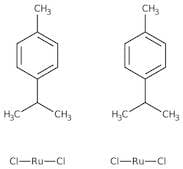
CAS:Di-μ-chlorobis[(p-cymene)chlororuthenium(II)], min. 98%
Fórmula:RuCl2(C10H14)Pureza:min. 98%Forma y color:brown pwdr.Peso molecular:612.39Dichloro(p-cymene)ruthenium(II) dimer
CAS:Fórmula:C20H28Cl4Ru2Pureza:97%Forma y color:SolidPeso molecular:612.3883Dichloro(p-cymene)ruthenium(II) Dimer
CAS:Dichloro(p-cymene)ruthenium(II) Dimer is an organometallic ruthenium complex, a widely used catalyst in various organic reactions
Fórmula:C20H28Cl4Ru2Forma y color:SolidPeso molecular:612.39Dichloro(p-cymene)ruthenium(II) dimer
CAS:Dichloro(p-cymene)ruthenium(II) dimerFórmula:·2Cl2Ru·2C10H14Pureza:98%Forma y color: red solidPeso molecular:612.38832g/molDichloro(p-cymene)ruthenium(II) dimer
CAS:Dichloro(p-cymene)ruthenium(II) dimerFórmula:·Cl2Ru·C10H14Pureza:98%Forma y color: red to reddish brown solidPeso molecular:306.19g/molDichloro(p-cymene)ruthenium(II)dimer
CAS:Fórmula:C20H28Cl4Ru2Pureza:97%Forma y color:Crystalline Powder,PowderPeso molecular:612.38Dichloro(p-cymene)ruthenium(II) Dimer
CAS:Producto controladoApplications The dichloro(p-cymene)ruthenium(II) dimer is a reagent used in organometallic chemistry, and usually adopts the “three-leg-piano-stool” geometry. The dichloro(p-cymene)ruthenium(II) dimer, when functionalized with di- or tripyridyl aromatic ether ligands, creates di- and three trinuclear organometallic complexes that act as antiparasitic agents.
References Chellan. P., et al.: Organometallics, 32, 4793 (2013); Grguric-Sipka, S., et al.: Eur. J. Med. Chem., 45, 1051 (2010)Fórmula:C20H28Cl4Ru2Forma y color:NeatPeso molecular:612.39Dichloro(p-cymene)ruthenium(II) dimer
CAS:Dichloro(p-cymene)ruthenium(II) dimer is an organometallic compound that is used as a catalyst in organic synthesis. It is a square planar molecule with a hydroxyl group at the center. The carbon atoms are bound to two dichloro pyridine ligands and two ruthenium atoms. Dichloro(p-cymene)ruthenium(II) dimer has been shown to be effective for the treatment of trichomonas vaginalis, cancer, and other diseases. This drug also has an amide ligand and a chelate ring that make it chemically stable in acidic environments. Dichloro(p-cymene)ruthenium(II) dimer is activated by amines in the presence of oxygen or hydrogen peroxide, which leads to its decomposition into dichloro pyridine and ruthenium dioxide.Fórmula:C20H28Cl4Ru2Pureza:Min. 95%Forma y color:Red PowderPeso molecular:612.39 g/mol



![Di-μ-chlorobis[(p-cymene)chlororuthenium(II)], min. 98%](/_next/image/?url=https%3A%2Fstatic.cymitquimica.com%2Fproducts%2F08%2Fthumb%2F44-0190.jpg&w=3840&q=75)