CAS 5254-86-4
:1-Naftalenometanotiol
Descripción:
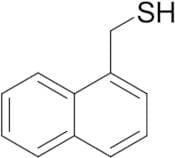
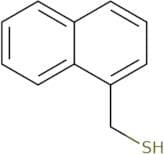
1-Naftalenometanotiol, con el número CAS 5254-86-4, es un compuesto orgánico caracterizado por la presencia de un anillo de naftaleno unido a un grupo tiol (-SH) a través de un puente metileno (-CH2-). Este compuesto exhibe propiedades típicas de los tioles, incluyendo un olor fuerte, a menudo desagradable, y es conocido por su reactividad debido al átomo de azufre, que puede participar en varias reacciones químicas como la oxidación y la sustitución nucleofílica. La presencia de la porción de naftaleno contribuye a sus características aromáticas, influyendo en su solubilidad y estabilidad. 1-Naftalenometanotiol es típicamente un líquido incoloro a amarillo pálido a temperatura ambiente y es soluble en disolventes orgánicos. Se utiliza en síntesis orgánica y puede servir como un bloque de construcción en el desarrollo de productos farmacéuticos, agroquímicos y ciencia de materiales. Además, debido a su grupo tiol, puede formar enlaces disulfuro, que son significativos en sistemas biológicos y química de materiales. Se deben tomar precauciones de seguridad al manipular este compuesto, ya que los tioles pueden ser tóxicos e irritantes.
Fórmula:C11H10S
Sinónimos:- 1-(Mercaptomethyl)naphthalene
- 1-Naphthylmethanethiol
- Nsc 33934
- a-(Mercaptomethyl)naphthalene
- a-Naphthylmethyl mercaptan
Ordenar por
Pureza (%)
0
100
|
0
|
50
|
90
|
95
|
100
Encontrado 2 productos.
Naphthalen-1-ylmethanethiol
CAS:Producto controladoFórmula:C11H10SForma y color:NeatPeso molecular:174.262(Naphthalen-1-yl)methanethiol
CAS:Naphthalen-1-ylmethanethiol is a molecular compound with the molecular formula CHS. It consists of one naphthalene ring and one methanethiol group. Naphthalen-1-ylmethanethiol has been found to have a high photoelectron emission intensity in the region of 2.5 eV, which is characteristic for sulfur-containing molecules. This molecule has three different types of orbitals: sigma, pi, and omega, each with different energies and intensities. The pi orbital is composed of four orbitals that are perpendicular to each other; the sigma orbital is composed of two orbitals that are perpendicular to each other; and the omega orbital is composed of two orbitals that point towards each other. The pi orbital has the highest energy and intensity as well as the lowest binding energy.Fórmula:C11H10SPureza:Min. 95%Peso molecular:174.26 g/mol