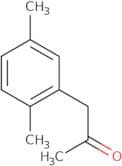
CAS 53291-89-7
:2,5-Dimetilfenilacetona
Descripción:
2,5-Dimetilfenilacetona, con el número CAS 53291-89-7, es un compuesto orgánico que pertenece a la clase de las cetonas. Presenta un grupo fenilo sustituido con dos grupos metilo en las posiciones 2 y 5, junto con un grupo funcional de acetona. Este compuesto es típicamente un líquido incoloro a amarillo pálido con un olor característico. Es conocido por su uso en la síntesis orgánica y como un posible intermedio en la producción de varios productos farmacéuticos y fragancias. La presencia del grupo funcional de cetona contribuye a su reactividad, permitiéndole participar en varias reacciones químicas, como adiciones nucleofílicas. Además, 2,5-Dimetilfenilacetona es relativamente estable en condiciones estándar, pero debe ser manejado con cuidado debido a los posibles riesgos para la salud asociados con las cetonas. Su solubilidad en disolventes orgánicos lo hace útil en varias aplicaciones, aunque es menos soluble en agua. Se deben seguir los protocolos adecuados de almacenamiento y manejo para garantizar la seguridad y mantener su integridad.
Fórmula:C11H14O
InChI:InChI=1/C11H14O/c1-8-4-5-9(2)11(6-8)7-10(3)12/h4-6H,7H2,1-3H3
SMILES:Cc1ccc(C)c(c1)CC(=O)C
Sinónimos:- 1-(2,5-Dimethylphenyl)Propan-2-One
Ordenar por
Pureza (%)
0
100
|
0
|
50
|
90
|
95
|
100
Encontrado 3 productos.
(2,5-Dimethylphenyl)acetone
CAS:2,5-Dimethylphenyl)acetone is an analogue of amphetamine that has been shown to have similar binding and uptake properties in the brain. This drug was synthesized for use in positron emission tomography (PET) studies on the distribution of amphetamine analogues in the human brain. It is also used as a radioligand for studies on cerebral uptake of amphetamines. 2,5-Dimethylphenyl)acetone itself has no significant central nervous system activity. However, it can be used to determine whether other drugs are able to cross the blood-brain barrier and enter the brain. Radiofluorination with iodine-123, which emits positrons during decay, yields a compound that binds to amines such as dopamine and norepinephrine receptors in the brain. The presence of these amines can then be detected using PET imaging techniques.END>Fórmula:C11H14OPureza:Min. 96 Area-%Forma y color:Clear LiquidPeso molecular:162.23 g/mol