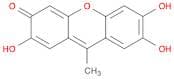
CAS 5407-46-5
:2,6,7-Trihidroxi-9-metil-3H-xanten-3-ona
Descripción:
2,6,7-Trihidroxi-9-metil-3H-xanten-3-ona, comúnmente conocido como un xantona, es un compuesto químico caracterizado por su estructura polifenólica, que incluye múltiples grupos hidroxilo. Este compuesto típicamente exhibe un color amarillo a naranja, que es característico de muchas xantonas. Es soluble en disolventes orgánicos y tiene una solubilidad limitada en agua, reflejando su naturaleza hidrofóbica debido a los anillos aromáticos presentes en su estructura. La presencia de grupos hidroxilo contribuye a sus potenciales propiedades antioxidantes, lo que lo hace de interés en diversas aplicaciones biológicas y farmacéuticas. Además, se sabe que las xantonas tienen diversas actividades biológicas, incluyendo efectos antiinflamatorios, antimicrobianos y anticancerígenos. La estructura molecular del compuesto permite diversas interacciones con sistemas biológicos, que pueden ser exploradas para usos terapéuticos. En general, 2,6,7-Trihidroxi-9-metil-3H-xanten-3-ona representa una clase significativa de compuestos con aplicaciones potenciales en salud y medicina.
Fórmula:C14H10O5
InChI:InChI=1S/C14H10O5/c1-6-7-2-9(15)11(17)4-13(7)19-14-5-12(18)10(16)3-8(6)14/h2-5,15-17H,1H3
Clave InChI:InChIKey=TZVNNUHRZXQCHM-UHFFFAOYSA-N
SMILES:CC1=C2C(OC=3C1=CC(O)=C(O)C3)=CC(=O)C(O)=C2
Sinónimos:- 2,6,7-Trihydroxy-9-Methylxanthen-3-One
- 2,6,7-trihydroxy-9-methyl-3H-xanthen-3-one
- 3H-Xanthen-3-one, 2,6,7-trihydroxy-9-methyl-
- 9-Methyl-2,3,7-trihydroxy-6-fluorone sulphate
- Methylfluorone
- NSC 5426
- NSC 66209
Ordenar por
Pureza (%)
0
100
|
0
|
50
|
90
|
95
|
100
Encontrado 2 productos.
9-Methyl-2,3,7-trihydroxy-6-fluorone
CAS:<p>9-Methyl-2,3,7-trihydroxy-6-fluorone (9MHF) is a natural compound found in honeybee propolis. It has been shown to have anticancer activity against a range of tumour types. 9MHF inhibits the replication of DNA by binding to single-stranded regions in the DNA molecule and preventing the formation of double helices. The optimum concentration for 9MHF is 0.1 μM. At this concentration, it was found that 9MHF had chemoresistance properties and could inhibit replication in staphylococcus cells at concentrations as low as 1 μM. This compound also has antioxidant properties, with redox potentials of -0.09 V and -0.06 V for its oxidized and reduced forms respectively.BR>BR><br>9MHF is an inhibitor that binds to basic dyes such as methylene blue or gentian violet and prevents them from binding to the bacterial cell</p>Fórmula:C14H10O5Pureza:Min. 95%Forma y color:Yellow PowderPeso molecular:258.23 g/mol