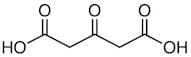
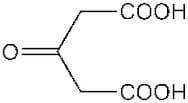
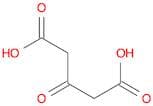
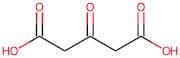
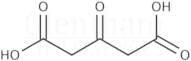
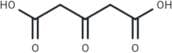
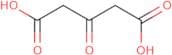
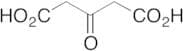
CAS 542-05-2
:Ácido 3-oxopentanodioico
- 1,3-Acetone diacrboxylic acid
- 1,3-Dicarboxyacetone
- 3-Ketoglutaric acid
- 3-Oxoglutaric acid
- 3-Oxopentanedioate
- 3-Oxopentanedioic acid
- Acetone-1,3-dicarboxylic acid
- Glutaric acid, 3-oxo-
- Glutaric acid, β-oxo-
- Pentanedioic acid, 3-oxo-
- s-Acetonedicarboxylic acid
- β-Ketoglutaric acid
- β-Oxoglutaric acid
- 3-Oxopentane-1,5-dioic acid
- ACETONEDIACETIC ACID
- 1,3-Acetonedicarboxylic
- ACETONEDICARBOXYLIC ACID
- β-Ketoglutaric scid
- 1,3-ACETONEDICARBOXYLIC ACID, 3-KETOGLUTARIC ACID
- 1,3-ACETONEDICARBOXYLIC ACID OR 3-KETOGLUTARIC ACID OR 3-OXO-PENTANEDIOIC ACID
- 1,3-Acetonediacrboxylicacid
- BETA-OXOGLUTARIC ACID
- 1,3-ACETONEDICARBOXYLIC ACID
- BETA-KETOGLUTARIC ACID
- 2-OXO-1,3-PROPANE DICARBOXYLIC ACID
- 3-oxo-pentanedioicaci
- 1,3-ACETONEDICARBOXYLIC ACID, TECH.
- Ver más sinónimos
1,3-Acetonedicarboxylic Acid
CAS:Fórmula:C5H6O5Pureza:>95.0%(T)Forma y color:White to Light yellow to Light orange powder to crystalPeso molecular:146.10Acetone-1,3-dicarboxylic acid, 97%
CAS:Acetone-1,3-dicarboxylic acid is used as a building block in organic chemistry. It is also used in the synthesis of hetrocyclic rings and in the Weiss-Cook reaction, which involves the preparation of cis-bicyclo[3.3.0]octane-3,7-dione by reacting with diacyl (1,2 ketone). Its presence in human urineFórmula:C5H4O5Pureza:97%Forma y color:White to pale cream, Crystals or powder or crystalline powderPeso molecular:144.08Ref: IN-DA0032L7
5gA consultar25kgA consultar50kgA consultar100kgA consultar25g25,00€50g28,00€100g34,00€500g96,00€Acetone-1,3-dicarboxylic acid
CAS:Acetone-1,3-dicarboxylic acidPureza:96%Peso molecular:146.09814g/mol1,3-Acetonedicarboxylic acid
CAS:Fórmula:C5H6O5Pureza:≥ 98.0%Forma y color:White to light yellow crystalline solidPeso molecular:146.103-Oxopentanedioic acid
CAS:3-Oxopentanedioic acid, a simple carboxylic acid, is useful in organic synthesis and a microbial metabolite.Fórmula:C5H6O5Forma y color:Colourless Solid PowderPeso molecular:146.11,3-Acetonedicarboxylic acid
CAS:1,3-Acetonedicarboxylic acid is a crystalline solid that belongs to the group of carboxylic acids. 1,3-Acetonedicarboxylic acid interacts with its receptor by binding to a hydroxyl group and two hydrogen atoms. It has been shown that 1,3-acetonedicarboxylic acid can inhibit HIV infection in vitro by preventing the virus from attaching to cells. It also inhibits malonic acid oxidation and citric acid cycle enzymes in rat liver mitochondria. The synthesis of 1,3-acetonedicarboxylic acid can be achieved through different methods:
1) By reacting sodium carbonate with malonic acid
2) By reacting hydrogen fluoride with malonic acid
3) By reacting sodium carbonate with citric acid (malonic ester) and then hydrolyzing it
4) By reacting sodium carbonate with malonitrile and then hydroFórmula:C5H6O5Pureza:Min. 95%Forma y color:PowderPeso molecular:146.1 g/molβ-Ketoglutaric Acid
CAS:Stability Unstable in Solution
Applications β-Ketoglutaric Acid is used in the synthesis of benzodiazepine derivatives. Also used in the synthesis of orally available hepatitis C virus polymerase inhibitors.
References Jung, D. et al.: Synth. Comm., 29, 1941 (1999); Li, H. et al.: J. Med. Chem., 52, 1255 (2009);Fórmula:C5H6O5Forma y color:Off White PowderPeso molecular:146.098