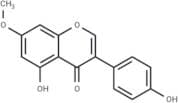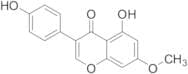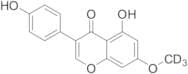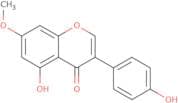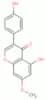
CAS 552-59-0
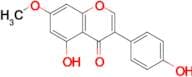
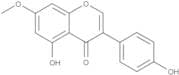
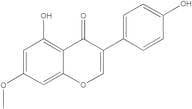
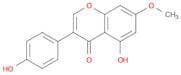
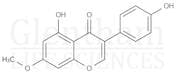
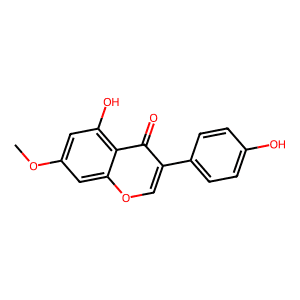
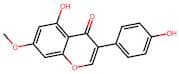
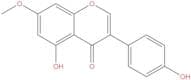
:5-hidroxi-3-(4-hidroxifenil)-7-metoxi-4-benzopirona
Descripción:
5-hidroxi-3-(4-hidroxifenil)-7-metoxi-4-benzopirona, también conocido como umbeliferona o por su número CAS 552-59-0, es un derivado de cumarina que se encuentra de forma natural. Este compuesto se caracteriza por su estructura de benzopirona, que consiste en un anillo de benceno y un anillo de pirona fusionados. Presenta una variedad de actividades biológicas, incluyendo propiedades antioxidantes, antiinflamatorias y antimicrobianas, lo que lo hace de interés en la investigación farmacológica. La presencia de grupos hidroxilo mejora su reactividad y solubilidad en disolventes polares, mientras que el grupo metoxi contribuye a su estabilidad y lipofilia. La umbeliferona se estudia a menudo por sus posibles aplicaciones terapéuticas, particularmente en los campos de la investigación del cáncer y la protección de la piel debido a su capacidad para absorber luz ultravioleta. Además, se encuentra en varias plantas, contribuyendo a sus propiedades medicinales. Su comportamiento químico puede verse influenciado por factores ambientales, y a menudo se utiliza como un marcador fluorescente en ensayos bioquímicos. En general, este compuesto representa un área significativa de interés tanto en la química de productos naturales como en la química medicinal.
Fórmula:C16H12O5
InChI:InChI=1/C16H12O5/c1-20-11-6-13(18)15-14(7-11)21-8-12(16(15)19)9-2-4-10(17)5-3-9/h2-8,17-18H,1H3
Clave InChI:InChIKey=KQMVAGISDHMXJJ-UHFFFAOYSA-N
SMILES:O=C1C=2C(=CC(OC)=CC2O)OC=C1C3=CC=C(O)C=C3
Sinónimos:- 4H-1-benzopyran-4-one, 5-hydroxy-3-(4-hydroxyphenyl)-7-methoxy-
- 5,4′-Dihydroxy-7-methoxyisoflavone
- 5-Hydroxy-3-(4-hydroxyphenyl)-7-methoxy-4H-1-benzopyran-4-one
- 5-Hydroxy-3-(4-hydroxyphenyl)-7-methoxy-4H-chromen-4-on
- 5-Hydroxy-3-(4-hydroxyphenyl)-7-methoxy-4H-chromen-4-one
- 7-O-Methylgenistein
- Isoflavone, 4′,5-dihydroxy-7-methoxy-
- Prunetin
- Prunusetin
- 5-Hydroxy-3-(4-hydroxyphenyl)-7-methoxychromen-4-one
- 4',5-DIHYDROXY-7-METHOXYISOFLAVONE
- 4’,5-dihydroxy-7-methoxy-isoflavon
- 5-hydroxy-3-(4-hydroxyphenyl)-7-methoxy-4-benzopyrone
- 3-(p-Hydroxyphenyl)-5-hydroxy-7-methoxychromone
- PRUNETIN(RG)
- Ver más sinónimos
Ordenar por
Pureza (%)
0
100
|
0
|
50
|
90
|
95
|
100
Encontrado 14 productos.
5-Hydroxy-3-(4-hydroxyphenyl)-7-methoxy-4H-chromen-4-one
CAS:Pureza:95.0%Peso molecular:284.2669982910156Prunetin
CAS:Prunetin analytical standard provided with w/w absolute assay, to be used for quantitative titration.Fórmula:C16H12O5Pureza:(HPLC) ≥98%Forma y color:PowderPeso molecular:284.27Prunetin; 7-O-Methylgenistein
CAS:Fórmula:C16H12O5Pureza:88.62%Forma y color:Brownish. SolidPeso molecular:284.04H-1-Benzopyran-4-one, 5-hydroxy-3-(4-hydroxyphenyl)-7-methoxy-
CAS:Fórmula:C16H12O5Pureza:95%Forma y color:SolidPeso molecular:284.2635Prunetin
CAS:Fórmula:C16H12O5Pureza:>90.0%(HPLC)Forma y color:White to Light yellow powder to crystalPeso molecular:284.27Prunetin
CAS:Prunetin reduces inflammation, mortality, obesity markers, and mucin secretion, while blocking NF-κB, ERK activation, and improving cellular barriers.Fórmula:C16H12O5Pureza:98.43% - ≥95%Forma y color:Creamy White Crystalline PowderPeso molecular:284.26Prunetin
CAS:Prunetin analytical standard provided with chromatographic purity, to be used as reference material for qualitative determination.
Fórmula:C16H12O5Pureza:(HPLC) ≥95%Forma y color:PowderPeso molecular:284.28Prunetin
CAS:Prunetin is a naturally occurring isoflavone, which is an organic compound derived from plant sources. It is primarily found in legumes and other plant materials where it naturally occurs as part of the plant's phytochemical arsenal. The mode of action of prunetin involves modulating various biochemical pathways, including acting as an antioxidant, influencing estrogenic activity, and affecting cellular signaling pathways. Its biochemical properties allow it to interact with multiple cellular targets, leading to its diverse biological activities.
Fórmula:C16H12O5Pureza:Min. 95%Forma y color:Slightly Brown PowderPeso molecular:284.26 g/mol