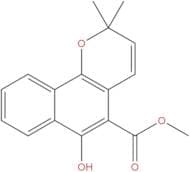
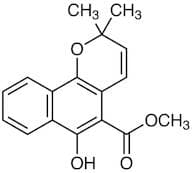
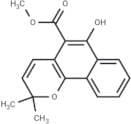
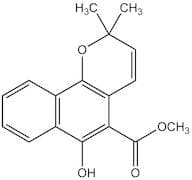
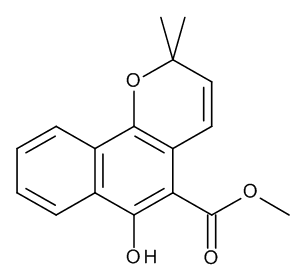
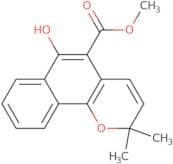
CAS 55481-88-4
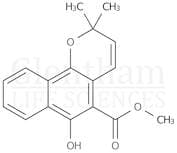
:Mollugin
- 2H-naphtho[1,2-b]pyran-5-carboxylic acid, 6-hydroxy-2,2-dimethyl-, methyl ester
- Methyl 6-hydroxy-2,2-dimethyl-2H-benzo[h]chromene-5-carboxylate
- Rubimaillin
- Smb 00431
- Mollugin
- 2H-Naphtho[1,2-b]pyran-5-carboxylic acid
- Mollugin/rubiMaillin
- 6-Hydroxy-2,2-dimethyl-2H-naphtho[1,2-b]pyran-5-carboxylic acid methyl ester
- Mollugin, 98%, from Rubia cordifolia L.
- 6-hydroxy-2, 2-dimethyl-, methylester
- RUBIMAILLIN; MOLLUGIN
- 2-DiMethyl-6-hydroxy-2H-naphtho[1,2-b]pyran-5-carboxylic acid Methyl ester
- 6-Hydroxy-2,2-dimethyl-2H-benzo[h]chromene-5-carboxylic Acid Methyl Ester
- 2,2-Dimethyl-6-hydroxy-2H-naphtho[1,2-b]pyran-5-carboxylic acid methyl ester
- MOLLUGIN(SH)
- Ver más sinónimos
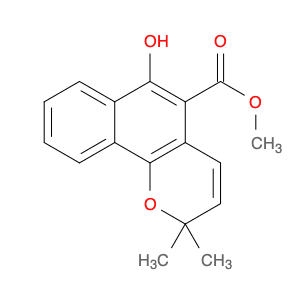
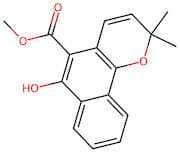
Methyl 6-Hydroxy-2,2-Dimethyl-2H-Benzo[H]Chromene-5-Carboxylate
CAS:Methyl 6-Hydroxy-2,2-Dimethyl-2H-Benzo[H]Chromene-5-CarboxylatePureza:99%Peso molecular:284.31g/molMollugin
CAS:Mollugin is a JAK2 inhibitor and inhibits LPS-induced inflammatory responses by blocking the activation of the JAK-STAT pathway. Mollugin may be a novel therapeutic candidate for bone loss-associated disorders including osteoporosis, rheumatoid arthritis, and periodontitis. Mollugin has anticancer efficacy, can modulate the HER2, HO-1, Nrf2 , and NF- κB pathways.Fórmula:C17H16O4Pureza:95%~99%Peso molecular:284.311Mollugin
CAS:Fórmula:C17H16O4Pureza:>98.0%(HPLC)Forma y color:White to Yellow to Orange powder to crystalPeso molecular:284.31Mollugin
CAS:Mollugin could be a JAK2 inhibitor, anti-inflammatory, chemotherapeutic agent in OSCCs, bone disorder therapy, and modulates HER2 in cancer.Fórmula:C17H16O4Pureza:99.87% - ≥95%Forma y color:SolidPeso molecular:284.31Mollugin
CAS:Producto controladoApplications Mollugin is an anti-tumor agent inducing apoptosis and autophagy in various cancer models.
References Zhang, L. et al.: Biochem. Biophys. Res. Comm., 450, 247 (2014); Idhayadhulla, A. et al.: Bioorg. Chem., 52, 77 (2014);Fórmula:C17H16O4Forma y color:NeatPeso molecular:284.31Mollugin
CAS:Mollugin is a bioactive compound, which is derived from the plant Rubia cordifolia. As a phytochemical, it is part of the anthraquinone family, isolated through extraction processes from the root of its source plant. Its mode of action involves modulating various biochemical pathways, notably exhibiting anti-inflammatory, anticancer, and antioxidant activities. These effects are primarily mediated through the inhibition of specific enzymes and signaling pathways, including the NF-κB and MAPK pathways, which are central to inflammatory and cancer processes.
Pureza:Min. 95%



![Methyl 6-Hydroxy-2,2-Dimethyl-2H-Benzo[H]Chromene-5-Carboxylate](/_next/image/?url=https%3A%2Fstatic.cymitquimica.com%2Fproducts%2F54%2Fthumb%2FOR1013849.jpg&w=3840&q=75)