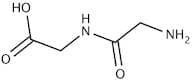
CAS 556-50-3
:Glicilglicina
Descripción:
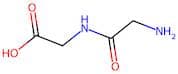
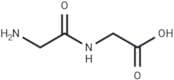
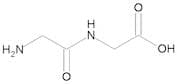
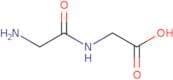
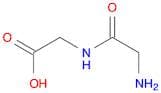
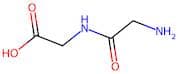
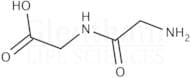
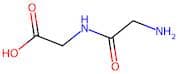
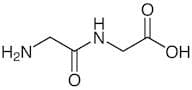
Glicilglicina, también conocido como diglicina, es un dipéptido compuesto por dos aminoácidos de glicina unidos por un enlace peptídico. Su fórmula química es C4H8N2O3 y tiene un peso molecular de aproximadamente 132.12 g/mol. Glicilglicina es un sólido cristalino blanco que es soluble en agua, lo que lo hace útil en diversas aplicaciones bioquímicas. Exhibe propiedades típicas de los aminoácidos, como la capacidad de formar zwitteriones, lo que significa que puede llevar tanto una carga positiva como una carga negativa dependiendo del pH de la solución. Glicilglicina se utiliza a menudo en la síntesis de péptidos, como agente tamponador en ensayos bioquímicos y en estudios relacionados con la estructura y función de las proteínas. Además, tiene aplicaciones potenciales en farmacéuticos y nutrición, particularmente en formulaciones destinadas a mejorar la absorción de aminoácidos. Su estructura relativamente simple permite una fácil incorporación en péptidos y proteínas más grandes, lo que lo convierte en un compuesto valioso tanto en contextos de investigación como industriales.
Fórmula:C4H8N2O3
InChI:InChI=1/C4H8N2O3/c5-1-3(7)6-2-4(8)9/h1-2,5H2,(H,6,7)(H,8,9)
Clave InChI:InChIKey=YMAWOPBAYDPSLA-UHFFFAOYSA-N
SMILES:C(NCC(O)=O)(CN)=O
Sinónimos:- 13: PN: WO2017167712 SEQID: 23 claimed protein
- 16: PN: WO2021041934 SEQID: 69 claimed protein
- 2-(2-Aminoacetamido)acetic acid
- 2-(Aminoacetamido)acetic acid
- 2-[(2-Aminoacetyl)amino]acetic acid
- 29: PN: US20200095309 SEQID: 56 claimed protein
- 31: PN: FR2860236 PAGE: 10 claimed protein
- 38: PN: WO2020048525 SEQID: 46 claimed protein
- 4: PN: WO2018201047 SEQID: 102 claimed protein
- 89: PN: WO2019035010 SEQID: 89 claimed protein
- Diglycine
- Diglycocoll
- G 0124
- Gly-Gly
- Gly-Gly Free Base
- Gly2
- Gly<sub>2</sub>
- Glycine dipeptide
- Glycine, Glycyl
- Glycine, N-glycyl-
- Glycine-glycine
- Glycyl-glycine,(Diglycine)
- Glycylglycine, Free Base
- H-Gly-Gly-OH
- N-Glycyl-Glycine
- N-Glycylglycin
- N-Glycylglycine
- N-glicilglicina
- Nsc 49346
- α-Glycylglycine
- Glycylglycine
- Glycyl-glycin
- GLY-GLY-OH
- (2-Amino-acetylamino)-aceticacid
- Glycinedipeptide
- 2-(Aminoacetamido)aceticacid
- Glycylglycin
- n-glycyl-glycin
- Ver más sinónimos
Ordenar por
Pureza (%)
0
100
|
0
|
50
|
90
|
95
|
100
Glycylglycine, ≥98.5%
CAS:Thermo Scientific GlycylglycineFórmula:C4H9ClN2O3Pureza:98.5%Forma y color:White crystalline powderPeso molecular:168.58Glycylglycine, 99%
CAS:Glycylglycine is as a buffering reagent and also used in biochemical research. It is the simplest of all dipeptides and is used as a starting template for preparation of more complex peptides. It is also employed as a practical buffer with a buffering range of 7.5 - 8.9 (at 25C). Valuable agent foFórmula:C4H9ClN2O3Pureza:99%Forma y color:White, Crystals or powder or crystalline powderPeso molecular:168.58H-Gly-Gly-OH
CAS:Standard acceptor in γ-glutamyltransferase assays, e.g. with H-Glu(pNA)-OH (GPNA) or H-Glu(AMC)-OH.Fórmula:C4H8N2O3Pureza:99.82%Forma y color:WhitePeso molecular:132.12Diglycine (glycylglycine)
CAS:Acyclic amides (including acyclic carbamates) and their derivatives and salts thereof, nesoiFórmula:C4H8N2O3Forma y color:White PowderPeso molecular:132.053492-(Aminoacetamido)acetic acid
CAS:Fórmula:C4H8N2O3Pureza:97%Forma y color:SolidPeso molecular:132.1179Ref: IN-DA0038NG
5g20,00€10g20,00€25g25,00€5kgA consultar100g40,00€10kgA consultar25kgA consultar500g115,00€Gly-Gly
CAS:Fórmula:C4H8N2O3Pureza:98.5 - 101.5 %Forma y color:White crystalline powderPeso molecular:132.12Glycylglycine
CAS:Fórmula:C4H8N2O3Pureza:>99.0%(T)Forma y color:White powder to crystalPeso molecular:132.12Glycylglycine
CAS:Glycylglycine (Diglycine) is a dipeptide used in biochemical research. It is the simplest and is used as a starting template for more complex peptides.Fórmula:C4H8N2O3Pureza:≥95%Forma y color:SolidPeso molecular:132.12N-Glycylglycine
CAS:Producto controladoApplications N-Glycylglycine is a derivative of Glycine (G615990), a non-essential amino acid that enhances N-methyl-D-aspartate (NMDA) receptor mediated synaptic potentials in the neocortex of rats. Glycine is also being used as adjuvant therapy for the treatment of schizophrenia.
References Logan, W. & Snyder, S.: Brain Res., 42, 413 (1972); Rosse, R., et al.: Clin. Neuropharmacol., 12, 416 (1989)Fórmula:C4H8N2O3Forma y color:NeatPeso molecular:132.12Glycyl-glycine
CAS:Glycyl-glycine is a versatile building block that can be used as a reaction component in the production of a wide range of compounds. It is also an intermediate in the manufacture of pharmaceuticals, speciality chemicals and research chemicals. Glycyl-glycine is a high quality reagent and can be used as a raw material for the synthesis of other compounds.Fórmula:C4H8N2O3Peso molecular:132.12 g/molRef: 3D-G-6001
1kgA consultar5kgA consultar10kgA consultar25kgA consultar2500gA consultar-Unit-kgkgA consultarGlycyl Glycine extrapure, 99%
CAS:Fórmula:C4H8N2O3Pureza:min. 99%Forma y color:White, Crystalline powderPeso molecular:132.12Gly-Gly
CAS:Gly-Gly is a natural compound that belongs to the group of esters. It has been shown to have an antioxidative effect in vitro and in vivo. Gly-Gly has been shown to inhibit the growth of carcinoma cells by binding with hydrogen bonding interactions, which leads to cell death. This compound also has a strong antibacterial efficacy against Gram-positive bacteria, such as methicillin-resistant Staphylococcus aureus (MRSA). In addition, gly-gly has been shown to be effective against Mycobacterium tuberculosis and Mycobacterium avium complex. This compound may be useful for treating infectious diseases caused by Gram-positive bacteria such as MRSA or methicillin resistant Staphylococcus aureus (MRSA).Fórmula:C4H8N2O3Pureza:Min. 95%Peso molecular:132.12 g/mol







![2-[(2-Aminoacetyl)amino]acetic Acid (Diglycine; N-Glycylglycine)](/_next/image/?url=https%3A%2Fstatic.cymitquimica.com%2Fproducts%2F86%2Fthumb%2FMM1509.02-0100.jpg&w=3840&q=75)