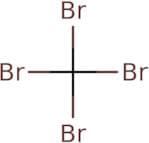
CAS 558-13-4
:Tetrabromuro de carbono
- Brn 1732799
- Bromid uhlicity
- Bromid uhlicity [Czech]
- Carbon bromide (CBr4)
- Carbon bromide (CBr<sub>4</sub>)
- Carbon tetrabromide [UN2516] [Poison]
- Hsdb 2032
- Kohlenstofftetrabromid
- Methane, tetrabromide
- Methane, tetrabromo-
- Nsc 6179
- Tetrabromomethane
- Tetrabromure de carbone
- Tetrabromuro De Carbono
- Un2516
- Ver más sinónimos
Carbon Tetrabromide
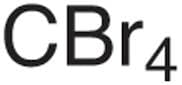
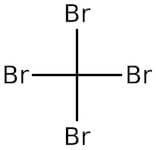
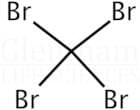
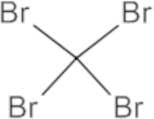
CAS:Fórmula:CBr4Pureza:>99.0%(GC)Forma y color:White powder to crystalPeso molecular:331.63Carbon tetrabromide, 98% (dry wt.), may cont. up to ca 6% water
CAS:Carbon tetrabromide is widely utilized as a solvent for greases, waxes and oils. In Appel reaction, it is used to convert alcohols to alkyl bromides. It has the property of non-flammability and finds application in fire-resistant chemicals as an active ingredient. It is also used for separating mine
Fórmula:CBr4Pureza:98%Forma y color:White to cream, Crystalline powder or lumpsPeso molecular:331.63Carbon tetrabromide
CAS:Fórmula:CBr4Pureza:≥ 99.0%Forma y color:White crystals or solidPeso molecular:331.63alpha-2,4-Trichloroacetophenone
CAS:Producto controladoApplications Carbon tetrabromide is commonly employed as an electron acceptor in organic synthesis reactions. Carbon tetrabromide is also an efficient catalyst for regioselective ring opening of epoxides with alcohols.
Not a dangerous good if item is equal to or less than 1g/ml and there is less than 100g/ml in the package
References Rosokha, S., et al.: Heteroatom Chem., 17, 449 (2006); Yadav, J., et al.: Synthesis, 2005, 2897 (2005)Fórmula:CBr4Forma y color:NeatPeso molecular:331.63Carbon tetrabromide
CAS:Fórmula:CBr4Pureza:99.0%Forma y color:Solid, Chunks or Crystalline Powder or PowderPeso molecular:331.627Carbon tetrabromide
CAS:Carbon tetrabromide is a chemical substance that is used in the synthesis of organic compounds. It can be used to synthesize carbon-carbon bonds by reacting with alkenes and alkynes. Carbon tetrabromide reacts with water vapor to produce carbon dioxide and bromine, which can then react with other molecules. The reaction mechanism for this process involves hydrogen bonding. Carbon tetrabromide has been shown to inhibit replication of DNA and RNA, as well as the protein synthesis in cells. This inhibition is based on its ability to form covalent bonds with nitrogen atoms in nucleic acids and proteins. The reactive properties of carbon tetrabromide make it an effective inhibitor of many infectious diseases caused by bacteria and viruses, including HIV and herpes simplex virus type 1 (HSV-1). This action may be due to the structural similarity between carbon tetrabromide and fatty acids found in cell membranes.
Fórmula:CBr4Pureza:Min. 95%Forma y color:White PowderPeso molecular:331.63 g/mol