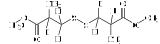
CAS 56-89-3
:(-)-Cistina
Descripción:
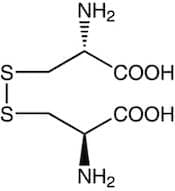
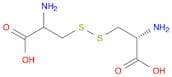
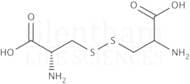
(-)-Cistina, con el número CAS 56-89-3, es un aminoácido que se encuentra de forma natural y juega un papel crucial en la estructura y función de las proteínas. Es una forma dimérica de cisteína, formada por la oxidación de dos moléculas de cisteína, resultando en un enlace disulfuro entre sus grupos tiol. Este compuesto se caracteriza por su apariencia cristalina blanca y es soluble en agua, lo que facilita sus funciones biológicas. (-)-Cistina es esencial para la estabilidad de las estructuras proteicas, particularmente en la formación de estructuras terciarias y cuaternarias debido a su capacidad para formar puentes disulfuro. También está involucrado en varios procesos metabólicos y es importante para la síntesis de glutatión, un antioxidante clave en el cuerpo. En términos de su importancia biológica, (-)-Cistina se encuentra en muchas proteínas y es vital para mantener el equilibrio redox dentro de las células. Su presencia se nota particularmente en la queratina, que es un componente principal del cabello, la piel y las uñas. En general, (-)-Cistina es integral para numerosos procesos fisiológicos y contribuye a la integridad estructural de las proteínas.
Fórmula:C6H12N2O4S2
InChI:InChI=1/C3H6NO2S3/c5-3(6)2(4-7)1-9-8/h2H,1,4H2,(H,5,6)
Clave InChI:InChIKey=LEVWYRKDKASIDU-IMJSIDKUSA-N
SMILES:[C@H](CSSC[C@@H](C(O)=O)N)(C(O)=O)N
Sinónimos:- (-)-3,3-Dithiobis(2-aminopropionic acid)
- (2R,2'S)-3,3'-disulfanediylbis(2-ammoniopropanoate)
- (H-Cys-OH)2
- (H-Cys-OH)2 (Disulfide bond)
- 2-Amino-3-[(2-amino-2-carboxyethyl)dithio]propanoic acid
- 3,3'-Dithiobis(2-aminopropanoic acid)
- <span class="text-smallcaps">L</span>-(-)-Cystine
- <span class="text-smallcaps">L</span>-Alanine, 3,3′-dithiobis-
- <span class="text-smallcaps">L</span>-Cysteine disulfide
- <span class="text-smallcaps">L</span>-Cystin
- Alanine, 3,3'-dithiobis-
- Bis(β-amino-β-carboxyethyl) disulfide
- Cistina
- Cystin
- Cystine
- Cystine acid
- Cystine, <span class="text-smallcaps">L</span>-
- Cystine, L-
- Dicysteine
- H-(Cys)_2-OH
- L(-)-3,3-Dithiobis(2-aminopropanoic acid)
- L-(-)-Cysteine
- L-Alanine, 3,3'-dithiobis-
- L-Cysteine disulfide
- L-Cystin
- L-Cystine, synthetically derived
- L-Cystine,food grade
- Nsc 13203
- Oxidized <span class="text-smallcaps">L</span>-cysteine
- Oxidized L-cysteine
- Propanoic acid, 3,3'-dithiobis[2-amino-, [R-(R*,R*)]-
- [R-(R*,R*)]-3,3'-Dithiobis[2-aminopropanoic acid]
- β,β'-Diamino-β,β'-dicarboxydiethyl disulfide
- β,β'-Dithiodialanine
- L-Cystine
- (R,R)-3,3'-DITHIOBIS(2-AMINOPROPIONIC ACID)
- (R)-(-)-CYSTINE
- L-CYTISINE
- (r-(r*,r*))-3,3’-dithiobis(2-aminopropanoicacid)
- L-CYSTINE BASE
- 3,3’-dithiobis(2-aminopropanoicacid)
- H-L-CYSTINE
- 3,3’-dithiobis-l-alanin
- BETA,BETA'-DITHIOBIS-A-AMINOPROPIONIC ACID
- (R,R)-(-)-CYSTINE
- 3,3’-dithiobis(2-amino-,(r-(r*,r*))-propanoicaci
- 1-cystine
- Ver más sinónimos
Ordenar por
Pureza (%)
0
100
|
0
|
50
|
90
|
95
|
100
L-(-)-Cystine
CAS:Fórmula:C6H12N2O4S2Pureza:>98.0%(HPLC)(N)Forma y color:White powder to crystalinePeso molecular:240.29L-Cystine, 99%
CAS:L-Cystine is used as an antioxidant, protecting tissues against radiation and pollution. It finds application in protein synthesis. It is required for utilization of vitamin B6 and is useful in healing burns and wounds. It is also is required by certain malignant cell lines in the culture medium asFórmula:C6H12N2O4S2Pureza:99%Forma y color:White to pale cream, Crystals or powder or crystalline powderPeso molecular:240.29L-Cystine, Cell Culture Reagent
CAS:L-cysteine acts as a major source of sulfur in cell culture. Cysteine has been used in pulse-chase experiments to study protein expression from an inducible promoter. L-Cysteine is used to supplement cell culture media. This Thermo Scientific Chemicals brand product was originally part of the Alfa AFórmula:C6H12N2O4S2Forma y color:White, Crystals or crystalline powderPeso molecular:240.29Cystine
CAS:Other organo-sulfur acid compoundsFórmula:C6H12N2O4S2Forma y color:White Crystalline PowderPeso molecular:240.02385L-Cystine, non-animal origin
CAS:Fórmula:C6H12N2O4S2Pureza:≤ 0.2%Forma y color:White or almost white crystalline powderPeso molecular:240.30L-Cystine, non-animal origin, Ph. Eur. grade
CAS:Fórmula:C6H12N2O4S2Forma y color:White or almost white crystalline powderPeso molecular:240.30L-Cystine
CAS:L-CystineFórmula:C6H12N2O4S2Pureza:99% (Typical Value in Batch COA)Forma y color: white powderPeso molecular:240.30g/molL-Cystine
CAS:Fórmula:C6H12N2O4S2Pureza:98.5 - 101.0 %Forma y color:White crystalline powderPeso molecular:240.30L-Cystine
CAS:L-Cystine (Cystine Acid) is not considered one of the 20 amino acids, L-Cystine (Cystine Acid) is a sulfur-containing derivative obtained from oxidation ofFórmula:C6H12N2O4S2Pureza:99.59% - 99.85%Forma y color:White Solid PowderPeso molecular:240.3