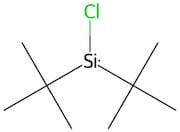
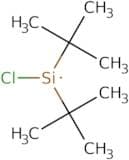
CAS 56310-18-0
:Di-terc-butilclorosilano
- Di-tert-butylchlorosilane
DI-t-BUTYLCHLOROSILANE
CAS:Trialkylsilyl Blocking Agent
Used as a protecting group for reactive hydrogens in alcohols, amines, thiols, and carboxylic acids. Organosilanes are hydrogen-like, can be introduced in high yield, and can be removed under selective conditions. They are stable over a wide range of reaction conditions and can be removed in the presence of other functional groups, including other protecting groups. The tolerance of silylated alcohols to chemical transformations summary is presented in Table 1 of the Silicon-Based Blocking Agents brochure.
Di-tert-butylchlorosilane; Chloro-bis(1,1-dimethylethyl)silyl hydride
Used in selective silylation of internal alcohols or diolsSummary of selective deprotection conditions is provided in Table 7 through Table 20 of the Silicon-Based Blocking Agents brochureFórmula:C8H19ClSiForma y color:LiquidPeso molecular:178.78Di-tert-butylchlorosilane
CAS:Di-tert-butylchlorosilane is a silicon compound that can be used as a reagent in organic synthesis. It is an oxidizing agent that converts guanine to guanosine and termini to transfer reactions. Triflic acid reacts with di-tert-butylchlorosilane to form trifluoromethanesulfonic acid, which is then reacted with a molecule of the desired product in a stepwise fashion to form the ligation product. The radical chain mechanism for this reaction starts with the oxidation of silicon by triflic acid. This reaction creates radicals on silicon atoms, which react with neighboring molecules and create new radicals. These radicals are responsible for the chain reaction that leads to the formation of products such as guanosine.Fórmula:C8H19ClSiPureza:Min. 95%Forma y color:Clear LiquidPeso molecular:178.77 g/mol