CAS 565-63-9
:Ácido angélico
Descripción:
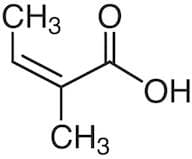
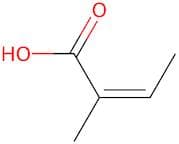
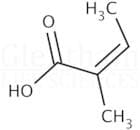
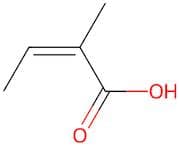
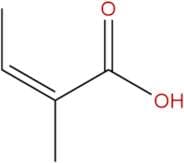
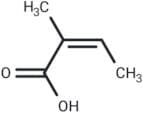
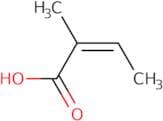
Ácido angélico, con el número CAS 565-63-9, es un ácido graso insaturado de origen natural caracterizado por su estructura única, que incluye un doble enlace en su cadena de carbono. Es un líquido incoloro a amarillo pálido a temperatura ambiente y tiene un olor ligeramente penetrante. La fórmula molecular de Ácido angélico es C5H8O2, y presenta una cadena principal de cinco carbonos con un grupo funcional ácido carboxílico. Este compuesto es conocido por su presencia en varios aceites esenciales y extractos de plantas, contribuyendo a sus perfiles de aroma y sabor. Ácido angélico también se utiliza en la síntesis de varios compuestos químicos y puede servir como un intermedio en la síntesis orgánica. Su reactividad está influenciada por la presencia del doble enlace, lo que permite diversas transformaciones químicas. Además, se ha estudiado Ácido angélico por sus posibles actividades biológicas, aunque se necesita más investigación para comprender completamente sus propiedades farmacológicas. En general, Ácido angélico es un compuesto versátil con aplicaciones tanto en la industria alimentaria como en la de fragancias, así como en la síntesis química.
Fórmula:C5H8O2
InChI:InChI=1S/C5H8O2/c1-3-4(2)5(6)7/h3H,1-2H3,(H,6,7)/b4-3-
Clave InChI:InChIKey=UIERETOOQGIECD-ARJAWSKDSA-N
SMILES:C(\C(O)=O)(=C\C)/C
Sinónimos:- (2Z)-2-Methyl-2-butenoic acid
- (Z)-2-Methylbut-2-enoic acid
- (Z)-2-Methylbutenoic acid
- 2-Butenoic acid, 2-methyl-, (Z)-
- 2-Butenoicacid, 2-methyl-, (Z)-
- Angelic acid
- Crotonic acid, 2-methyl-, (Z)-
- Z-2-Methyl-but-2-enoic acid
- cis-2-Methyl-2-butenoic acid
- cis-a,b-Dimethylacrylic acid
- 2-Butenoic acid, 2-methyl-, (2Z)-
Ordenar por
Pureza (%)
0
100
|
0
|
50
|
90
|
95
|
100
Encontrado 10 productos.
Angelic Acid
CAS:Fórmula:C5H8O2Pureza:>98.0%(GC)(T)Forma y color:White to Light yellow powder to crystalPeso molecular:100.12Angelic Acid
CAS:Angelic Acid, an unsaturated monocarboxylic acid, is used in herbal medicine to treat pain, fever, gout, heartburn, etc.Fórmula:C5H8O2Pureza:99.17% - 99.97%Forma y color:Pale Yellow Crystalline SolidPeso molecular:100.12Angelic Acid
CAS:Applications Angelic Acid, occurs naturally in the roots of many plants, especially of the family Apiaceae. The angelic acid esters, are the active chemical behind the strong pain-relieving and spasmolytic action of extracts from the plant butterbur.
Not a dangerous good if item is equal to or less than 1g/ml and there is less than 100g/ml in the package
References Buchner, L.A., et al.: Justus Liebigs Ann. Chem., 42, 226 (1842); Sonobe, H., et al.: J. Agricul. Food Chem., 29 (6), 1125 (1981); Fritz Weiss, Weiss`s herbal medidince, 91, 46 (2001);Fórmula:C5H8O2Forma y color:NeatPeso molecular:100.12Angelic acid
CAS:Angelic acid is a naturally occurring unsaturated carboxylic acid, which is sourced from several plant species, including members of the Apiaceae family. It is isomeric with tiglic acid and is notable for its distinct double-bond configuration, contributing to its chemical reactivity and biological activity.Fórmula:C5H8O2Pureza:Min. 95%Forma y color:White PowderPeso molecular:100.12 g/mol