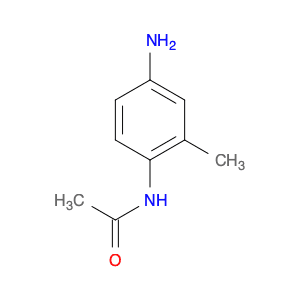
CAS 56891-59-9
:N-(4-amino-2-metilfenil)acetamida
Descripción:
N-(4-amino-2-metilfenil)acetamida, también conocido como 4-amino-2-metilacetanilida, es un compuesto orgánico caracterizado por su grupo funcional amida y un anillo aromático. Presenta un grupo amino (-NH2) y un grupo acetamida (-C(=O)NH2) unidos a un anillo fenílico sustituido. Este compuesto generalmente aparece como un sólido a temperatura ambiente y es soluble en disolventes polares como agua y alcoholes, debido a su capacidad para formar enlaces de hidrógeno. Su estructura molecular contribuye a sus posibles aplicaciones en farmacéuticos, particularmente como un intermedio en la síntesis de varios medicamentos. La presencia del grupo amino aumenta su reactividad, lo que lo convierte en un bloque de construcción útil en la síntesis orgánica. Además, puede exhibir actividad biológica, lo que justifica una mayor investigación en química medicinal. Se deben consultar los datos de seguridad para las pautas de manejo y exposición, como con cualquier sustancia química. En general, N-(4-amino-2-metilfenil)acetamida es un compuesto de interés tanto en entornos industriales como de investigación.
Fórmula:C9H12N2O
InChI:InChI=1/C9H12N2O/c1-6-5-8(10)3-4-9(6)11-7(2)12/h3-5H,10H2,1-2H3,(H,11,12)
SMILES:Cc1cc(ccc1N=C(C)O)N
Sinónimos:- Acetamide, N-(4-amino-2-methylphenyl)-
Ordenar por
Pureza (%)
0
100
|
0
|
50
|
90
|
95
|
100
Encontrado 4 productos.
N1-(4-AMINO-2-METHYLPHENYL)ACETAMIDE
CAS:Fórmula:C9H12N2OPureza:95%Forma y color:SolidPeso molecular:164.20444'-Amino-2'-methylacetanilide
CAS:4'-Amino-2'-methylacetanilideFórmula:C9H12N2OPureza:≥95%Forma y color: faint brown powderPeso molecular:164.20g/molN-(4-Amino-2-methylphenyl)acetamide
CAS:4-Amino-2-methylphenylacetic acid (AMPA) is a chemical compound that has been used in the treatment of skin disorders. AMPA is not active when applied to the skin, but it can be converted to 4-amino-2-methylphenylacetamide (AMPAA), which is an effective treatment for psoriasis. This conversion can be achieved with keratinocyte cells, which are found in the outer layer of skin. The optimal conditions for this conversion include coculturing keratinocytes and thp-1 cells over a period of 48 hours. This process was demonstrated using a human keratinocyte cell line and thp-1 cells. The sensitivity of these cells to AMPA was tested by exposing them to increasing concentrations of AMPA until they were killed. The results showed that AMPA had no effect on keratinocyte cells, but at higher concentrations it had an adverse effect on thp-1 cells. It was alsoFórmula:C9H12N2OPureza:Min. 95%Peso molecular:164.21 g/mol