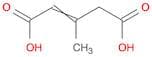
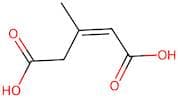
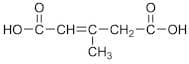
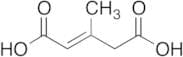
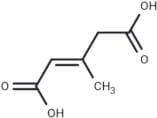
CAS 5746-90-7
:Ácido 3-metilglutacónico
Descripción:
Ácido 3-metilglutacónico, con el número CAS 5746-90-7, es un compuesto orgánico caracterizado por sus grupos funcionales de ácido carboxílico y una estructura de cadena ramificada. Es un derivado del ácido glutacónico, que presenta un grupo metilo en la tercera posición del carbono. Este compuesto es típicamente un sólido incoloro a amarillo pálido y es soluble en agua debido a la presencia de sus grupos de ácido carboxílico. Ácido 3-metilglutacónico es de particular interés en la investigación bioquímica, ya que está asociado con ciertos trastornos metabólicos, incluida la Ácido 3-metilglutacónicouria, que puede resultar de defectos en la función mitocondrial. El compuesto puede participar en varias reacciones químicas, incluida la esterificación y la descarboxilación, lo que lo hace relevante en la química orgánica sintética. Su fórmula molecular refleja su composición de carbono, hidrógeno y oxígeno, y su estructura permite interacciones potenciales con enzimas y otras moléculas biológicas. En general, Ácido 3-metilglutacónico sirve como un compuesto importante tanto en contextos clínicos como sintéticos.
Fórmula:C6H8O4
InChI:InChI=1S/C6H8O4/c1-4(2-5(7)8)3-6(9)10/h2H,3H2,1H3,(H,7,8)(H,9,10)
Clave InChI:InChIKey=WKRBKYFIJPGYQC-UHFFFAOYSA-N
SMILES:C(C(=CC(O)=O)C)C(O)=O
Sinónimos:- (2E)-3-Methyl-2-pentenedioic acid
- 2-Pentenedioic acid, 3-methyl-
- 2-pentenedioic acid, 3-methyl-, (2E)-
- 3-Methyl-2-pentenedioic acid
- 3-Methylglutaconic acid
- Glutaconic acid, 3-methyl-
- NSC 249232
- β-Methylglutaconic acid
- (2E)-3-Methylpent-2-enedioic acid
Ordenar por
Pureza (%)
0
100
|
0
|
50
|
90
|
95
|
100
Encontrado 7 productos.
3-Methylglutaconic Acid
CAS:Fórmula:C6H8O4Pureza:>95.0%(GC)(T)Forma y color:White to Light yellow powder to crystalPeso molecular:144.133-Methylglutaconic Acid
CAS:Producto controladoStability Hygroscopic
Applications 3-Methylglutaconic acid is a glutarate which builds up in the urine in 3-methylglutaconic aciduria. 3-methylglutaconic aciduria is a term used to describe five different disorders that impair the functioning of energy-producing centers within cells (mitochondria)
References Walsh, R., et al.: J. Inherit. Metab. Dis., 22, 251 (1999); Gonzalez, I., et al.: Am J Med Genet A., 134, 409 (2005); MacKenzie, J., et al.: Biochim Biophys Acta., 1772, 509 (2007)Fórmula:C6H8O4Forma y color:NeatPeso molecular:144.133-Methylglutaconic acid
CAS:3-Methylglutaconic acid is a metabolite of creatine, which is an important energy source in the body. It is also involved in cholesterol synthesis and fatty acid production. The metabolic profile of 3-methylglutaconic acid can be used to diagnose metabolic disorders such as methylglutaconic aciduria and fatty acid oxidation defects. This compound can also be found in urine samples, but the concentration may vary depending on the patient's clinical condition. Nuclear DNA analysis has shown that 3-methylglutaconic acid is synthesized from acetyl coenzyme A and Mg2+, with the latter being supplied by ATP.Fórmula:C6H8O4Pureza:Min. 95%Forma y color:PowderPeso molecular:144.13 g/mol3-Methylglutaconic acid
CAS:3-Methylglutaconic acid, a primary metabolite accumulating in 3-Methylglutaconic aciduria (MGTA), induces lipid and protein oxidation, while diminishing non-enzymatic antioxidant defenses in cerebral cortex supernatants, thereby promoting oxidative stress in the cerebral cortex. This compound is utilized in research concerning brain damage diseases [1].Fórmula:C6H8O4Pureza:98%Forma y color:SolidPeso molecular:144.13