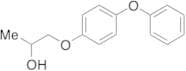
CAS 57650-78-9
:1-(4-fenoxifenoxi)-2-propanol
Descripción:
1-(4-fenoxifenoxi)-2-propanol, con el número CAS 57650-78-9, es un compuesto orgánico caracterizado por su estructura única, que incluye un esqueleto de propanol sustituido con dos grupos fenoxi. Este compuesto típicamente exhibe propiedades asociadas tanto con alcoholes como con compuestos aromáticos, como una solubilidad moderada en disolventes orgánicos y una posible hidrofobicidad debido al grupo hidroxilo (-OH). Puede mostrar actividad biológica, lo que lo hace de interés en la investigación farmacéutica y agroquímica. La presencia de los grupos fenoxi puede influir en su reactividad e interacciones, permitiendo potencialmente aplicaciones en diversas síntesis químicas o como material funcional. Además, la estabilidad y reactividad del compuesto pueden verse afectadas por factores ambientales como el pH y la temperatura. Se deben consultar las hojas de datos de seguridad para obtener información sobre el manejo y la toxicidad, como con cualquier sustancia química. En general, 1-(4-fenoxifenoxi)-2-propanol representa un compuesto versátil con aplicaciones potenciales en múltiples campos, incluida la química medicinal y la ciencia de materiales.
Ordenar por
Pureza (%)
0
100
|
0
|
50
|
90
|
95
|
100
Encontrado 4 productos.
1-(4-Phenoxyphenoxy)-2-propanol
CAS:Applications 1-(4-Phenoxyphenoxy)-2-propanol is a metabolite of Pyriproxyfen (P998850); a pyridine-based pesticide used against a variety of arthropoda, in particular to protect cotton crops against whitefly.
References Amiri, A., et al.: J. Agri. Sci. Technol., 14, 1205 (2012); Basit, M., et al.: Crop. Protect., 44, 135 (2013)Fórmula:C15H16O3Forma y color:NeatPeso molecular:244.291-(4-Phenoxyphenoxy)-2-propanol
CAS:1-(4-Phenoxyphenoxy)-2-propanol is an analog of a Chinese medicinal herb that has shown promising results as an anticancer agent. It works by inhibiting kinase activity, which is essential for cancer cell growth and proliferation. This compound has been found to induce apoptosis, or programmed cell death, in several types of human cancer cells, including leukemia. It is a potent inhibitor of protein kinases, making it a promising candidate for the development of new cancer therapies. In addition, 1-(4-Phenoxyphenoxy)-2-propanol has been detected in urine samples from patients with tumors, indicating its potential as a diagnostic tool for cancer detection and monitoring. Overall, this compound shows great potential as a powerful anticancer agent and warrants further investigation.Fórmula:C15H16O3Pureza:Min. 95%Peso molecular:244.28 g/mol