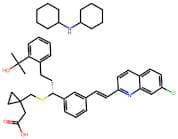
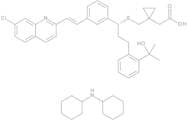
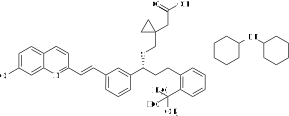
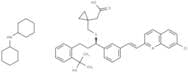
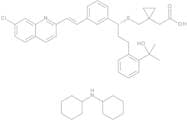
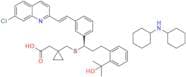
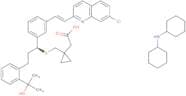
![Cyclopropaneacetic acid, 1-[[[(1R)-1-[3-[(1E)-2-(7-chloro-2-quinolinyl)ethenyl]phenyl]-3-[2-(1-hyd…](/_next/image/?url=https%3A%2Fstatic.cymitquimica.com%2Fcas-image%2Fthumb-webp%2F363505-cyclopropaneacetic-acid-1-1r-1-3-1e-2-7-chloro-2-quinolinyl-ethenyl-phenyl-3-2-1-hydroxy-1-methylethyl-phenyl-propyl-thio-methyl-compd-with-n-cyclohexylcyclohexanamine-1-1.webp&w=3840&q=75)
CAS 577953-88-9
:Ácido ciclopropanoacético, 1-[[[(1R)-1-[3-[(1E)-2-(7-cloro-2-quinolinil)etenil]fenil]-3-[2-(1-hidroxi-1-metiletil)fenil]propil]tio]metil]-, compd. con N-ciclohexilciclohexanamina (1:1)
Descripción:
Ácido ciclopropanoacético, 1-[[[(1R)-1-[3-[(1E)-2-(7-cloro-2-quinolinil)etenil]fenil]-3-[2-(1-hidroxi-1-metiletil)fenil]propil]tio]metil]-, compd. con N-ciclohexilciclohexanamina (1:1), identificado por el número CAS 577953-88-9, es un compuesto orgánico complejo caracterizado por sus características estructurales únicas. Esta sustancia contiene un anillo de ciclopropano, que contribuye a su tensión y reactividad, junto con un grupo funcional de ácido acético que puede conferir propiedades ácidas. La presencia de múltiples anillos aromáticos y sustituyentes, incluyendo un moiety de cloroquinolina, sugiere una posible actividad biológica, posiblemente influyendo en sus propiedades farmacológicas. La formulación del compuesto como una sal con N-ciclohexilciclohexanamina indica un potencial para una mayor solubilidad y estabilidad. Su estructura intrincada puede llevar a interacciones interesantes en sistemas biológicos, convirtiéndolo en un candidato para la investigación en química medicinal. Sin embargo, propiedades físicas y químicas específicas como el punto de fusión, el punto de ebullición y la solubilidad requerirían datos empíricos para una caracterización precisa.
Fórmula:C35H36ClNO3S·C12H23N
InChI:InChI=1S/C35H36ClNO3S.C12H23N/c1-34(2,40)30-9-4-3-7-25(30)13-17-32(41-23-35(18-19-35)22-33(38)39)27-8-5-6-24(20-27)10-15-29-16-12-26-11-14-28(36)21-31(26)37-29;1-3-7-11(8-4-1)13-12-9-5-2-6-10-12/h3-12,14-16,20-21,32,40H,13,17-19,22-23H2,1-2H3,(H,38,39);11-13H,1-10H2/b15-10+;/t32-;/m1./s1
Clave InChI:InChIKey=ZLOLVGQQYDQBMP-HKHDRNBDSA-N
SMILES:C(S[C@H](CCC1=C(C(C)(C)O)C=CC=C1)C2=CC(/C=C/C3=NC4=C(C=C3)C=CC(Cl)=C4)=CC=C2)C5(CC(O)=O)CC5.N(C1CCCCC1)C2CCCCC2
Sinónimos:- 2-[1-[[[(1R)-1-[3-[(1E)-2-(7-Chloro-2-quinolinyl)ethenyl]phenyl]-3-[2-(1-hydroxy-1-methylethyl)phenyl]propyl]thio]methyl]cyclopropyl]acetic acid dicyclohexylamine salt
- Cyclopropaneacetic acid, 1-[[[(1R)-1-[3-[(1E)-2-(7-chloro-2-quinolinyl)ethenyl]phenyl]-3-[2-(1-hydroxy-1-methylethyl)phenyl]propyl]thio]methyl]-, compd. with N-cyclohexylcyclohexanamine (1:1)
- DCHA Salt, Montelukast dicyclohexylamine Salt
- Montelukast dicyclohexylamine salt
Ordenar por
Pureza (%)
0
100
|
0
|
50
|
90
|
95
|
100
Encontrado 13 productos.
Montelukast dicyclohexylamine
CAS:Montelukast dicyclohexylamineFórmula:C47H59ClN2O3SPureza:99.8%Forma y color:BeigePeso molecular:766.39349Montelukast Dicyclohexylamine
CAS:Compounds (excluding drugs and pesticides) containing a quinoline or isoquinoline ring-system (whether or not hydrogenated) not further fused, nesoiFórmula:C35H36ClNO3S·C12H23NForma y color:White PowderPeso molecular:585.210442-[1-[[[(1R)-1-[3-[(1E)-2-(7-Chloro-2-quinolinyl)ethenyl]phenyl]-3-[2-(1-hydroxy-1-methylethyl)phenyl]propyl]thio]methyl]cyclopropyl]acetic acid dicyclohexylamine salt
CAS:Fórmula:C47H59ClN2O3SPureza:97%Forma y color:SolidPeso molecular:767.5010Dicyclohexylamine (R,E)-2-(1-(((1-(3-(2-(7-chloroquinolin-2-yl)vinyl)phenyl)-3-(2-(2-hydroxypropan-2-yl)phenyl)propyl)thio)methyl)cyclopropyl)acetate
CAS:Dicyclohexylamine (R,E)-2-(1-(((1-(3-(2-(7-chloroquinolin-2-yl)vinyl)phenyl)-3-(2-(2-hydroxypropan-2-yl)phenyl)propyl)thio)methyl)cyclopropyl)acetatePureza:97%Peso molecular:767.52g/molMontelukast Dicyclohexylamine
CAS:Producto controladoFórmula:C35H36ClNO3S·C12H23NForma y color:NeatPeso molecular:767.50Montelukast dicyclohexylamine
CAS:Montelukast (MK0476), a selective CysLT1 antagonist, treats asthma, liver injury, and is researched for COVID-19.Fórmula:C47H59ClN2O3SForma y color:SolidPeso molecular:767.5Montelukast Dicyclohexylamine Salt
CAS:Fórmula:C35H36ClNO3S·C12H23NForma y color:White To BeigePeso molecular:767.5Montelukast dicyclohexylamine
CAS:Producto controladoMontelukast is a leukotriene receptor antagonist that is used as an anti-inflammatory agent. It is a monosodium salt of montelukast, which is a trifluoroacetic acid ester of the fatty acid, dicyclohexylamine. The reaction solution can be in either the polymorphic or monomorphic form. The polymorphic form has been shown to be more stable than the monomorphic form and both forms are soluble in organic solvents such as ethanol and ether. The salt can further react with sulphonic acids, chlorides, benzoates, and inorganic acids to produce other salts.Fórmula:C47H59ClN2O3SPureza:Min. 95%Forma y color:PowderPeso molecular:767.5 g/mol


![2-[1-[[[(1R)-1-[3-[(1E)-2-(7-Chloro-2-quinolinyl)ethenyl]phenyl]-3-[2-(1-hydroxy-1-methylethyl)phe…](/_next/image/?url=https%3A%2Fstatic.cymitquimica.com%2Fproducts%2FIN%2Fthumb%2FDA00EFC9.jpg&w=3840&q=75)