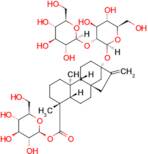
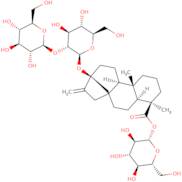
![Kaur-16-en-18-oic acid, 13-[(2-O-β-D-glucopyranosyl-β-D-glucopyranosyl)oxy]-, β-D-glucopyranosyl e…](https://static.cymitquimica.com/cas-image/thumb-webp/397681-stevioside.webp)
CAS 57817-89-7
:Ácido caur-16-en-18-oico, 13-[(2-O-β-D-glucopiranosil-β-D-glucopiranosil)oxi]-, éster β-D-glucopiranosil, (4α)-
Descripción:
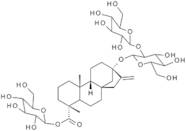
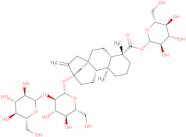
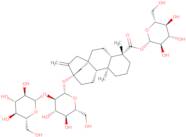
El ácido kaur-16-en-18-oico, 13-[(2-O-β-D-glucopiranosil-β-D-glucopiranosil)oxi]-, éster de β-D-glucopiranosilo, con número CAS 57817-89-7, es un compuesto glicósilado complejo derivado de la familia de terpenos kaureno. Esta sustancia presenta un esqueleto de kaureno, caracterizado por una estructura de anillo fusionado de ciclohexano y ciclopentano, que es típica de muchos terpenos de origen vegetal. La presencia de múltiples unidades de azúcar, específicamente unidades de β-D-glucopiranosilo, indica su posible papel en sistemas biológicos, posiblemente mejorando la solubilidad y la biodisponibilidad. Tal glicosilación también puede influir en las propiedades farmacológicas del compuesto, incluida su interacción con receptores biológicos y enzimas. Los derivados del ácido kaur-16-en-18-oico se estudian a menudo por sus posibles aplicaciones terapéuticas, incluidas actividades antiinflamatorias y anticancerígenas. La estereoquímica específica, denotada por la configuración (4α), sugiere un arreglo espacial particular de átomos que puede afectar la reactividad y la función biológica del compuesto. En general, este compuesto ejemplifica la intrincada relación entre la estructura y la función en los productos naturales.
Fórmula:C38H60O18
InChI:InChI=1S/C38H60O18/c1-16-11-37-9-5-20-35(2,7-4-8-36(20,3)34(50)55-32-29(49)26(46)23(43)18(13-40)52-32)21(37)6-10-38(16,15-37)56-33-30(27(47)24(44)19(14-41)53-33)54-31-28(48)25(45)22(42)17(12-39)51-31/h17-33,39-49H,1,4-15H2,2-3H3/t17-,18-,19-,20+,21+,22-,23-,24-,25+,26+,27+,28-,29-,30-,31+,32+,33+,35-,36-,37-,38+/m1/s1
Clave InChI:InChIKey=UEDUENGHJMELGK-HYDKPPNVSA-N
SMILES:C[C@]12[C@]3([C@]4(C[C@](O[C@H]5[C@H](O[C@@H]6O[C@H](CO)[C@@H](O)[C@H](O)[C@H]6O)[C@@H](O)[C@H](O)[C@@H](CO)O5)(C(=C)C4)CC3)CC[C@@]1([C@@](C(O[C@@H]7O[C@H](CO)[C@@H](O)[C@H](O)[C@H]7O)=O)(C)CCC2)[H])[H]
Sinónimos:- (4α)-β-D-Glucopyranosyl-13-[(2-O-β-D-glucopyranosyl-β-D-glucopyranosyl)oxy]kaur-16-en-18-oat
- (4α)-β-D-glucopyranosyl 13-[(2-O-β-D-glucopyranosyl-β-D-glucopyranosyl)oxy]kaur-16-en-18-oate
- 1,2-Stevioside
- 13-[(2-O-β-D-glucopiranosil-β-D-glucopiranosil)oxi]kaur-16-en-18-oato de (4α)-β-D-glucopiranosilo
- 13-[(2-O-β-D-glucopyrannosyl-β-D-glucopyrannosyl)oxy]kaur-16-ene-18-oate de (4α)-β-D-glucopyrannosyle
- 1H-2,10a-Ethanophenanthrene, kaur-16-en-18-oic acid deriv.
- E 960
- Kaur-16-en-18-oic acid, 13-[(2-O-β-<span class="text-smallcaps">D</smallcap>-glucopyranosyl-β-<smallcap>D</smallcap>-glucopyranosyl)oxy]-, β-<smallcap>D</span>-glucopyranosyl ester, (4α)-
- Stevian 50
- Stevioside
- Steviosin
- α-G Sweet PX
- α-G-Sweet
- 1-O-[(5bêta,8alpha,9bêta,10alpha,13alpha)-13-{[2-O-(bêta-D-Glucopyranosyl)-bêta-D-glucopyranosyl]oxy}-18-oxokaur-16-én-18-yl]-bêta-D-glucopyranose
- (1R,4S,5R,9S,10R,13S)-13-{[(2S,3R,4S,5S,6R)-4,5-Dihydroxy-6-(hydroxyméthyl)-3-{[(2S,3R,4S,5S,6R)-3,4,5-trihydroxy-6-(hydroxyméthyl)tétrahydro-2H-pyran-2-yl]oxy}tétrahydro-2H-pyran-2-yl]oxy}-5,9-diméthyl-14-méthylènetétracyclo[11.2.1.0~1,10~.0~4,9~]hexadécane-5-carboxylate de (2S,3R,4S,5S,6R)-3,4,5-trihydroxy-6-(hydroxyméthyl)tétrahydro-2H-pyran-2-yle
- 1-O-[(5beta,8alpha,9beta,10alpha,13alpha)-13-{[2-O-(beta-D-Glucopyranosyl)-beta-D-glucopyranosyl]oxy}-18-oxokaur-16-en-18-yl]-beta-D-glucopyranose
- Kaur-16-en-18-oic acid, 13-[(2-O-β-D-glucopyranosyl-β-D-glucopyranosyl)oxy]-, β-D-glucopyranosyl ester, (4α)-
- (2S,3R,4S,5S,6R)-3,4,5-Trihydroxy-6-(hydroxymethyl)tetrahydro-2H-pyran-2-yl (1R,4S,5R,9S,10R,13S)-13-{[(2S,3R,4S,5S,6R)-4,5-dihydroxy-6-(hydroxymethyl)-3-{[(2S,3R,4S,5S,6R)-3,4,5-trihydroxy-6-(hydroxymethyl)tetrahydro-2H-pyran-2-yl]oxy}tetrahydro-2H-pyran-2-yl]oxy}-5,9-dimethyl-14-methylenetetracyclo[11.2.1.0~1,10~.0~4,9~]hexadecane-5-carboxylate
- Stevia Sugar
- (2S,3R,4S,5S,6R)-3,4,5-Trihydroxy-6-(hydroxymethyl)tetrahydro-2H-pyran-2-yl-(1R,4S,5R,9S,10R,13S)-13-{[(2S,3R,4S,5S,6R)-4,5-dihydroxy-6-(hydroxymethyl)-3-{[(2S,3R,4S,5S,6R)-3,4,5-trihydroxy-6-(hydroxymethyl)tetrahydro-2H-pyran-2-yl]oxy}tetrahydro-2H-pyran-2-yl]oxy}-5,9-dimethyl-14-methylentetracyclo[11.2.1.0~1,10~.0~4,9~]hexadecan-5-carboxylat
- Ver más sinónimos
Ordenar por
Pureza (%)
0
100
|
0
|
50
|
90
|
95
|
100
Stevioside - min 75%
CAS:Stevioside - min 75% is a high-purity glycoside compound that functions as a natural sweetener. It is derived from the leaves of the Stevia rebaudiana plant, a member of the Asteraceae family, which is native to Paraguay and Brazil. This compound works by interacting with the sweet receptors on the tongue, specifically the TAS1R2 and TAS1R3 receptors, to provide a sweet taste sensation that is several hundred times sweeter than sucrose, without contributing to caloric intake.Fórmula:C38H60O18Pureza:(%) Min. 75%Forma y color:White PowderPeso molecular:804.87 g/molStevioside - min 98%
CAS:Stevia glycoside is a natural sweetener found in the medicinal herb Stevia rebaudiana Bertoni. Stevia glycoside is a low calorie, high-intensity sweetener and is up to three hundred times sweeter than sucrose. Due to the sweet taste of Stevia glycoside, it has a high commercial value throughout the world as sugar substitute in medicine, foods products and beverages. The Stevia plant contains also other steviosides, which include: rebaudioside A, rebaudioside D and dulcoside D, all of which are known as Stevia sweeteners (Mathur, 2017).Fórmula:C38H60O18Pureza:Min. 95%Forma y color:White Off-White PowderPeso molecular:804.87 g/molStevioside - min 95%
CAS:Stevioside - min 95% is a high-purity steviol glycoside, which functions as a natural sweetener. It is extracted from the leaves of Stevia rebaudiana, a plant native to South America. The main source of this compound is the glycosides present in the plant's leaves, which are responsible for its sweet properties.Fórmula:C38H60O18Pureza:Min. 95%Forma y color:White PowderPeso molecular:804.87 g/molSteviol glycosides
CAS:Steviol glycosides are natural sweeteners, which are extracted from the leaves of the Stevia rebaudiana plant with glycosidic compounds as their principal components. These compounds interact with taste receptors on the tongue, specifically the T1R2 and T1R3 proteins, to produce a sweet sensation via non-caloric pathways, as they do not undergo the metabolic processes typical of carbohydrates. Steviol glycosides' primary use is in the food and beverage industry as a non-caloric sugar alternative, facilitating reduced sugar formulations while maintaining sweetness. They are also employed in pharmaceuticals and dietary supplements, where reduced caloric intake is desired. Due to their high-intensity sweetness and stability under heat and pH variations, steviol glycosides are preferred in various formulations, including baked goods and carbonated beverages. Their natural origin and metabolic neutrality offer advantages for developing health-conscious products.Pureza:Min. 95%Forma y color:PowderStevioside hydrate
CAS:Stevioside hydrate is a natural sweetener, which is a steviol glycoside derived from the leaves of the Stevia rebaudiana plant. The stevia plant is native to South America and has been used for centuries as a non-caloric sweetener. The mode of action of stevioside involves its interaction with the sweet taste receptors on the tongue, specifically binding to the taste receptor cells and triggering a sensory response that is perceived as sweetness. Unlike sucrose, which provides calories, stevioside offers a sweetening effect without significant caloric contribution, making it an advantageous option for sugar replacement.Fórmula:C38H60O18•xH2OPureza:Min. 90 Area-%Forma y color:PowderPeso molecular:804.87 g/mol