CAS 583-50-6
:D-Eritrosa
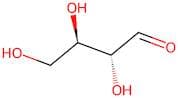
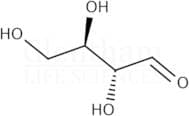
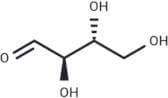
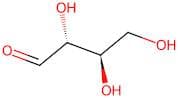
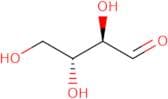
- (2R,3R)-2,3,4-Trihydroxybutanal
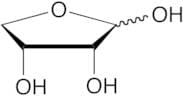
- (2R,3R,4R)-tetrahydrofuran-2,3,4-triol
- (2R,3S)-2,3,4-trihydroxybutanal
- (2S,3R)-2,3,4-trihydroxybutanal
- (3R,4R)-tetrahydrofuran-2,3,4-triol
- <span class="text-smallcaps">D</span>-(-)-Erythrose
- Butanal, 2,3,4-trihydroxy-, (2R,3R)-
- Butanal, 2,3,4-trihydroxy-, [R-(R*,R*)]-
- Erythrose, <span class="text-smallcaps">D</span>-
- Erythrosesyrupwv
- Erythrose, D-
- D-Erythrose
- Ver más sinónimos
Butanal, 2,3,4-trihydroxy-, (2R,3R)-
CAS:Fórmula:C4H8O4Pureza:75%Forma y color:LiquidPeso molecular:120.1039D-(-)-Erythrose
CAS:Fórmula:C4H8O4Pureza:≥ 75.0% (anhydrous basis)Forma y color:Colourless to light-yellow syrupPeso molecular:120.10D-Erythrose
CAS:D-Erythrose (D-(-)-Erythrose) is a four-carbon sugar, an important intermediate in various metabolic pathways.Fórmula:C4H8O4Pureza:99.76% - 99.8%Forma y color:LiquidPeso molecular:120.1D-Erythrose, 70% aqueous solution
CAS:D-Erythrose, 70% aqueous solutionPureza:75%Forma y color:Colourless LiquidPeso molecular:120.10g/molD-Erythrose (w/v = 10 mg/ml)
CAS:Applications D-Erythrose is a tetrose carbohydrate that have been tested as an potential anticariogenic sweetener along with L-Erythrulose as a blend.
References Elseviers, M., et al.: Agro. Food. Indus. Hi.Tech., 10, 15 (1999); Alkorta, I., et al.: Carbo. Res., 346, 2933 (2011);Fórmula:C4H8O4Forma y color:Colourless LiquidPeso molecular:120.1D-Erythrose - min 50% purity as a 70% aq. solution
CAS:Erythrose is a sugar that is used in the biosynthesis of other sugars, such as ribose and D-erythrose. It is also an intermediate in the pentose phosphate pathway for the production of NADPH. Erythrose can be converted to erythritol by reductase enzymes, which are necessary for the synthesis of DNA. The enzyme erythrose reductase has been shown to act on wild-type strains. Erythrose reduces d-erythrose to erythritol, which inhibits polymerase chain reactions by blocking transcription and replication of DNA. Erythrose has also been shown to have inhibitory properties against Toll-like receptor signaling pathways, which may be due to its ability to reduce reactive oxygen species (ROS) and hydrogen peroxide levels in cells.
Fórmula:C4H8O4Pureza:Min. 50 Area-%Forma y color:Clear LiquidPeso molecular:120.1 g/molD-Erythrose-13C4 (As a solution in water ~0.1M)
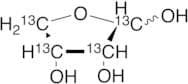
CAS:Producto controladoApplications D-Erythrose-13C4 is the isotope labelled analogue of D-Erythrose (E650131), a tetrose carbohydrate that have been tested to be used as an potential anticariogenic sweetener along with L-Erythrulose as a blend.
References Elseviers, M., et al.: Agro. Food. Indus. Hi.Tech., 10, 15 (1999); Alkorta, I., et al.: Carbo. Res., 346, 2933 (2011);Fórmula:C4H8O4Forma y color:ColourlessPeso molecular:124.08