CAS 583-91-5
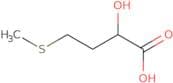
:Ácido 2-hidroxi-4-(metiltio)butanoico
Descripción:
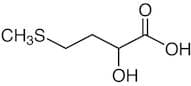
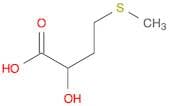
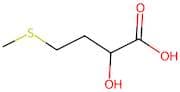
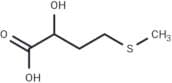
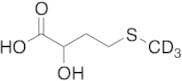
Ácido 2-hidroxi-4-(metiltio)butanoico, también conocido por su número CAS 583-91-5, es un compuesto orgánico caracterizado por la presencia de un grupo hidroxilo (-OH) y un grupo metiltio (-S-CH3) unidos a una estructura de ácido butanoico. Este compuesto es un tipo de derivado de aminoácido, específicamente un tioéter, que contribuye a sus propiedades químicas únicas. Típicamente es un sólido cristalino blanco a blanco sucio que es soluble en agua debido al grupo hidroxilo polar. La presencia del grupo metiltio puede influir en su reactividad e interacciones con otras moléculas, lo que lo hace de interés en diversas aplicaciones bioquímicas. Este compuesto puede estar involucrado en vías metabólicas y puede servir como precursor o intermediario en la síntesis de otras moléculas biológicamente relevantes. Sus características, incluyendo el punto de fusión, el punto de ebullición y la reactividad específica, pueden variar según las condiciones ambientales y la presencia de otras sustancias. En general, Ácido 2-hidroxi-4-(metiltio)butanoico es significativo tanto en contextos de química sintética como biológica.
Fórmula:C5H10O3S
InChI:InChI=1S/C5H10O3S/c1-9-3-2-4(6)5(7)8/h4,6H,2-3H2,1H3,(H,7,8)
Clave InChI:InChIKey=ONFOSYPQQXJWGS-UHFFFAOYSA-N
SMILES:C(C(O)=O)(CCSC)O
Sinónimos:- 2-Hydroxy-4-(Methylsulfanyl)Butanoic Acid
- 2-Hydroxy-4-(methylmercapto)butyric acid
- 2-Hydroxy-4-(methylthio)butanoic acid
- 2-Hydroxy-4-Methylthiobutyric acid = DL-2-Hydroxy-4-(methylthio)butyric Acid (68-72% in Water)
- <span class="text-smallcaps">DL</span>-2-Hydroxy-4-(methylmercapto)butanoic acid
- <span class="text-smallcaps">DL</span>-2-Hydroxy-4-(methylmercapto)butyric acid
- <span class="text-smallcaps">DL</span>-2-Hydroxy-4-(methylthio)butanoic acid
- <span class="text-smallcaps">DL</span>-2-Hydroxy-4-(methylthio)butyric acid
- <span class="text-smallcaps">DL</span>-α-Hydroxy-γ-methylmercaptobutyric acid
- Alimet
- At 88
- Biox-A
- Butanoic acid, 2-hydroxy-4-(methylthio)-
- Butyric acid, 2-hydroxy-4-(methylthio)-
- Butyric acid, α-hydroxy-γ-(methylmercapto)-
- DL-2-Hydroxy-4-(methylthio)butyric acid
- Desmenidol
- Desmeninol
- Hmtba
- Hydan L
- MHA acid
- Mha-Fa
- α-Hydroxy-4-(methylthio)butyric acid
- α-Hydroxy-γ-(methylmercapto)butyric acid
- α-Hydroxy-γ-(methylthio)butyric acid
- γ-(Methylmercapto)-α-hydroxybutyric acid
- Ver más sinónimos
Ordenar por
Pureza (%)
0
100
|
0
|
50
|
90
|
95
|
100
Encontrado 7 productos.
2-Hydroxy-4-(methylthio)butyric Acid (65-72% in Water)
CAS:Fórmula:C5H10O3SForma y color:White - Yellow LiquidPeso molecular:150.192-Hydroxy-4-(methylthio)butyric acid
CAS:Fórmula:C5H10O3SPureza:85%Forma y color:LiquidPeso molecular:150.19612-Hydroxy-4-(methylthio)butyric acid
CAS:2-Hydroxy-4-(methylthio)butyric acidPureza:85%Peso molecular:150.20g/molDesmeninol
CAS:Desmeninol, found in urine and cytoplasm, is used in organic synthesis, dye-making, medicine, photo-coloring, and as a fungicide.Fórmula:C5H10O3SForma y color:2-Hydroxy-4-(Methylthio)-Butanoic Acid Is A Light Brown Liquid (Uscg 1999)Peso molecular:150.2DL-2-Hydroxy-4-(methylthio)butanoic acid-d3
CAS:Producto controladoFórmula:C5D3H7O3SForma y color:NeatPeso molecular:153.2152-Hydroxy-4-(methylthio)butanoic acid
CAS:2-Hydroxy-4-(methylthio)butanoic acid (2HMB) is an amide that is used as a microbial metabolism inhibitor, especially for the inhibition of bacterial growth. 2HMB and its analogues are also used in plant physiology. 2HMB has been shown to have transport properties and can be used as an inorganic acid for the manufacture of hydrochloric acid. It has been found to have enzyme activities, such as polymerase chain reaction and hydroxyl group transferases, which make it a useful catalyst for reactions involving organic compounds. The hydroxyl group in 2HMB makes it a good candidate for use in fatty acid synthesis and oxidation reactions. Chronic exposure to this chemical may lead to carbonyl oxygen formation.Fórmula:C5H10O3SPureza:Min. 95%Forma y color:Yellow PowderPeso molecular:150.2 g/mol