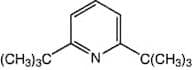
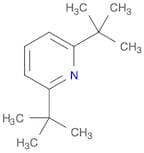
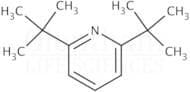
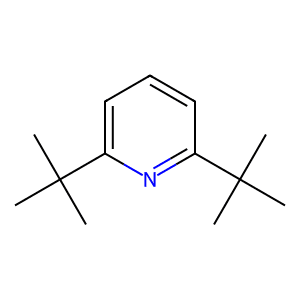
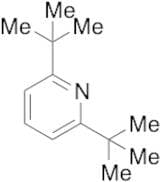
CAS 585-48-8
:2,6-Di-terc-butilpiridina
- 2,6-Bis(1,1-dimethylethyl)pyridine
- 2,6-Di(tert-butyl)pyridine
- 2,6-Di-Tert-Butylpyridine
- 2,6-Ditert-butylpyridine
- NSC 175805
- Poly(2,6-Di-Tert-Butyl-4-Vinylpyridine)
- Poly(2,6-Di-Tert-Butyl-4-Vinylpyridine)Crosslinked With Divinylbenzene
- Poly(2,6-di-tert-butyl-4-vinylpyridine), Poly(2,6-di-tert-butyl-4-vinylpyridine)crosslinked with divinylbenzene
- Pyridine, 2,6-bis(1,1-dimethylethyl)-
- Pyridine, 2,6-di-tert-butyl-
2,6-Di-tert-butylpyridine, 97+%
CAS:2,6-Di-tert-butylpyridine is used in the preparation of 2, 6-di-tert-butylpyridine hydrotriflate. It is used as a proton scavenger to check the progress of the living polymerization of isobutylene. It is associated with cerric ammonium nitrate and used in the alfa-enolation of aldehydes. It is involFórmula:C13H21NPureza:97+%Forma y color:Colorless to light yellow, LiquidPeso molecular:191.32Ref: IN-DA003323
1kgA consultar500gA consultar1g20,00€5g35,00€10g56,00€25g85,00€50g129,00€100g175,00€250g527,00€2,6-Di-tert-butylpyridine
CAS:Fórmula:C13H21NPureza:≥ 97.0%Forma y color:Colourless to light yellow liquidPeso molecular:191.322,6-Bis(tert-butyl)pyridine
CAS:2,6-Bis(tert-butyl)pyridineFórmula:C13H21NPureza:≥95%Forma y color: colourless liquidPeso molecular:191.31g/mol2,6-Di-tert-butylpyridine
CAS:Fórmula:C13H21NPureza:>97.0%(GC)Forma y color:Colorless to Light yellow to Light orange clear liquidPeso molecular:191.322,6-Di-tert-butylpyridine
CAS:2,6-Di-tert-butylpyridine is a proton donor that can be used in cationic polymerization. It is also used as a reagent to generate chloride and yield acidic products. 2,6-Di-tert-butylpyridine has been shown to react with pyridinium ions, forming pyridinium salts. The chemical structure of 2,6-di-tert-butylpyridine consists of a molecule with two phenyl groups and one tertiary butyl group. It is an aromatic compound that has been shown to have an expansion coefficient of 0.0183℃−1 when heated from 25°C to 100°C. FTIR spectroscopy has revealed the presence of hydrogen bonds between the nitrogen atom in the tertiary butyl group and the carbonyl group in the phenyl groups. The magnetic resonance spectrum showed that it has a paramagnetic character due to
Fórmula:C13H21NPureza:Min. 95%Forma y color:Clear LiquidPeso molecular:191.31 g/mol2,6-Di-tert-butylpyridine
CAS:Fórmula:C13H21NPureza:95%Forma y color:Liquid, ClearPeso molecular:191.3182,6-di-tert-Butylpyridine
CAS:Producto controladoApplications 2,6-di-tert-Butylpyridine is used in the preparation of polymers with n-type nitroxide side groups to be used in organic radical batteries.
References Jaehnert, T., et. al.: Eur. Polymer J., 61, 105 (2014)Fórmula:C13H21NForma y color:NeatPeso molecular:191.31