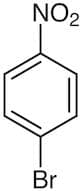
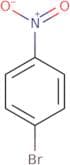
CAS 586-78-7
:1-Bromo-4-nitrobenceno
Descripción:
1-Bromo-4-nitrobenceno es un compuesto orgánico caracterizado por la presencia de grupos funcionales de bromo y nitro unidos a un anillo bencénico. Su fórmula molecular es C6H4BrNO2, lo que indica que contiene seis átomos de carbono, cuatro átomos de hidrógeno, un átomo de bromo, un átomo de nitrógeno y dos átomos de oxígeno. Este compuesto típicamente aparece como un sólido cristalino amarillo y es conocido por su moderada solubilidad en disolventes orgánicos como el etanol y la acetona, pero su solubilidad en agua es limitada. 1-Bromo-4-nitrobenceno se utiliza principalmente en la síntesis orgánica, sirviendo como un intermedio en la producción de varios fármacos, colorantes y agroquímicos. Exhibe reactividad de sustitución aromática electrofílica debido a la presencia del grupo nitro, que es un fuerte grupo atrayente de electrones, aumentando la reactividad del anillo aromático. Además, es importante manejar este compuesto con cuidado, ya que puede presentar riesgos para la salud, incluyendo toxicidad potencial y peligros ambientales. Se deben observar las medidas de seguridad adecuadas al trabajar con esta sustancia en entornos de laboratorio.
Fórmula:C6H4BrNO2
InChI:InChI=1S/C6H4BrNO2/c7-5-1-3-6(4-2-5)8(9)10/h1-4H
Clave InChI:InChIKey=ZDFBKZUDCQQKAC-UHFFFAOYSA-N
SMILES:N(=O)(=O)C1=CC=C(Br)C=C1
Sinónimos:- 1-Brom-4-nitrobenzol
- 1-Bromo-4-Nitrobenceno
- 1-Bromo-4-nitro benzene
- 1-Nitro-4-bromobenzene
- 4-Bromo-1-nitrobenzene
- 4-Bromonitrobenzene
- 4-Nitro-1-bromobenzene
- 4-Nitrobromobenzene
- 4-Nitrophenyl Bromide
- Benzene, 1-bromo-4-nitro-
- Nitrobromobenzene
- Nsc 3526
- P-Bromonitrobenzene
- p-Nitrobromobenzene
- p-Nitrophenyl bromide
- Ver más sinónimos
Ordenar por
Pureza (%)
0
100
|
0
|
50
|
90
|
95
|
100
Encontrado 7 productos.
1-Bromo-4-nitrobenzene
CAS:Fórmula:C6H4BrNO2Pureza:>99.0%(GC)Forma y color:White to Light yellow to Green powder to crystalPeso molecular:202.011-Bromo-4-nitrobenzene, 98%
CAS:It can be employed as a syntheses material intermediate. It is also used as a pharmaceutical intermediate. This Thermo Scientific Chemicals brand product was originally part of the Alfa Aesar product portfolio. Some documentation and label information may refer to the legacy brand. The original AlfFórmula:C6H4BrNO2Pureza:98%Forma y color:White to cream to orange to brown, PowderPeso molecular:202.014-Bromonitrobenzene
CAS:4-BromonitrobenzeneFórmula:C6H4BrNO2Pureza:≥95%Forma y color: off white to pale yellow crystalline solidPeso molecular:202.00546g/mol1-Bromo-4-nitrobenzene
CAS:Fórmula:C6H4BrNO2Pureza:95.0%Forma y color:Solid, Yellow powderPeso molecular:202.0071-Bromo-4-nitrobenzene
CAS:Producto controladoApplications 1-Bromo-4-nitrobenzene is part of a group of compounds that have the ability to stimulate the microbial degradation of polychlorinated biphenyls (PCBs), rendering them less harmful to the environment, animals and humans. 1-Bromo-4-nitrobenzene is also an electron-poor arene that has genotoxic effects on humans.
Not a dangerous good if item is equal to or less than 1g/ml and there is less than 100g/ml in the package
References DeWeerd, K. & Bedard, D.: Env. Sci. Tech., 33, 2057 (1999); Huang, Q., et al.: J. Env. Sci., 8, 103 (1995); Imperato. G., et al.: Adv. Synth. Cat. 348, 2243 (2006)Fórmula:C6H4BrNO2Forma y color:NeatPeso molecular:202.011-Bromo-4-nitrobenzene
CAS:1-Bromo-4-nitrobenzene is a bromonitrile that is used to synthesize optical sensors. It is an intermediate in the synthesis of 1,5-dibromo-4-nitrobenzane, which was used as a model system for the reaction mechanism of coupling reactions. The coupling of 1-bromo-4-nitrobenzane with hydrochloric acid and palladium catalysts leads to the formation of a diazonium salt. This reaction can be analyzed by looking at the nitro group and the halides in the molecule. The nitro group reacts with ammonia to form an aminonitrile and water. Halides react with ammonia to form ammonium salts and hydrogen halides. Diazonium salts are then generated by adding nitrous acid (HNO2) or hydroxylamine (NHOH) to these compounds. Finally, transfer reactions are carried out by heating 1Fórmula:C6H4BrNO2Pureza:Min. 95%Peso molecular:202.01 g/mol