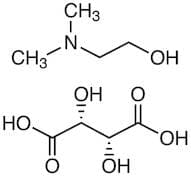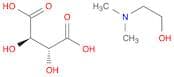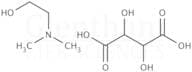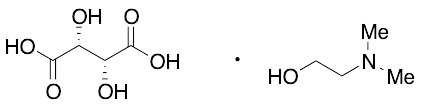
CAS 5988-51-2
:Bitartrato de dimetilaminoetanol
- 2,3-Dihydroxybutanedioate
- 2-(Dimethylamino)ethanol Hydrogen L-(+)-Tartrate
- 2-Dimethylaminoethanol (+)-Bitartrate Salt
- 2-Dimethylaminoethanol bitartrate
- 2-Dimethylaminoethanol tartrate
- 2-Hydroxyethyl-Dimethyl-Ammonium
- DMAE Bitartrate
- Deanol bitartrate
- Dimethylaminoethanol bitartrate
- Ethanol, 2-(dimethylamino)-, (2R,3R)-2,3-dihydroxybutanedioate (1:1)
- Ethanol, 2-(dimethylamino)-, (2R,3R)-2,3-dihydroxybutanedioate (1:1) (salt)
- Ethanol, 2-(dimethylamino)-, [R-(R*,R*)]-2,3-dihydroxybutanedioate (1:1) (salt)
- Ethanol, 2-(dimethylamino)-, tartrate (1:1)
- L(+)Dmae Bitartrate
- Liparon
- Ver más sinónimos
2-(Dimethylamino)ethanol Hydrogen L-(+)-Tartrate
CAS:Fórmula:C4H11NO·C4H6O6Pureza:>98.0%(T)Forma y color:White to Almost white powder to crystalPeso molecular:239.222-(Dimethylamino)ethanol (2R,3R)-2,3-dihydroxysuccinate
CAS:Fórmula:C8H17NO7Pureza:95%Forma y color:SolidPeso molecular:239.22312-Dimethylaminoethanol L-Tartrate
CAS:Fórmula:C4H11NO·C4H6O6Forma y color:White To Off-White SolidPeso molecular:89.14 150.092-Dimethylaminoethanol (+)-bitartrate salt
CAS:Fórmula:C4H11NO·C4H6O6Forma y color:White to off-white powder or crystalsPeso molecular:239.222-Dimethylaminoethanol Bitartrate
CAS:Producto controladoApplications 2-Dimethylaminoethanol Bitartrate is used in biological studies to evaluate motor activity in response to the injection of 2-dimethylaminoethanol.
References Takagi, K., et al.: Jpn J. Pharmacol., 21, 797 (1971);Fórmula:C8H17NO7Forma y color:NeatPeso molecular:239.222-Dimethylaminoethanol (+)-bitartrate salt
CAS:Producto controlado2-Dimethylaminoethanol (+)-bitartrate salt is a potent, reversible inhibitor of protein synthesis that binds reversibly to the 50S ribosomal subunit. It is used in regulatory toxicology and clinical pathology as a positive control for the study of chronic toxicity and long-term effects. 2-Dimethylaminoethanol (+)-bitartrate salt has shown no treatment effect on ovary weight or estrous cycle length in female Sprague-Dawley rats after chronic exposure and long-term exposure at doses up to 1,000 mg/kg/day. This drug has also shown no effect on rat fertility or reproductive performance, indicating it does not cause reproductive toxicity.
Fórmula:C4H11NO·C4H6O6Forma y color:White Off-White PowderPeso molecular:239.22 g/mol