CAS 59880-97-6
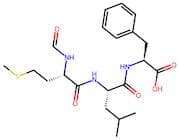
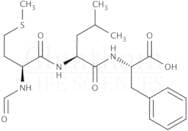
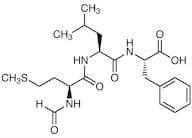
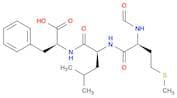
:N-Formil-L-metionil-L-leucil-L-fenilalanina
Descripción:
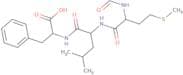
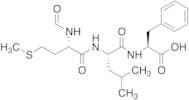
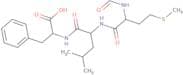
N-Formil-L-metionil-L-leucil-L-fenilalanina, con el número CAS 59880-97-6, es un péptido sintético que consiste en tres aminoácidos: metionina, leucina y fenilalanina, con un grupo formilo unido al término amino del residuo de metionina. Este compuesto se caracteriza por su secuencia específica de aminoácidos, que contribuye a su actividad biológica y posibles aplicaciones en la investigación bioquímica. Los péptidos como este a menudo exhiben propiedades como solubilidad en disolventes polares, estabilidad bajo condiciones fisiológicas y la capacidad de interactuar con receptores biológicos o enzimas. La presencia del grupo formilo puede influir en la reactividad del péptido y su papel en diversas vías bioquímicas. N-Formil-L-metionil-L-leucil-L-fenilalanina también puede servir como un compuesto modelo para estudiar la síntesis de péptidos, las relaciones estructura-actividad y los mecanismos de señalización mediada por péptidos en sistemas biológicos. Su estructura única lo convierte en un tema de interés en campos como la química medicinal y la farmacología.
Fórmula:C8H12ClNO
InChI:InChI=1/C21H31N3O5S/c1-14(2)11-17(23-19(26)16(22-13-25)9-10-30-3)20(27)24-18(21(28)29)12-15-7-5-4-6-8-15/h4-8,13-14,16-18H,9-12H2,1-3H3,(H,22,25)(H,23,26)(H,24,27)(H,28,29)/t16-,17-,18-/m0/s1
Clave InChI:InChIKey=PRQROPMIIGLWRP-BZSNNMDCSA-N
SMILES:[C@H](C(N[C@@H](CC1=CC=CC=C1)C(O)=O)=O)(NC([C@H](CCSC)NC=O)=O)CC(C)C
Sinónimos:- 3: PN: WO2010089019 PAGE: 22 claimed protein
- 4-(2-Aminoethyl)Phenol Hydrochloride (1:1)
- 4-Hydroxy-phenethylamine hydrochloride
- <span class="text-smallcaps">L</smallcap>-Phenylalanine, N-[N-(N-formyl-<smallcap>L</smallcap>-methionyl)-<smallcap>L</span>-leucyl]-
- <span class="text-smallcaps">L</smallcap>-Phenylalanine, N-formyl-<smallcap>L</smallcap>-methionyl-<smallcap>L</span>-leucyl-
- For-Met-Leu-Phe-OH
- Formyl-Met-Leu-Phe-OH
- N-Formyl-<span class="text-smallcaps">L</smallcap>-methionyl-<smallcap>L</smallcap>-leucyl-<smallcap>L</span>-phenylalanine
- N-Formyl-Met-Leu-Phe
- N-Formyl-Met-Leu-Phe-OH
- N-Formyl-methionyl-leucyl-phenylalanine
- N-formylmethionylleucylphenylalanine
- NSC 350593
- L-Phenylalanine, N-formyl-L-methionyl-L-leucyl-
- L-Phenylalanine, N-[N-(N-formyl-L-methionyl)-L-leucyl]-
- N-Formyl-L-methionyl-L-leucyl-L-phenylalanine
- fMLF
- 4-HYDROXYPHENYLETHYLAMINE HCL
- 4-HYDROXYPHENETHYLAMINE HYDROCHLORIDE
- fMLP (misnomer but widely used)
- F-MET-LEU-PHE
- TYRAMINE MONOHYDROCHLORIDE
- 4-(2-AMINOETHYL)PHENOL HYDROCHLORIDE
- P-HYDROXYPHENETHYLAMINE HYDROCHLORIDE
- TYRAMINE HCL(P)
- TYRAMINE HCL
- TIMTEC-BB SBB003808
- P-(2-AMINOETHYL)PHENOL HYDROCHLORIDE
- 2-(4-HYDROXYPHENYL)ETHYLAMMONIUM CHLORIDE
- TYROSAMINE HCL
- TYROSAMINE HYDROCHLORIDE
- TYRAMINE
- 2-(4-HYDROXYPHENYL)ETHYLAMINE HYDROCHLORIDE
- 4-HYDROXYPHENYLETHYLAMINE HYDROCHLORIDE
- 2-(4-HYDROXYPHENYL)ETHYLAMINE HCL
- Ver más sinónimos
Ordenar por
Pureza (%)
0
100
|
0
|
50
|
90
|
95
|
100
Encontrado 13 productos.
N-Formyl-L-methionyl-L-leucyl-L-phenylalanine
CAS:Fórmula:C21H31N3O5SPureza:>98.0%(HPLC)Forma y color:White to Almost white powder to crystalPeso molecular:437.56Chemotactic Peptide
CAS:For cellular and molecular biology applicationsFórmula:C21H31N3O5SForma y color:White to pale cream, Lyophilized PowderPeso molecular:437.56Ref: IN-DA00E9MC
1gA consultar250mgA consultar5mg120,00€10mg133,00€25mg165,00€50mg229,00€100mg319,00€N-formyl-[U-13C-15N]-Met-Leu-Phe-OH
CAS:N-formyl-[U-13C-15N]-Met-Leu-Phe-OHPureza:98%Peso molecular:437.55g/molN-Formyl-Met-Leu-Phe
CAS:N-Formyl-Met-Leu-Phe (N-Formyl-MLF) (fMLF) is a synthetic peptide that acts as an agonist at formyl peptide receptors (FPR; Ki = 0.8 pM).Fórmula:C21H31N3O5SPureza:98.69% - 98.69%Forma y color:SolidPeso molecular:437.55N-Formyl-Met-Leu-Phe
CAS:Custom research peptide; min purity 95%. For different specs please use the Peptide Quote ToolFórmula:C21H31N3O5SPeso molecular:437.6 g/molChemotactic Peptide
CAS:As a chemotactic peptide, For-Met-Leu-Phe (FMLP) has chemotactic properties, which means it can attract cells. For example it is a chemoattractant for phagocytic leukocytes and neutrophils. Neutrophils which have seven transmembrane G-protein coupled receptors are activated during the acute inflammatory response by FMLP and other chemotactic factors which bind to its surface receptors. This results in the activate of NF- κB, MAPK and PI3K pathways. In particular FMLP is known to induce Interleukin-8 (IL-8) which is responsible for both tissue damage and the pathogenesis of inflammatory processes resulting from neutrophils. Chemotactic peptide have been used to study the function of polymorphonuclear leukocytes and other white blood cells in inflammation. Chemotactic peptides are often used as fluorescent probes to measure intracellular metabolic responses to chemoattractant stimulation. This product is available as a 0.5mg vial.Fórmula:C21H31N3O5SPureza:Min. 95%Peso molecular:437.55 g/molN-Formyl-Met-Leu-Phe
CAS:Producto controladoApplications N-Formyl-Met-Leu-Phe is an inducer of superoxide release and agonist for FPR1.
Fórmula:C21H31N3O5SForma y color:NeatPeso molecular:437.55Chemotactic Peptide
CAS:Chemotactic peptides are peptides that possess chemotactic properties, which means they attract cells. One well-known chemotactic peptide is For-Met-Leu-Phe (FMLP) and is a chemoattractant for phagocytic leukocytes and neutrophils. During the acute inflammatory response chemotactic factors activate neutrophils which have seven transmembrane G-protein coupled receptors. FMLP bind to these G-protein coupled receptors on the surface of neutrophils and activate NF- κB, MAPK and PI3K pathways. In particular FMLP is known to induce Interleukin-8 (IL-8) which is responsible for both tissue damage and the pathogenesis of inflammatory processes resulting from neutrophils. Chemotactic peptide have been used to study the function of polymorphonuclear leukocytes and other white blood cells in inflammation. Chemotactic peptides are often used as fluorescent probes to measure intracellular metabolic responses to chemoattractant stimulation.Fórmula:C21H31N3O5SPureza:Min. 95%Peso molecular:437.55 g/molFor-Met-Leu-Phe-OH
CAS:There is evidence that pretreatment of human polymorphonuclear neutrophils (PMN) with fMLF results in the inhibition of TNF-α secretion, which indicates that this typical proinflammatory agent could play, at least at determined conditions, an antiinflammatory role.Fórmula:C21H31N3O5SPureza:99.7%Forma y color:White PowderPeso molecular:437.56




![N-formyl-[U-13C-15N]-Met-Leu-Phe-OH](/_next/image/?url=https%3A%2Fstatic.cymitquimica.com%2Fproducts%2F54%2Fthumb%2FOR1023295.jpg&w=3840&q=75)