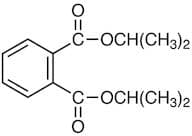
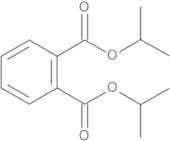
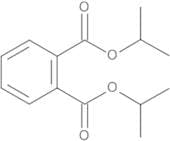
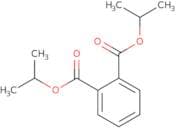
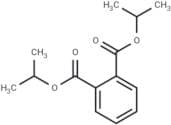
CAS 605-45-8
:Ftalato de diisopropilo
- 1,2-Benzenedicarboxylic acid, 1,2-bis(1-methylethyl) ester
- 1,2-Benzenedicarboxylic acid, bis(1-methylethyl) ester
- Diisopropyl phthalic acid
- Dipropan-2-Yl Benzene-1,2-Dicarboxylate
- NSC 15315
- Phthalic acid diisopropyl ester
- Diisopropyl phthalate
Diisopropyl Phthalate
CAS:Fórmula:C14H18O4Pureza:>98.0%(GC)Forma y color:White or Colorless to Almost white or Almost colorless powder to lump to clear liquidPeso molecular:250.29Di-iso-propyl Phthalate-3,4,5,6-d4
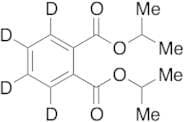
CAS:Fórmula:C6D4COOCH(CH3)2Pureza:99 atom % DForma y color:Colorless LiquidPeso molecular:167.10101Diisopropyl Phthalate
CAS:Producto controladoApplications Diisopropyl Phthalate, is a volatile components present in essential oils of various plants. It can also be used in the synthesis of enantioenriched C2-symmetric molecules.
References Mahatheeranont, S., et al.: Kasetsart Journal: Natural Sci., 29 (4), 508 (1995); Kurashov, E. A., et al.: Rastitel'nye Resursy, 49 (1), 85 (2013); Castaldi, M. P., et al.: Euro. J. Org. Chem., 8, 1867 (2006);Fórmula:C14H18O4Forma y color:NeatPeso molecular:250.29Diisopropyl Phthalate-d4
CAS:Producto controladoApplications Diisopropyl Phthalate-d4, is the labeled analogue of Diisopropyl Phthalate (D459450), a volatile components present in essential oils of various plants. Also used in the synthesis of enantioenriched C2-symmetric molecules.
References Mahatheeranont, S., et al.: Kasetsart Journal: Natural Sci., 29 (4), 508 (1995); Kurashov, E. A., et al.: Rastitel'nye Resursy, 49 (1), 85 (2013); Castaldi, M. P., et al.: Euro. J. Org. Chem., 8, 1867 (2006);Fórmula:C14H14D4O4Forma y color:NeatPeso molecular:254.31Diisopropyl Phthalate
CAS:Diisopropyl Phthalate (DIP) is a sample preparation chemical that can be used to extract fatty acids from test samples. This chemical is also used as a catalyst in the production of diphenyl ethers and as an additive in paints, varnishes, and lacquers. DIP is not hazardous to the environment because it does not readily dissolve in water or enter the atmosphere. DIP is soluble in organic solvents such as acetone, chloroform, dichloromethane, and hexane. The use of DIP for extraction of fatty acids from test samples has been shown to have linear calibration curves with a receptor binding capacity that is comparable to butyric acid. DIP has been shown to be effective at wastewater treatment facilities for removal of solids and hydrogen bond formation.Fórmula:C14H18O4Pureza:Min. 95%Forma y color:Clear LiquidPeso molecular:250.29 g/molDiisopropyl phthalate
CAS:Diisopropyl phthalate is widely used as an additive in plastics and consumer products in the chemical industries.Fórmula:C14H18O4Pureza:98.81%Forma y color:White Light Beige Crystalline PowderPeso molecular:250.29