CAS 606-23-5
:1,3-Indandiona
Descripción:
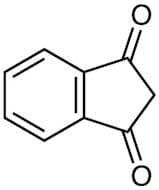
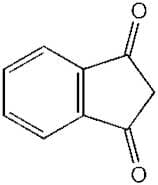
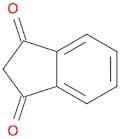
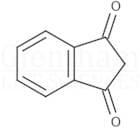
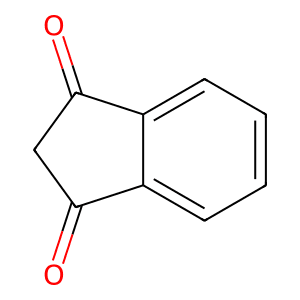
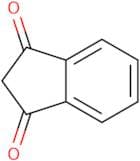
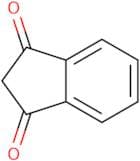
1,3-Indandiona, con el número CAS 606-23-5, es un compuesto orgánico caracterizado por su estructura bicíclica, que consiste en un sistema de indeno fusionado y diketona. Aparece como un sólido cristalino de color amarillo a naranja y es conocido por su capacidad para someterse a diversas reacciones químicas, incluyendo condensación y oxidación. Este compuesto se utiliza a menudo en síntesis orgánica y como un bloque de construcción en la preparación de colorantes, productos farmacéuticos y agroquímicos. Su funcionalidad de diketona le permite participar en reacciones como adiciones de Michael y formación de enolatos, lo que lo convierte en un intermediario versátil en la química sintética. Además, 1,3-Indandiona exhibe propiedades de fluorescencia, que pueden ser explotadas en aplicaciones analíticas. El compuesto es moderadamente soluble en disolventes orgánicos, y su reactividad puede verse influenciada por la presencia de sustituyentes en los anillos aromáticos. Se deben tomar precauciones de seguridad al manipular esta sustancia, ya que puede representar riesgos para la salud si se ingiere o inhala. En general, 1,3-Indandiona es un compuesto valioso tanto en aplicaciones de investigación como industriales.
Fórmula:C9H6O2
InChI:InChI=1S/C9H6O2/c10-8-5-9(11)7-4-2-1-3-6(7)8/h1-4H,5H2
Clave InChI:InChIKey=UHKAJLSKXBADFT-UHFFFAOYSA-N
SMILES:O=C1C=2C(C(=O)C1)=CC=CC2
Sinónimos:- 1,3-Diketohydrindene
- 1,3-Dioxobenzocyclopentane
- 1,3-Indandione
- 1H-Indene-1,3(2H)-dione
- 2H-Indene-1,3-dione
- 3-hydroxy-1H-inden-1-one
- Indan-1,3-Dione
- Indan-1,3-dion
- Indandione
- Indane-1,3-dione
- Indano-1,3-Diona
- Indene-1,3(2H)-dione
- Nsc 26329
- Nsc 6312
- Ver más sinónimos
Ordenar por
Pureza (%)
0
100
|
0
|
50
|
90
|
95
|
100
Se han encontrado 10 productos.
1,3-Indandione
CAS:Fórmula:C9H6O2Pureza:>97.0%(GC)Forma y color:Light yellow to Yellow Green to Brown powder to crystalPeso molecular:146.151,3-Indanedione, 97%
CAS:It is used in the first stage of forensic identification of latent fingerprints. It is particularly useful for paper, and for items printed with thermal inks such as receipts. This Thermo Scientific Chemicals brand product was originally part of the Alfa Aesar product portfolio. Some documentation aFórmula:C9H6O2Pureza:97%Forma y color:White to cream or yellow to yellow-green to pale green to pale brown, Powder or crystalsPeso molecular:146.15Ref: IN-DA0032M2
1kgA consultar1g20,00€5g26,00€10g40,00€25g70,00€50g103,00€100g153,00€250g261,00€500g668,00€1,3-Indanedione
CAS:Fórmula:C9H6O2Pureza:≥ 97.0%Forma y color:Yellow to dark-yellow or yellow-green powder or crystalsPeso molecular:146.15Indane-1,3-dione
CAS:Indane-1,3-dioneFórmula:C9H6O2Pureza:98%Forma y color: light yellow to beige/brown crystalline solidPeso molecular:146.14g/mol1,3-Indanedione
CAS:1,3-Indanedione is an organic compound that is a reactive fatty acid. It reacts with copper to form a complex. The reaction mechanism of 1,3-Indanedione with copper is not yet fully understood. 1,3-Indanedione has been shown to be effective against prostate cancer cells at an optimum concentration. This compound also has potential use in the treatment of other types of cancers and as a light emitting material in photonics applications.Fórmula:C9H6O2Pureza:Min. 95%Forma y color:Beige PowderPeso molecular:146.14 g/mol1,3-Indanedione pure, 96%
CAS:Fórmula:C9H6O2Pureza:min. 96.0%Forma y color:Light yellow-green to pale green to pale brown, Crystalline powderPeso molecular:146.151,3-Indandione
CAS:Producto controladoApplications 1,3-Indandione is one of the starting materials in the one-pot multi-component synthesis of indenone-fused heterocyclic derivatives. Also it acts as electron-withdrawing end group used for organic photovoltaic cell application.
References Bayayt, M., et al.: Tetrahedron, 73, 1196-1204 (2017); Lim, E.: Mol. Cryst. Liq. Cryst., 635, 94-101 (2016);Fórmula:C9H6O2Forma y color:NeatPeso molecular:146.141,3-Indanedione, 70%
CAS:1,3-Indanedione is a precursor of indane diones that is used in the synthesis of fluorescent molecules. In the presence of light, 1,3-indanedione produces light emission and can be used as a chemiluminescent probe. In the presence of trifluoroacetic acid and copper complex, 1,3-indanedione undergoes intramolecular hydrogen transfer to form an intermediate which reacts with malonic acid to form an alkyl radical. The alkyl radical then reacts with hydrochloric acid to produce an ionic polymerization product. The biological sample is reactive with fatty acids and can be used for the detection of prostate cancer cells.Fórmula:C9H6O2Pureza:(%) Min. 70%Forma y color:PowderPeso molecular:146.14 g/mol