CAS 609-36-9
:DL-Prolina
Descripción:
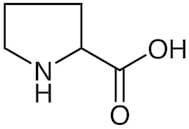
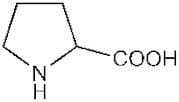
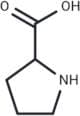
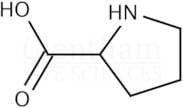
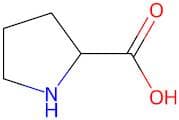
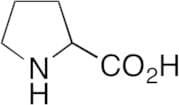
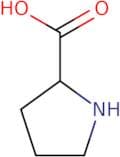
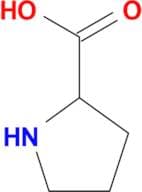
DL-Prolina es un aminoácido no esencial que desempeña un papel crucial en la síntesis de proteínas y se clasifica como un aminoácido cíclico debido a su estructura única de anillo de pirrolidina. Es una molécula quiral, que existe en dos formas enantioméricas: L-prolina y D-prolina, siendo DL-Prolina una mezcla racémica de ambas. Este aminoácido se caracteriza por su naturaleza hidrofóbica, que influye en el plegamiento y la estabilidad de las proteínas. DL-Prolina es soluble en agua y presenta un punto de fusión que varía según su forma. Se utiliza comúnmente en diversas aplicaciones, incluyendo productos farmacéuticos, la industria alimentaria como agente saborizante, y en la investigación bioquímica como un bloque de construcción para péptidos. Además, se ha estudiado DL-Prolina por su posible papel en la síntesis de colágeno y sus efectos en el metabolismo celular. Su número CAS, 609-36-9, es un identificador único que facilita la identificación y regulación de este compuesto en la literatura científica y aplicaciones industriales.
Fórmula:C5H9NO2
InChI:InChI=1S/C5H9NO2/c7-5(8)4-2-1-3-6-4/h4,6H,1-3H2,(H,7,8)
Clave InChI:InChIKey=ONIBWKKTOPOVIA-UHFFFAOYSA-N
SMILES:C(O)(=O)C1CCCN1
Sinónimos:- (+/-)-Pyrrolidine-2-carboxylic acid
- (.+-.)-Proline
- (RS)-Proline
- 2-Pyrrolidinylcarboxylic acid
- <span class="text-smallcaps">D</smallcap><smallcap>L</span>-Pro
- <span class="text-smallcaps">D</smallcap><smallcap>L</span>-Proline
- DL-Pro
- DL-Prolin
- DL-prolina
- H-DL-Pro-OH
- Nsc 97923
- Proline, <span class="text-smallcaps">D</smallcap><smallcap>L</span>-
- Proline, DL-
- ProlinePyrrolidinecarboxylicacid
- Ver más sinónimos
Ordenar por
Pureza (%)
0
100
|
0
|
50
|
90
|
95
|
100
Se han encontrado 9 productos.
DL-Proline
CAS:Fórmula:C5H9NO2Pureza:>99.0%(T)(HPLC)Forma y color:White to Almost white powder to crystalPeso molecular:115.13DL-Proline, 99%
CAS:DL-Proline is used as an agonist of glycine receptors. It acts as a catalyst for aldol condensation. It is an essential component of collagen. It plays a significant role in the immune system and strengthening of heart muscles. It is an osmoprotectant and therefore is used in many pharmaceutical, biFórmula:C5H9NO2Pureza:99%Forma y color:White, Crystals or powder or crystalline powderPeso molecular:115.13DL-Proline
CAS:DL-Proline is a DL mixture of proline with multiple biological activities, and is commonly used in solid-phase or liquid-phase peptide synthesis.Fórmula:C5H9NO2Pureza:99.93%Forma y color:Flat Needles From Alcohol + Ether; Prisms From Water White Crystalline PowderPeso molecular:115.13DL-Proline
CAS:Fórmula:C5H9NO2Pureza:≥ 98.0%Forma y color:White to off-white powderPeso molecular:115.13DL-Proline
CAS:DL-ProlineFórmula:C5H9NO2Pureza:98%Forma y color: white to off-white solidPeso molecular:115.13g/molDL-Proline
CAS:Applications DL-Proline is the racemic mixture of both L-Proline (P755995) and D-Proline (P755990).
References Bondarenko, L.B., et al.: Int. J. Peptides., 2, 1687 (2012); Rimer, T., et al.: Biomacromolecules, 13, 2110 (2012);Fórmula:C5H9NO2Forma y color:NeatPeso molecular:115.13DL-Proline
CAS:A useful as an intermediate in the synthesis of peptides, proteins, and other organic molecules. It can be used as a reagent or as an additive to other chemicals.Fórmula:C5H9NO2Pureza:Min. 99 Area-%Peso molecular:115.13 g/molH-DL-Pro-OH
CAS:M02942 - H-DL-Pro-OH
Fórmula:C5H9NO2Pureza:98%Forma y color:SolidPeso molecular:115.132